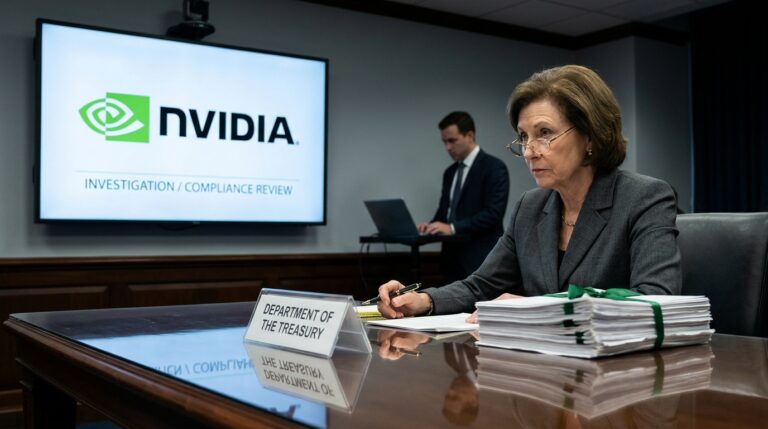

Speaking from Shenzhen on Thursday, where he attended the Asia-Pacific Economic Cooperation summit, President Trump told Fox News he would let Nvidia sell Blackwell chips to China in two or three years, once a next-generation product supersedes them. “In two years or three years, I would, if I were here, I would say, go ahead,” Trump said. The H200, he noted, is already eligible for case-by-case licensing under current rules, though Nvidia disclosed this week it has stopped shipping even those US-licensed processors to China.
Nvidia shares, down more than 19% year-to-date and sitting near their 52-week low of $148.80 after a slide over five sessions, rose roughly 1.5% in overnight trading on Trump’s comments. The move matters less for its size than for what it reveals: investors are already trying to put a value on a China reopening that may be years away, constitutionally uncertain, and actively being foreclosed by Congress.
The Bull Case
The optimistic reading starts with the fundamental demand story, which has not changed. Blackwell demand continues to outstrip supply, and Nvidia’s Q3 results beat its own guidance by a wide margin. Wall Street’s consensus target sits near the mid-$240s, against a price of roughly $151. The China angle is upside, not the core.
Then there is Trump’s track record as the dominant variable in export policy. The administration reversed a Biden-era diffusion rule, and now the president is flagging Blackwell openness from the same summit where he met President Xi. Commerce Secretary Howard Lutnick, who has agreed to testify before Congress on the matter, has reportedly resisted tightening export rules. If the executive branch continues to hold the pen, Blackwell sales to China in 2028 or 2029 are a real scenario, and even a downgraded Blackwell variant could represent billions in incremental revenue.
The Bear Case
Congress is not waiting. Three bills, the AI Overwatch Act, the MATCH Act, and the Chip Security Act, are being pushed into final negotiations around the NDAA, which Congress is expected to take up in December. Speaker Mike Johnson said on November 12 there is “a developing consensus in Congress” for restricting China’s access to advanced AI chips. The AI Overwatch Act would codify current executive-branch restrictions on the most advanced AI chip exports to countries of concern and add new certification requirements before Commerce approves licenses for less advanced chips. The Chip Security Act would require location verification on chips after shipment. The MATCH Act would press US allies to match American controls on certain semiconductor manufacturing equipment.
Critically, one earlier version of the AI Overwatch Act was dropped from the House NDAA after pressure from Nvidia and the White House. That was before Jensen Huang resigned over an affair with a woman US intelligence officials suspect may be tied to Beijing, before transcribed congressional interviews were set for December 1 and 2, and before Megaspeed became a household name in Washington. The political environment has shifted sharply. Bipartisan support for the three bills now spans dozens of lawmakers, and Nvidia’s lobbying operation, now led by an interim chief executive, may be less well positioned to blunt it.
There is also a timing problem embedded in Trump’s offer itself. His term ends in January 2029. Two to three years from today lands between November 19, 2028 and November 19, 2029. For the later end of that range, Trump would need to still be in office, and any commitment he makes today carries no legal weight for a future administration.
Where the Evidence Leads
The bull case leans on executive discretion and Nvidia’s underlying demand momentum. Both are real. But the bear case rests on structural constraints: congressional legislation with 65 consecutive years of NDAA passage behind it, bipartisan sponsorship, and a scandal that has concentrated political attention on exactly the question of who gets access to American AI chips.
Nvidia has already moved to assume zero licensed Hopper data center shipments to China in its Q4 guidance. That is the company itself marking China as de-risked from the forecast, not an analyst estimate. AMD and Broadcom each jumped roughly 4% on Wednesday while Nvidia slid, suggesting the market is rotating within the AI chip theme rather than abandoning it. That rotation, by itself, is a signal about where investors see the cleaner risk-reward.
The rotation has a destination. Broadcom’s custom AI accelerator revenue grew 143% year over year as hyperscalers diversify away from general-purpose GPUs.
What to Watch
The December NDAA conference is the first real test: whether the three chip bills survive the House-Senate reconciliation. Huang’s December 1 transcribed interview before the House Foreign Affairs Committee, the House Permanent Select Committee on Intelligence, and the Select Committee on the Chinese Communist Party adds more near-term noise. If the NDAA passes with the AI Overwatch Act intact, the executive branch’s ability to approve Blackwell sales unilaterally narrows considerably.
The bull case is not wrong. It is just conditional on outcomes that are months away and contested at every level of government.