
Jensen Huang was not just Nvidia’s CEO. He was, by most honest accounts, the AI economy’s underwriter of last resort. That job is now vacant.
According to Nvidia’s quarterly filing for the period ended July 26, 2026, the company carried $36 billion in off-balance-sheet commitments tied to its AI cloud partner model. CoreWeave, Nebius, and IREN all sit in Nvidia’s portfolio. Beyond those commitments, PitchBook data cited by TechCrunch shows Nvidia participated in 105 venture rounds this year, frequently as the largest investor in the room. One estimate from Tomasz Tunguz of Theory Ventures put Nvidia’s share of U.S. venture capital at 16.4% of all dollars deployed in the second quarter.
The bull case for continuity is real. Goldman Sachs analyst James Schneider said this week he expects Nvidia to honor its existing commitments, though new multi-party financing structures may be harder. Yardeni Research’s Ed Yardeni wrote that his base case is Nvidia’s financing strategy remaining intact under interim CEO Colette Kress, and that any selloff is a buying opportunity for the AI trade. The structure Huang built, the argument goes, is now larger than any single executive. Contracts exist. Relationships persist.
CreditSights analyst Andy Li took a narrower view: creative deal-making and equity and credit support, he said, is going to moderate. That phrasing deserves attention. Moderating support from the entity that supplied nearly a sixth of U.S. venture capital in the second quarter is not a marginal change.
The Bear Case: This Was Always Circular
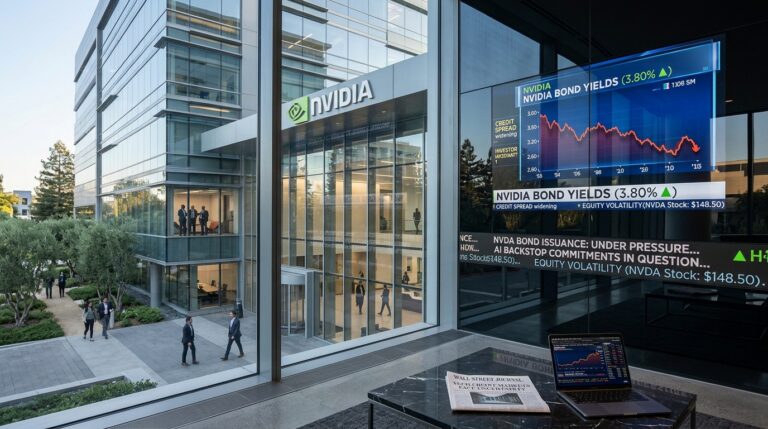
Nvidia’s arrangement had a troubling internal logic. Under Huang, the company used its chip profits to backstop the neoclouds that bought its chips, which generated more profits to backstop more neoclouds. That loop worked as long as Huang was personally willing to write the next check. CoreWeave’s unsecured bonds have traded at yields in the mid-teens in November, with the 9.75% 2031 notes around 14% to 15% yield-to-worst based on recent TRACE-based pricing. The 9.75% 2031 bond also traded above 15% at points earlier this month.
The circular character of the arrangement is not a new critique. The IMF and the Bank for International Settlements have flagged the systemic risk from circular financing in the AI ecosystem, including among neocloud operators. Axios reported that Nvidia’s total off-balance-sheet commitments and guarantees, including memory purchases and data center backstops, reached $530 billion according to SemiAnalysis. SemiAnalysis’s figure spans more than the neocloud-specific $36 billion in the quarterly filing, but both numbers point in the same direction: Nvidia was not merely a chipmaker. It was a financing vehicle dressed as one.
Interim CEO Kress is a CFO by background. Reporting in recent days has described her as more conservative on these financing structures than Huang was. Infrastructure startups that raised half their GPU financing from Nvidia, often $100 million to $500 million at valuations above $1 billion, face a sharply different conversation with her office than they did with Huang.
Where the Evidence Leads
Existing commitments will almost certainly be honored. The market-building exercise Huang ran, with Nvidia simultaneously acting as technology supplier, customer, investor, and credit backstop to scores of AI companies, will not be replicated by Kress in anything like the same form. That is not a prediction; it is what her own investors expect, on the record.
The question that matters most for CRWV, NBIS, and IREN is not whether Nvidia defaults on existing obligations. It is whether new capital, from ORCL, AVGO, the large hyperscalers, or any other source, can substitute for the idiosyncratic willingness Huang had to write oversized checks into companies that depended on his own products. Google, Amazon, and Microsoft may back mature startups, but they are unlikely to pour hundreds of millions into pre-revenue infrastructure plays the way Nvidia did.
The bull case requires believing Nvidia’s financing was prudent market-building that now stands on its own. The bear case requires only reading the bond market, which as of this week is still pricing CoreWeave at distressed levels without a credible replacement backstop in sight. On current evidence, the bears have the stronger argument, and the most important data point to watch is not Nvidia’s stock price. It is whether CoreWeave can refinance tens of billions of dollars of debt and commitments through 2027 without Huang’s personal guarantee of relevance behind it.