October 26, 2026
Bonus Content: APD Wrote Off Up to $2.9B in Hydrogen Projects. The Solid-State Case Looks Stronger.

Patriots’ Most Trusted Gold Company
The Debt Just Passed $40 Trillion. Nobody Asked Your Savings.
For U.S. savers age 55+ with $50,000 or more in an IRA, 401(k) or savings. Free of charge, no obligation to buy anything.
In August 2026 the national debt passed $40 trillion.1 It was not voted on. There was no ceremony. Most Americans found out from a headline, if they found out at all.
Somebody has to absorb it
A debt that size does not simply sit there. It gets serviced, refinanced, and eventually dealt with – and there are only three ways to deal with it: raise taxes, cut spending, or reduce the real value of what is owed by letting the currency weaken. The first two require Congress to do something unpopular on the record. The third requires nobody to do anything at all.
That is why the figure matters to a retirement account rather than just to a budget committee. Every dollar in your IRA is a claim denominated in the same currency the debt is denominated in. If the obligation is managed down in real terms, that happens through your savings, not around them.
The evidence is already behind us. It takes roughly $1.95 today to buy what a dollar bought in 2000.2 Nothing was confiscated. The unit was simply worth less each year, and savers holding it carried the cost quietly.
Gold is the one asset in this conversation with no issuer. No treasury can print it, no company can dilute it, no counterparty can default on it. Central banks themselves have been buying more than a thousand tons a year.3 They are not doing it for the yield.
You are allowed to hold physical gold inside an IRA. Most savers have never been told that, because the firms holding their money do not sell it. The free 2026 Gold IRA Guide walks through exactly how a rollover from an IRA, 401(k) or TSP works, which metals the IRS allows, how insured depository storage works, and the mistakes that cost retirees the most. It is free and it takes about thirty seconds to request.
Claim Your Free 2026 Gold IRA Guide →


Rock legend Ted Nugent and former White House Press Secretary Sean Spicer are official endorsers and clients of Bishop Gold Group. 10 years in business – 5-star rated on Trustpilot and Google – Mint Authorized Dealer
Prefer to speak to someone? U.S.–based specialists, no pressure, no jargon.
Mon-Fri – 7am-5pm PT
Sources
1 U.S. Treasury total public debt outstanding, which passed $40 trillion in August 2026 as widely reported.
2 U.S. Bureau of Labor Statistics Consumer Price Index (CPI-U), 2000 to 2026. $1.00 in 2000 equates to approximately $1.95 in 2026 – cumulative inflation of roughly 95%; the inverse gives purchasing power of about 51 cents.
3 World Gold Council, Gold Demand Trends, annual central bank net purchases 2022-2024.
Past performance is not a guarantee of future results. Precious metals are volatile and can decline in value. Figures here are historical and are not a prediction or a recommendation to buy or sell any asset.
APD Wrote Off Up to $2.9B in Hydrogen Projects. The Solid-State Case Looks Stronger.
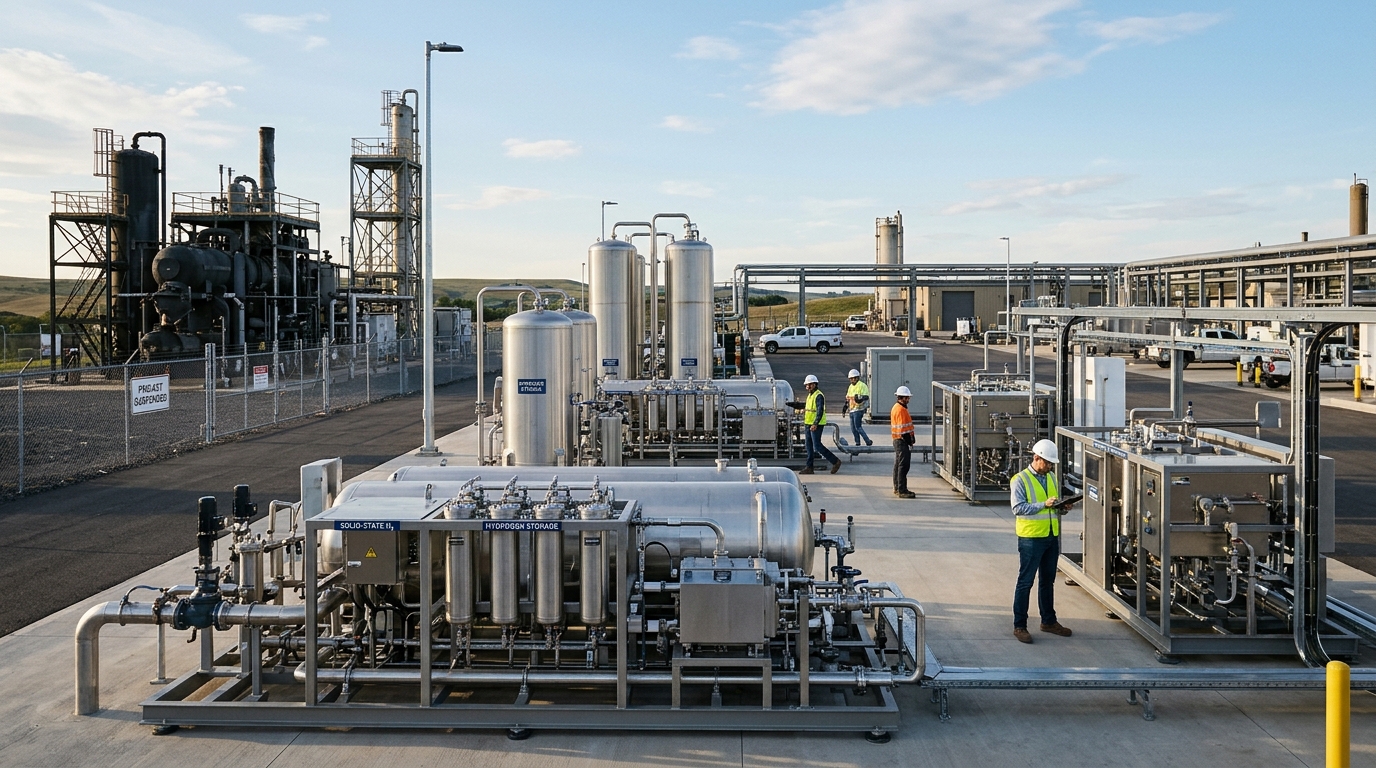
Air Products said it would take pre-tax charges not expected to exceed $2.9 billion to exit its Louisiana Clean Energy Complex and discontinue its Casa Grande, Arizona green hydrogen facility this summer. The GAAP loss per share for the fiscal third quarter came in at $6.47 while the adjusted figure was $3.47, up 12% year over year. Read the retreat one way and it looks like defeat. Read it another, and it points directly at the technology that cryogenic infrastructure was always competing against: solid-state hydrogen storage in metal-hydride alloy matrices.
The core physics matter here. Liquefied hydrogen demands storage at around negative 253 degrees Celsius. Compressed-gas tanks can operate at 700 bar. Metal hydrides store hydrogen chemically at low pressures, binding it within an alloy lattice and releasing it on demand through modest thermal input, with no cryogenic cooling and potentially reduced explosion risk. Volumetric storage density in selected hydride systems is often cited as materially higher than 700-bar compressed gas. That is not a marginal edge.
The bull case for APD in this context is specific. The company already owns the hydrogen, the pipeline infrastructure, and the industrial relationships. It generated about $3.2 billion in Q3 sales and has said it is targeting approximately $1.5 billion per year in traditional industrial gas capital expenditure going forward. Its Gulf Coast hydrogen pipeline is a strategic asset inside its Americas footprint. Layering solid-state transport capability onto an existing delivery network is a different economic problem than building green hydrogen from scratch in the Louisiana wetlands.
The scientific backdrop has shifted materially in 2026. High-entropy alloys, multi-element BCC structures tuned by configurational entropy, have moved from laboratory curiosity to serious IP race. But specific performance claims and broad patent-growth percentages vary widely depending on how the searches are defined and what lag is assumed between filing and publication. The broader point stands: solid-state hydrogen storage research is active, and the path from papers to scalable, costed systems is the real bottleneck.
The bear case is harder to dismiss than the patent filings suggest. Thermal management remains the field’s engineering wall: magnesium hydride, which offers about 7.6 weight percent capacity, typically requires temperatures above 300 degrees Celsius for desorption. Scale-up economics are unproven at industrial volumes. Air Products’ core business is optimized for gas delivery, not alloy manufacturing.
Thermal management is not only hydrogen’s engineering wall. Vertiv built an entire business around solving heat dissipation at industrial scale inside AI data centers, and the liquid-cooling architecture it sells faces a version of the same physics constraints.
What the Q3 write-down actually communicates is that APD’s management, led by CEO Eduardo Menezes, is done paying a premium to be first into unproven markets. The company raised its full-year adjusted EPS guidance to $13.39 to $13.49, implying about 11% to 12% growth, by doing less. If solid-state hydrogen storage matures on the timeline the patent landscape implies, APD’s existing infrastructure becomes the distribution layer, not the science experiment. That is a more durable position than the one it just abandoned.