The investment committee argument this week is not really about SpaceX. It is about what SpaceX’s deal says about everyone else.
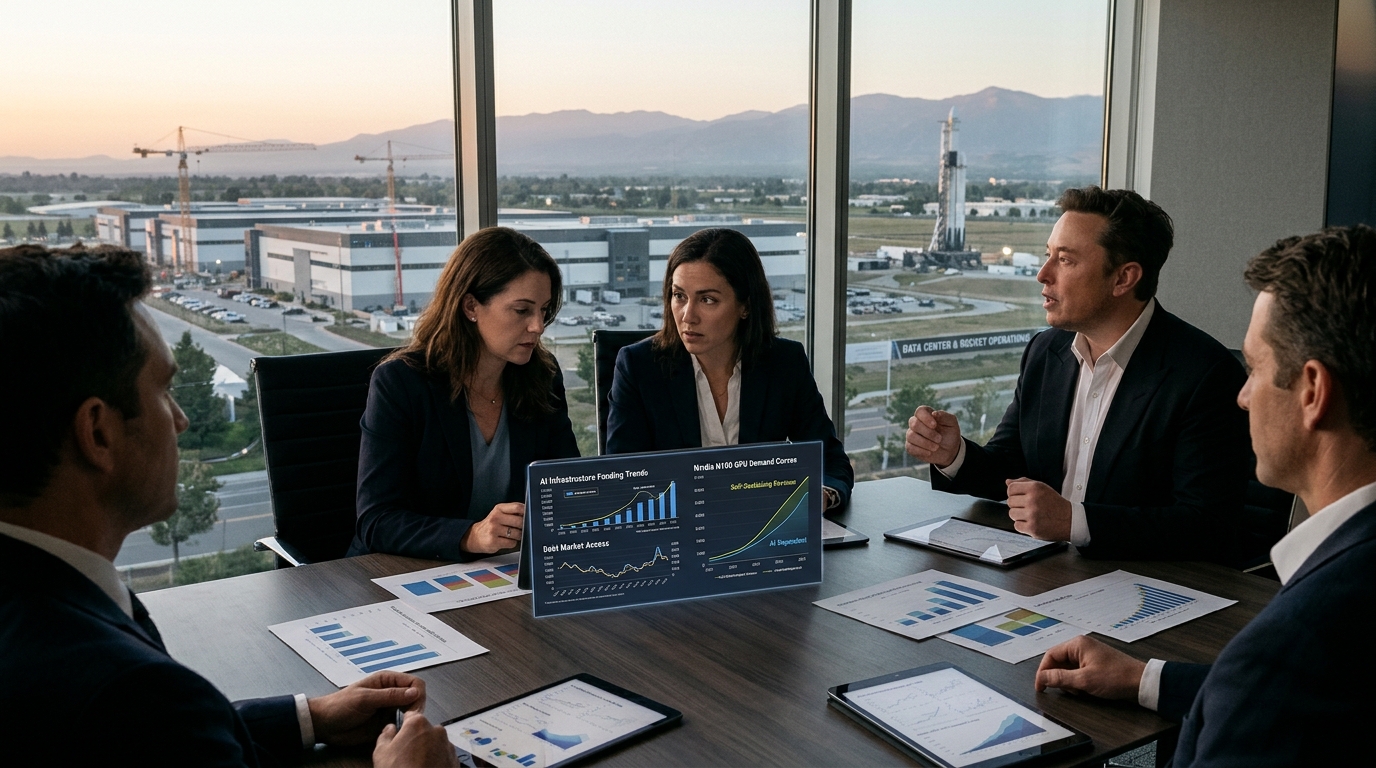
Musk wrote on X Sunday afternoon that “debt markets have almost entirely shut off access to money for any company that doesn’t have substantial revenue independent of AI data centers.” He was not describing a gradual tightening. He was describing a gate that has swung largely shut. SpaceX still got its deal done, he said, because “we’re investment grade and have Starlink & launch revenue.”
In a post on X on Sunday, Musk said SpaceX had closed the financing, noting the company was investment grade and generated revenue from its Starlink satellite internet and rocket launch businesses. A follow-up post described the financing as primarily callable debt for graphics processing units expected to arrive in the first and second quarters of 2027. One wrinkle: people familiar with the discussions told Bloomberg News that talks over pricing were still ongoing as of late October, suggesting the announcement was slightly ahead of the paperwork.
The Bull Case: Credit Flows to Creditworthy Borrowers
The optimistic read is straightforward. A closed $40 billion deal, if the terms are what Musk describes, shows that investors will still fund AI hardware for the right borrower. SpaceX is structurally different from the neoclouds. The proposed financing would use a special purpose vehicle to keep the debt off SpaceX’s balance sheet and preserve its investment-grade credit ratings. Goldman Sachs was leading talks with investors, including Apollo Global Management, over the financing structure. That is not distressed-debt territory. That is institutional appetite, fully engaged, for the right counterparty.
For Nvidia, the GPU deliveries slated for Q1 and Q2 2027 are a concrete demand signal. Oracle, separately, reported it delivered more than 300,000 GPUs to its AI cloud customers in Q1, nearly triple the capacity delivered in the prior quarter, underscoring that the strongest players are still accelerating their chip absorption.
The Bear Case: Consolidation Into Fewer, Bigger Hands
Here is the problem. Musk predicted that the 200-plus neoclouds are going to see “guppy-level death and consolidation.” That is not a fringe view. It has been building for weeks.
CoreWeave’s unsecured bonds fell into distressed territory in mid-October 2026, trading below 80 cents on the dollar. Credit default swap spreads on CoreWeave rose to roughly the 1,000 to 1,200 basis point range, levels that price in real default anxiety, not just rate volatility. CoreWeave shares also sank sharply in October as investors balked at the company’s heavy debt load tied to AI data centers, even as revenue growth remained rapid.
The tension is real: strong demand, but lenders no longer willing to fund the buildout indiscriminately. Carlyle estimated in an October paper that private credit could be called on to finance roughly $1 trillion of the AI-compute buildout, but warned that rapid lending into the sector could create concentration risks similar to those that emerged in software lending.
What Investors Are Missing
The consolidation Musk describes does not hurt Nvidia uniformly. It reshapes its customer base. SpaceX’s $40 billion shows the strongest buyers can still borrow. If smaller ones can’t, Nvidia’s demand narrows to fewer, bigger customers with more bargaining power. Fewer, larger buyers historically extract better pricing and longer delivery commitments. That is a margin headwind Nvidia’s model has not fully faced.
Oracle’s Investor Day on October 28 will be the next stress test of this thesis. Heavy capital spending, negative free cash flow, rising debt, and credit-market scrutiny have increased investor attention ahead of that event. Oracle has an investment-grade rating and massive contracted backlog, it reported remaining performance obligations of $664 billion as of August 31, 2026, but it is spending as aggressively as any neocloud.
Stocks to Watch
Nvidia (NVDA): The immediate demand beneficiary, but watch whether the customer base narrows. Fewer counterparties means harder negotiations, not just on price but on return and cancellation terms.
SpaceX (SPCX): The clearest winner in the credit story. Investment-grade status plus diversified revenue is the new moat in AI infrastructure financing. If Musk’s warning proves accurate, SpaceX’s compute advantage widens structurally.
CoreWeave (CRWV): The central risk case. The near-term question is whether CoreWeave can refinance upcoming maturities without punishing terms. A clean refinance changes the story. A messy one validates every concern about AI-only credit.
Oracle (ORCL): The company most worth watching as the middle case. It has the balance sheet discipline the neoclouds lack, but the capex ambition that keeps credit markets vigilant. Wednesday’s Investor Day is the moment to clarify which side of that trade investors should be on.