October 26, 2026
Takaichi’s push for more bond buying ahead of the BoJ meeting crosses a line.
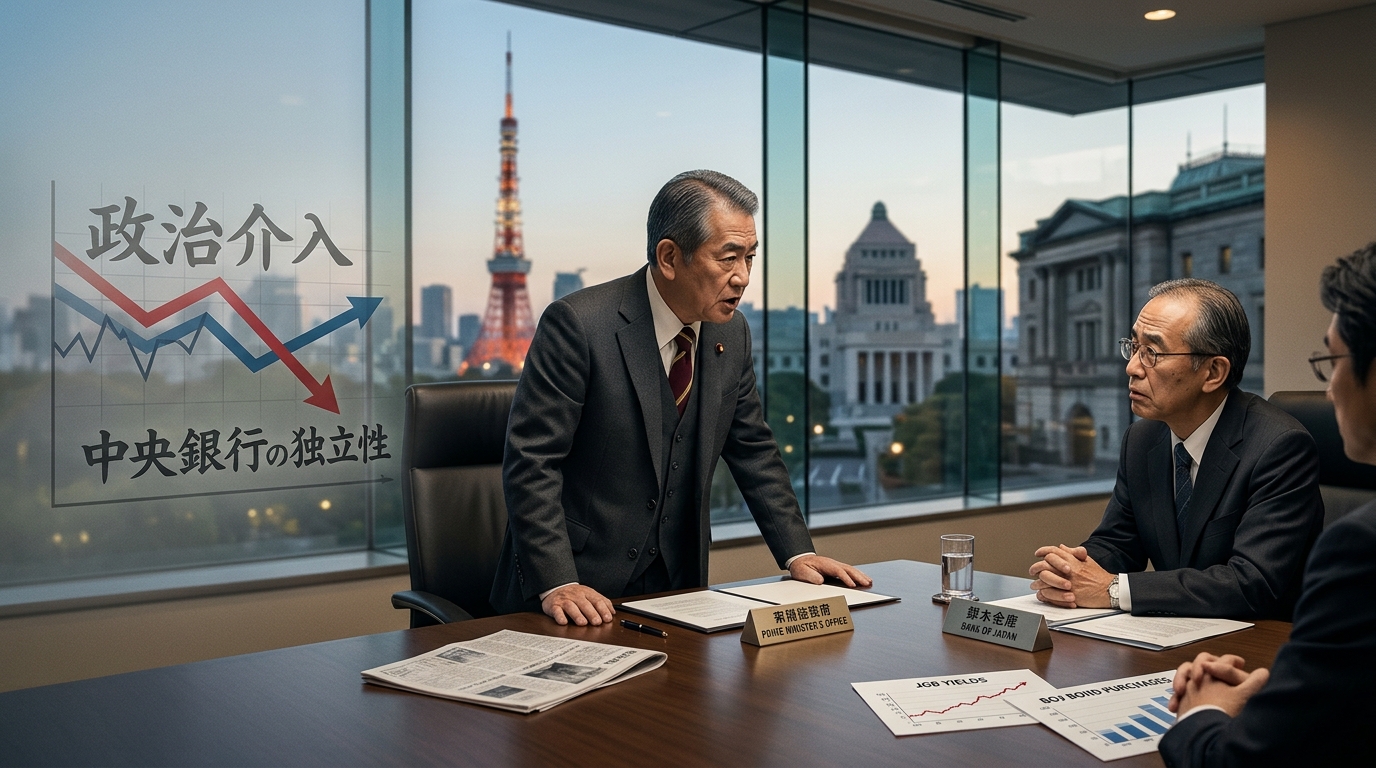
There is a version of what Japan’s Prime Minister Sanae Takaichi is doing that looks sensible. She has a food-tax cut to fund, a bond market at multi-decade highs, and an election cycle to manage. If the Bank of Japan buys more government bonds, long-term rates ease, the cost of her programme falls, and voters notice. Pragmatic, even. But there is another version: a sitting prime minister is instructing her central bank to act, days before it meets. That version deserves to be called what it is.
Former CIA Analyst: “These Are Elon’s Next Three Moves”
The man who called the SpaceX IPO almost to the exact day says Elon is about to spend his $2.1 trillion war chest on three publicly traded companies.
The Bull Case: Yield Control as Fiscal Necessity
The 10-year JGB yield sits at 2.78% as of today, still roughly a full percentage point above where it stood a year ago. At those levels, the benchmark yield has hit multi-decade highs on concerns that Takaichi’s spending plans may lead to increased debt issuance and strain Japan’s already worsening finances. For Takaichi’s supporters, the argument is that temporary bond purchases would simply smooth volatility without reversing the BoJ’s broader exit from stimulus.
In August, Reuters reported that Jiji said Takaichi urged BoJ Governor Kazuo Ueda in a May meeting to increase bond buying if needed to curb rises in long-term interest rates. That is not an irrational position for a fiscal authority to hold. Long rates affect mortgage costs, corporate investment, and debt servicing on a roughly ¥1,000-trillion government debt load. The spending review she has relaunched adds at least nominal credibility: Japan is targeting 201 public funds holding around ¥7 trillion to help pay for the food tax cut. Credible savings that cap new debt issuance near 40 trillion yen could ease some fiscal risk premium in long-dated JGBs and lend modest support to the yen.
The Bear Case: Central Bank Independence Is the Asset at Risk
The efficiency drive’s track record undermines the fiscal discipline argument before it starts. Reuters reported that the first round reviewed roughly 120 tax breaks and produced just three abolition proposals. A record 143 trillion yen in budget requests underlines how wide the funding gap could be. Asking the BoJ to buy bonds is not a supplement to fiscal restraint. Given those numbers, it looks more like a substitute.
Power Bill Revolt Could Hit the Ballot Box Nov. 3: ‘Dark Energy’ Stocks Set to Soar
Power bills have doubled and even tripled across America, and furious voters are about to send a clear message on November 3: get AI off the grid. The only way to get AI off the power grid… without losing to China and crashing the economy… is a criticaltech now being deployed by Elon Musk. One expert calls it “Dark Energy.” Washington has already greenlit it on an emergency basis, it comes online almost instantly, it’s already sold out through 2028… and one small group of companies hold the keys to it.
The deeper problem is institutional. The Bank of Japan has raised interest rates since Takaichi took office and has continued reducing its government bond purchases, all consistent with its mandate to address inflation and yen weakness. Reuters has described the dispute as growing tension between the prime minister’s expansionary fiscal policies and the central bank’s efforts to address inflation and the yen’s weakness. When a government publicly leans on its central bank days before a policy meeting, it does not matter whether the BoJ ultimately holds. The pressure itself is the signal markets read.
Reuters reported that the Bank of Japan raised its key short-term rate by 25 basis points to 1.25% in a 7-2 vote at its September meeting, taking borrowing costs to their highest level since April 1995. The next BoJ decision is scheduled for October 30. If Takaichi’s pressure is seen to have delayed a future hike, the yen absorbs the consequence.
Where the Evidence Leads
The spending review is aimed as much at bond investors as at the actual budget. The first round’s thin results leave markets likely to wait for concrete numbers from year-end budget talks before giving the government credit. That is the right instinct. Announcing a review is not the same as producing savings, and Reuters has reported that the review’s findings are expected to inform year-end tax reform talks and budget negotiations, where the government will be under pressure to show how it intends to fund its promises while keeping the confidence of bond investors.
One idea. Backed by the analysts.
Join 130,000+ self-directed investors who get one trade idea a day, sourced from top Wall Street analysts and explained in plain English. Free, and a five-minute read.
The bull case requires believing that Takaichi’s fiscal consolidation rhetoric is credible enough to offset the institutional damage of leaning on the BoJ. The bear case requires only reading the spending review’s own scorecard. One round, 120 tax breaks examined, three cut. The bond market has not been patient.
Japan is not the only sovereign bond market where fiscal credibility is being tested in real time. France’s OAT spread widening past Italy shows how quickly bond investors reprice when a government’s funding arithmetic looks stretched.
Final Verdict
The bear case is better supported. A government visibly pressing its central bank on the eve of a policy meeting corrodes the institutional credibility that anchors long-term rates more than any bond purchase programme can restore. Takaichi’s food-tax cut may be popular. Funding it by subordinating the BoJ is not a trade Japan’s bond market will offer indefinitely. Watch Thursday’s decision for any shift in language on bond purchase guidance. That is the line between a hold and a precedent.