Moderna stock started 2026 at $29.49. It has since risen more than 650% year to date. That move came almost entirely on the promise of a cancer vaccine the market still has not seen in full. This Saturday in Madrid, it will.
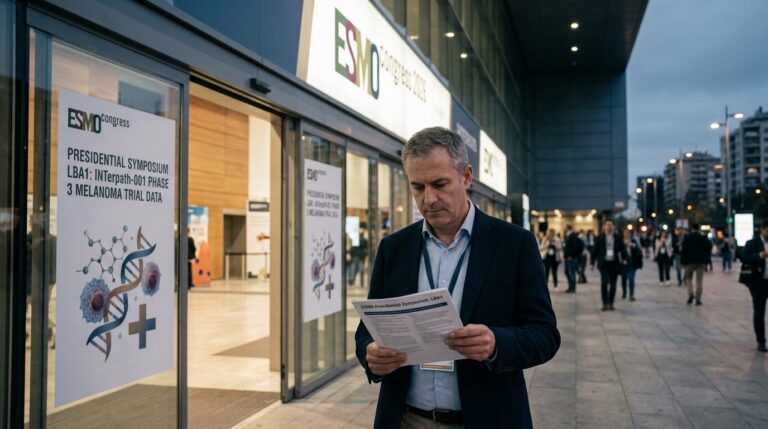
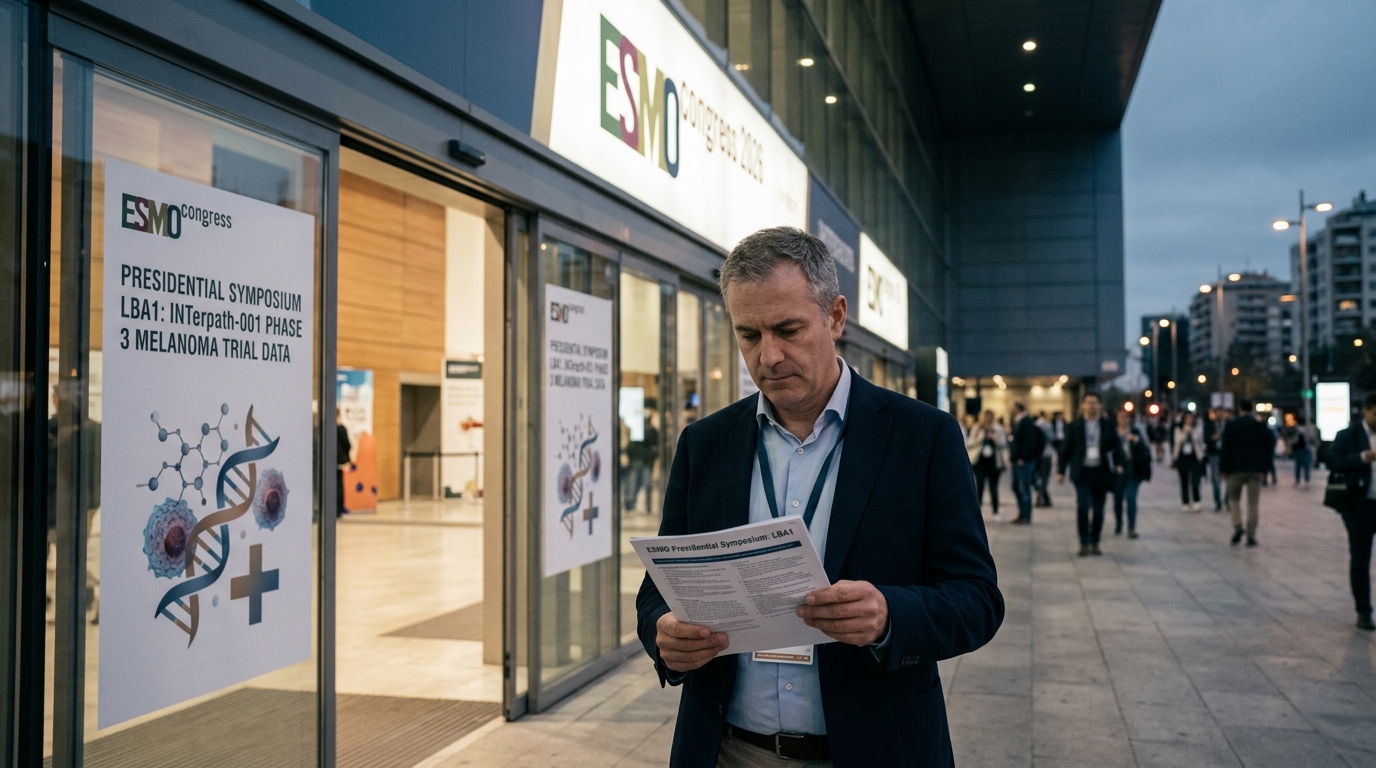
LBA1 in ESMO’s Presidential Symposium, scheduled for Saturday October 24 at 4:30 PM local time, is INTerpath-001: a Phase 3 study of intismeran autogene plus pembrolizumab versus pembrolizumab alone for adjuvant treatment of resected stage IIB-IV melanoma. The presenter is Dr. Georgina V. Long. Moderna has scheduled an investor webcast for later that evening.
The topline headline has been known since August. The trial met its primary endpoint of recurrence-free survival and a key secondary endpoint of distant metastasis-free survival, representing the first positive Phase 3 readout for an individualized neoantigen therapy and for an mRNA-based cancer therapy. The trial enrolled 1,137 patients, randomized 2:1 to receive intismeran plus pembrolizumab or pembrolizumab alone for approximately one year following surgery. What ESMO will deliver Saturday is everything the topline release withheld: the hazard ratios, confidence intervals, and subgroup cuts that determine whether this result is commercially transformative or merely encouraging.
Why the Numbers Matter More Than the Verdict
The investment thesis for Moderna is not that intismeran works in melanoma. That question was answered in August. The thesis is that it works well enough, across a large enough population, to justify a market cap that currently prices in revenues that do not yet exist.
At a median five-year follow-up of the Phase 2b KEYNOTE-942 study, intismeran plus Keytruda demonstrated a 49% reduction in the risk of recurrence or death and a 59% reduction in the risk of distant metastasis or death compared to Keytruda alone. That Phase 2b result, built over 157 patients, now needs a Phase 3 trial of 1,137 patients to confirm its magnitude. Analysts had flagged that a hazard ratio of 0.5 to 0.8 on recurrence-free survival should be considered clinically meaningful. Where Saturday’s data lands inside, or outside, that range will move the stock.
Bloomberg Intelligence estimates up to $12 billion in non-risk-adjusted peak sales by 2040 in a best-case scenario, compared with approximately $5.4 billion on a risk-adjusted basis. Barclays analysts have estimated intismeran could generate around $3 billion in annual melanoma sales by 2035. Both figures assume efficacy data that compels broad physician adoption. A weaker-than-expected hazard ratio would compress every one of those projections.
The Bear Case Is Already Inside the Stock
Analyst consensus has not followed the share price. According to 23 analysts, the average rating for MRNA is Hold, with a 12-month price target of $123.61, implying a decline of more than 43% from recent levels. On October 16, Moderna shed 7.8% in a single session, a pullback that followed a rally exceeding 50% over the prior month, coinciding with analyst debates about the company’s valuation ahead of the October 24 presentation.
The underlying business is still loss-making. Moderna lost $782 million in Q2 on $145 million in revenue. Current share prices appear to assume sales from products beyond COVID. The manufacturing challenge is real: unlike a conventional vaccine that can be produced in large batches, intismeran is personalized for each patient based on the mutations in their tumor. Moderna returned former manufacturing leader Juan Andres as Chief Operating Officer specifically to oversee scaling for the cancer vaccine, as it moves from Phase 3 data toward potential launch.
Beyond Melanoma, and Beyond Moderna
The second reason to watch Saturday closely is the read-through to every other indication Moderna and Merck are pursuing. The broader INTerpath development program currently includes nine Phase 2 and Phase 3 trials evaluating intismeran with pembrolizumab across melanoma, non-small cell lung cancer, bladder cancer, and renal cell carcinoma. A strong hazard ratio in a 1,137-patient melanoma study is the best possible argument for all of them.
Sunday brings a second presidential-level data event. Summit Therapeutics and Akeso will present Phase 3 HARMONi-GI1 data for ivonescimab plus chemotherapy versus AstraZeneca’s durvalumab plus chemotherapy as first-line treatment for advanced biliary tract cancer. Akeso reported at a pre-specified interim analysis that the ivonescimab regimen achieved statistically significant superiority in overall survival over the durvalumab regimen, also meeting progression-free survival and objective response rate endpoints, making it the first known Phase 3 study in advanced biliary tract cancer to demonstrate OS superiority versus an anti-PD-(L)1 plus chemotherapy regimen. For Summit investors, Sunday provides the specific numbers behind that topline headline.
What to Watch
Saturday’s Moderna presentation is the week’s defining event. The hazard ratio on recurrence-free survival is the single most important number. A result near the Phase 2b result of 0.51 would validate the bull case. A result closer to 0.80 would raise serious questions about whether intismeran’s benefit is large enough to justify widespread adoption over Keytruda alone. Fuller intismeran data and any regulatory or launch timelines will sit alongside the November 6 earnings release as key checkpoints. Madrid is the first checkpoint. Investors who have ridden a 650% rally deserve to see what they actually bought.