
October 13, 2026
Bonus Content: A Drop of Blood. Ten Minutes. The Lab Is Losing Its Monopoly.

Three shipments, fifty tonnes, and 4,405 ounces of silver
Fifty tonnes is about two truckloads. In 1907, 1916 and 1917 men carried roughly that much rock out by hand and by horse.
Government records put the grade between about 2,400 and 4,160 grams of silver a tonne, and the recovered silver near 4,405 ounces.
After 1917, silence for ninety years. Then in 2008 a loose rock from the same area assayed insane results. Enough to get the team mobilized.
See what modern mining technology is finding what was missed 100+ years ago..
A Drop of Blood. Ten Minutes. The Lab Is Losing Its Monopoly.

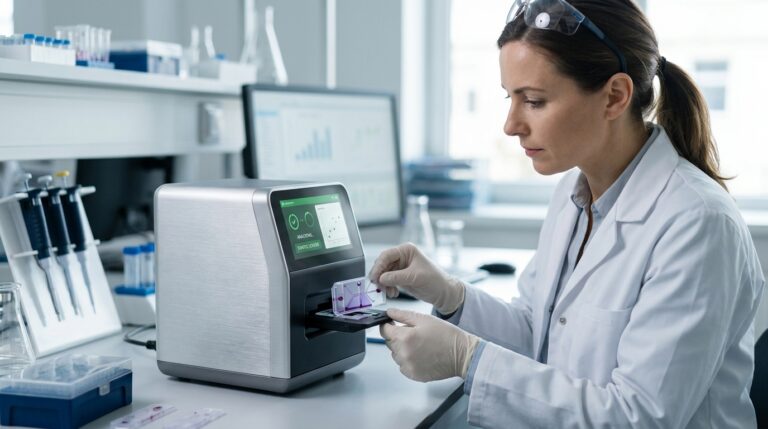
The central hospital laboratory has quietly enjoyed a monopoly on complex blood analysis for decades. That position is now being squeezed from below, not by a better laboratory, but by a benchtop device the size of a coffee maker.
The Bull Case
The numbers are not speculative. The Business Research Company estimates the medical microfluidic devices market will grow from $7.32 billion in 2026 to $12.79 billion by 2030, about a 15% CAGR. That pace of growth reflects genuine clinical pull, not venture optimism.
The technology earning that premium is genuinely disruptive. In its January 2025 announcement, bioMérieux said SpinChip’s platform can deliver a result in under 10 minutes from a drop of blood, with sensitivity and performance comparable to laboratory tests. That matters most in acute care, where cardiac troponin measurements have historically required a central lab run of 30 to 60 minutes. SpinChip’s public materials emphasize a high-sensitivity troponin I test, which is one of the biomarkers emergency physicians need fastest.
Big diagnostics money is validating this. In January 2025, bioMérieux announced an agreement to acquire SpinChip Diagnostics for a total enterprise value of NOK 1,624 million (about EUR 138 million). In that same announcement, bioMérieux said the deal was intended to strengthen its microfluidics-enabled point-of-care offering by adding SpinChip’s rapid, high-sensitivity immunoassay platform. When a French in vitro diagnostics leader pays about EUR 138 million for a small Norwegian startup, the bull case writes itself.
Underneath that deal sits a broader platform shift. Recent academic reviews and research describe a convergence of microfluidics with AI-enabled control and analysis, newer fabrication methods including 3D printing, and more integrated lab-on-a-chip workflows. The devices are getting cheaper to manufacture and harder to displace once embedded in clinical workflows.
The incumbents best positioned to absorb these platform shifts are already visible. Danaher’s bioprocessing and diagnostics consumables business shows how embedded these supply relationships become once a platform enters clinical workflows.
The Bear Case
Execution risk is real and historically punishing in this sector. The FDA 510(k) pathway for novel cartridge architectures is neither cheap nor fast, and truly novel designs can be pushed into more demanding routes when there is no clear predicate. Time and validation cost are not theoretical here.
Reimbursement is the second wall. Medicare’s Advanced Diagnostic Laboratory Test (ADLT) category exists, but it is narrowly defined and generally tied to tests offered by a single lab, not broadly sold point-of-care cartridges. More broadly, payers still tend to move cautiously on new diagnostics unless they clearly improve outcomes or total cost of care.
Payer caution on new diagnostics does not exist in a vacuum. Managed care’s medical cost ratio is the lever that determines how aggressively insurers push back on novel test reimbursement.
The SpinChip deal also illustrates a risk that bulls overlook. The most credible microfluidic platforms are being absorbed by large incumbents rather than reaching escape velocity as independents. Public disclosures around the transaction emphasized platform potential, not a mature commercial business. That protects the technology; it does not guarantee returns for standalone investors in the space.
Where the Evidence Leads
The bull case rests on proven science and accelerating clinical demand. But the market-size numbers in this category vary widely depending on definitions. One recent industry report, for example, puts point-of-care diagnostics at $22.6 billion in 2026 and $29.9 billion by 2033. Even on those more conservative assumptions, decentralization is a real trend, and some lab volume is likely to shift.
The bear case rests on regulatory friction and a consolidation dynamic that makes pure-play exposure hard to find. For investors, the clearest opportunity may sit one level upstream: the consumable cartridge manufacturers and the CMOS chip designers whose components end up inside every competing platform, regardless of which brand wins the bedside.