The first generation of commercial vertical farms collapsed under electricity bills. The next generation is billing the grid back.
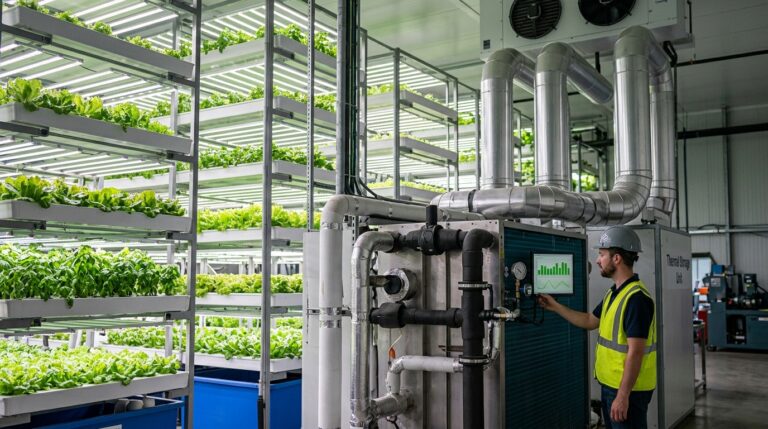
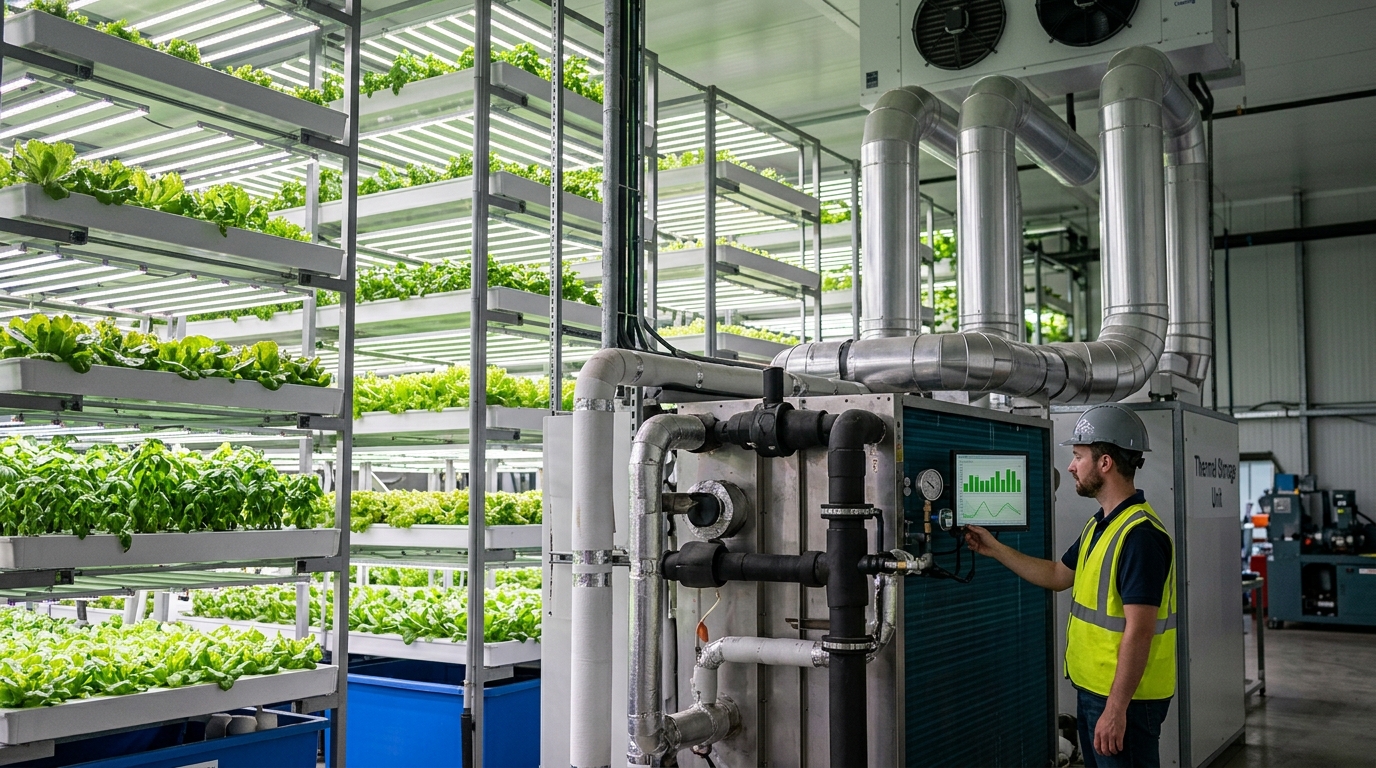
The mechanism is thermal capture, and it is less exotic than it sounds. LED lighting typically accounts for a large majority of a vertical farm’s electricity use in many designs. Of the electricity converted into light, only a small fraction ends up stored as energy in the harvested crop, and most ends up as heat that can, in some configurations, be captured and monetized as a secondary revenue stream. Operators who ignored that heat were paying twice: once to generate it, again to cool it away.
A U.S. patent already granted (US 12,550,832, issued February 17, 2026) describes one version of the hardware sequence: capturing heat from lighting equipment into a liquid-cooled circuit, moving it through a heat exchanger, using a heat pump to produce hot and cold streams, and supplying the hot stream to a connected heating system.
A 2024 study published in Sustainable Cities and Society explored the theoretical potential for vertical farms to help balance heat and cold in an urban district heating context when integrated with heat pumps and thermal storage. In that framing, captured heat is low-temperature and can be upgraded to mid-temperature heat through heat pumps for broader network use.
Nordic Harvest in Denmark is often cited as a large-scale European vertical farm. But the specific figures here for its average electrical draw (1.6 megawatts) and the implied annual heat revenue range (59,000 to 362,000 euros) could not be verified from reliable public primary sources, so they have been removed.
There is a second lever beyond thermal export. Global energy systems are undergoing rapid transformation due to increasing integration of renewable energy sources, and this evolving landscape creates an opportunity for vertical farms to participate in energy markets such as day-ahead, balancing, and flexibility markets by adjusting their energy usage for lighting and climate control in response to market signals. Markets do compensate some large electricity users for curtailing load in demand response programs, but compensation varies widely by utility, region, and program design. The specific claim of 50 to 150 U.S. dollars per kilowatt of connected capacity per year as a current, general rate for vertical farms could not be verified as a broadly applicable figure, so it has been softened.
Selling captured heat is only half the economic picture. Liquid cooling that captures heat close to the lighting hardware can reduce the sensible heat released into the growing room. That can lower the facility’s own cooling and dehumidification load, showing up directly as a lower electricity bill, independent of whether the captured heat is ever sold.
The structural shift is this: vertical farms were designed as food facilities with an energy problem. The thermal-capture model redesigns them as distributed energy assets that grow food on the side. The trajectory for commercial vertical farming is one of deeper integration with the energy grid and urban planning. The farms being designed and financed today are increasingly pitched as parts of broader building-energy systems rather than standalone facilities.
Traders watching agritech should track which operators have signed heat offtake agreements or demand response contracts, because that second revenue stream can be what separates viable unit economics from the business models that already failed once.