
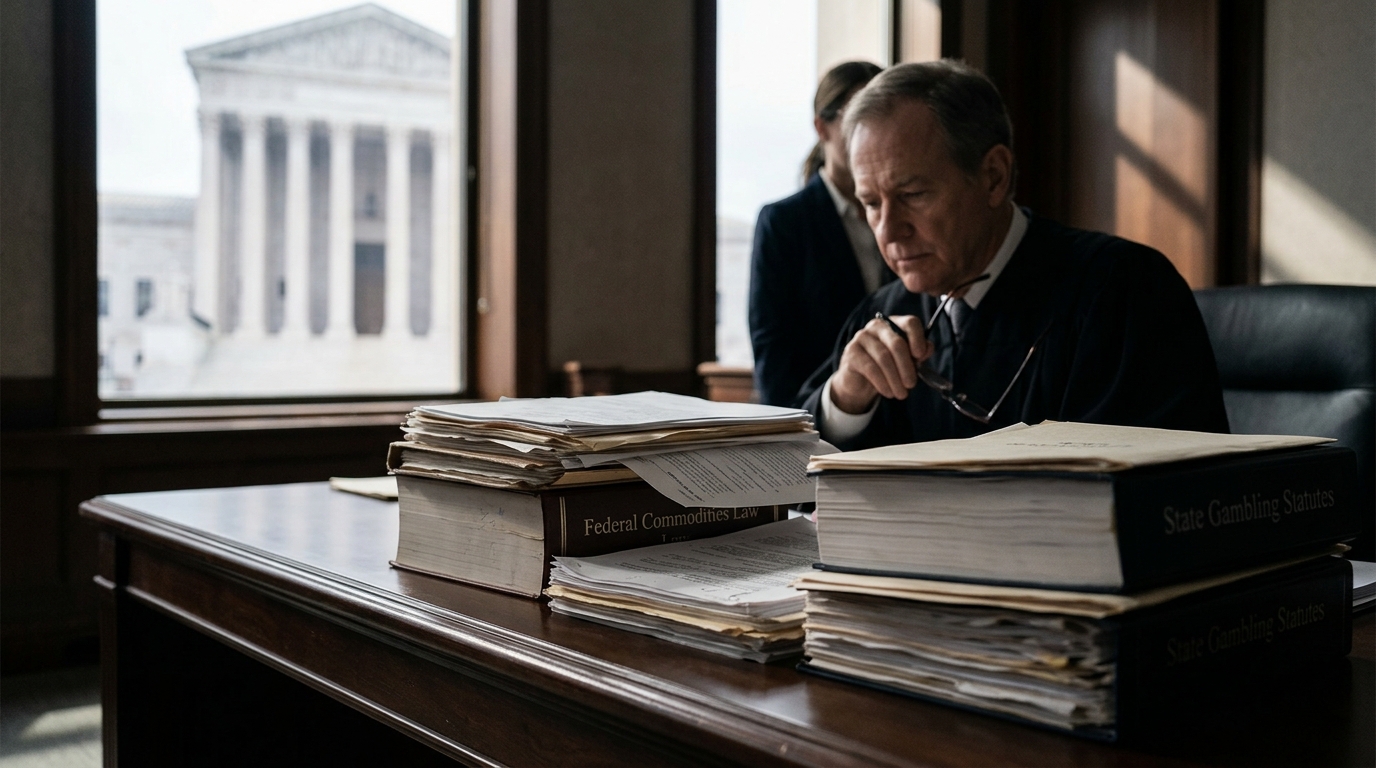
Prediction markets had a brutal Friday. A federal appeals court ruled that Ohio and Tennessee can enforce their sports gambling laws against Kalshi, rejecting the platform’s argument that federal commodities law shields its sports event contracts and overrides the authority of the states. The decision was unanimous. A three-judge panel of the Sixth Circuit held that Kalshi has not shown those contracts meet the legal definition of a swap, upholding Ohio’s win in the lower court and vacating an injunction Kalshi had secured against Tennessee.
That is the second appellate loss in roughly a month. The Sixth Circuit ruling follows a similar outcome from the Ninth Circuit in late August, and both broke from the Third Circuit’s April 6 decision, which allowed Kalshi to operate in New Jersey as its appeal proceeds. Three circuits have now weighed the same core question and reached two different answers. The map for operating a national prediction market has become ungovernable.
The Bull Case for Prediction Markets
President Trump has supported the rise of prediction markets and backed the CFTC having exclusive authority over the platforms. That political alignment matters. The CFTC, under Chair Michael Selig, has claimed exclusive authority over prediction markets and filed an amicus brief backing Kalshi in the Ohio appeal. A federal regulator and the White House are on the same side of this argument. That combination rarely loses at the Supreme Court level, and the circuit split now practically compels the justices to take the case.
Kalshi’s own framing has the logic of scale behind it. “Markets can’t operate when the rules change at every state line, which is why Congress created a single federal regulator with nationwide rules,” a Kalshi spokesperson said Friday. U.S. sports prediction-market execution volume reached $31.1 billion through September 20. That is not a niche product. Fragmenting it state by state destroys the liquidity that makes the price signal meaningful in the first place.
The Bear Case: Geography as a Death Sentence
The bull case assumes the Supreme Court takes the case and rules for federal preemption. Neither is guaranteed. While the Court receives thousands of requests annually, it typically looks for conflicts among circuits on important matters before granting review, and even that standard does not guarantee a grant. Meanwhile, Kalshi must now block users in Ohio and Tennessee while the circuit split over state versus federal oversight widens. Every month of uncertainty is a month competitors can geofence around and a month state attorneys general can use to build enforcement records.
The FDIC scrutiny of Polymarket adds a separate vector of risk that markets have not yet priced. Polymarket contracts on the likelihood of failure at JPMorgan Chase, Wells Fargo, and Bank of America are drawing scrutiny from FDIC officials and lawmakers on Capitol Hill, with some worried the contracts could eventually help fuel a real-world bank run. Those contracts recorded about $76,000 in year-end trading volume on Polymarket’s overseas platform. The notional figure is trivial. The precedent being debated is not. Authorities are concerned less about current trading volume than about the risk that concentrated bets on a specific bank’s probability of failure could trigger a real liquidity crisis.
On that specific question, the FDIC’s concern looks like prudent oversight rather than prohibition instinct. FDIC Chairman Travis Hill expressed concern at a private event in March about speculation on the timing of bank failures, but also said prediction markets could be a useful tool for monitoring financial risk. That is an ambivalent regulator, not a crusading one. Senior staff recently discussed whether the agency’s existing ethics restrictions needed revising to prohibit employees from trading on Polymarket. So far, the issue appears to be under review.
Where the Evidence Leads
The Polymarket bank-failure contracts are a sideshow dressed up as a systemic threat. $76,000 in volume does not move depositor sentiment at JPMorgan. The FDIC is right to monitor them and wrong to treat monitoring as a policy emergency.
The Kalshi circuit split is the real investment question. The likelihood of Supreme Court review rose Friday, with the Ninth and Sixth Circuits now empowering states to regulate sports prediction markets while the Third Circuit has blocked states on federal preemption grounds. That three-way conflict is almost exactly the configuration that draws a cert grant. Companies with concentrated exposure to the sports contract segment, including DraftKings and Flutter, face a period of genuine legal uncertainty regardless of which side ultimately prevails. CME, which operates under unambiguous CFTC jurisdiction, is insulated from the state-by-state enforcement risk entirely and may be the cleaner expression of the prediction-market thesis while the courts work this out.
Final Verdict
The bear case wins in the near term. Kalshi must now geofence two major states, a fourth circuit ruling is still pending in Maryland, and the Supreme Court has not agreed to hear anything yet. The bull case is structurally sound, but it requires patience measured in years and a favorable ruling from nine justices who have shown no urgency on the question. Watch for New Jersey’s cert petition to receive a response from the Court this term. That signal, more than any earnings report or contract volume figure, is what determines whether prediction markets become a durable asset class or a permanently fragmented one.