

A new set of 7 AI stocks are DOMINATING the market.
Here’s why one financial guru says they could be the most famous companies in the world by 2030.
Anthropic Wants $2 Trillion. Its Own Contracts Say the Math Is Hard.
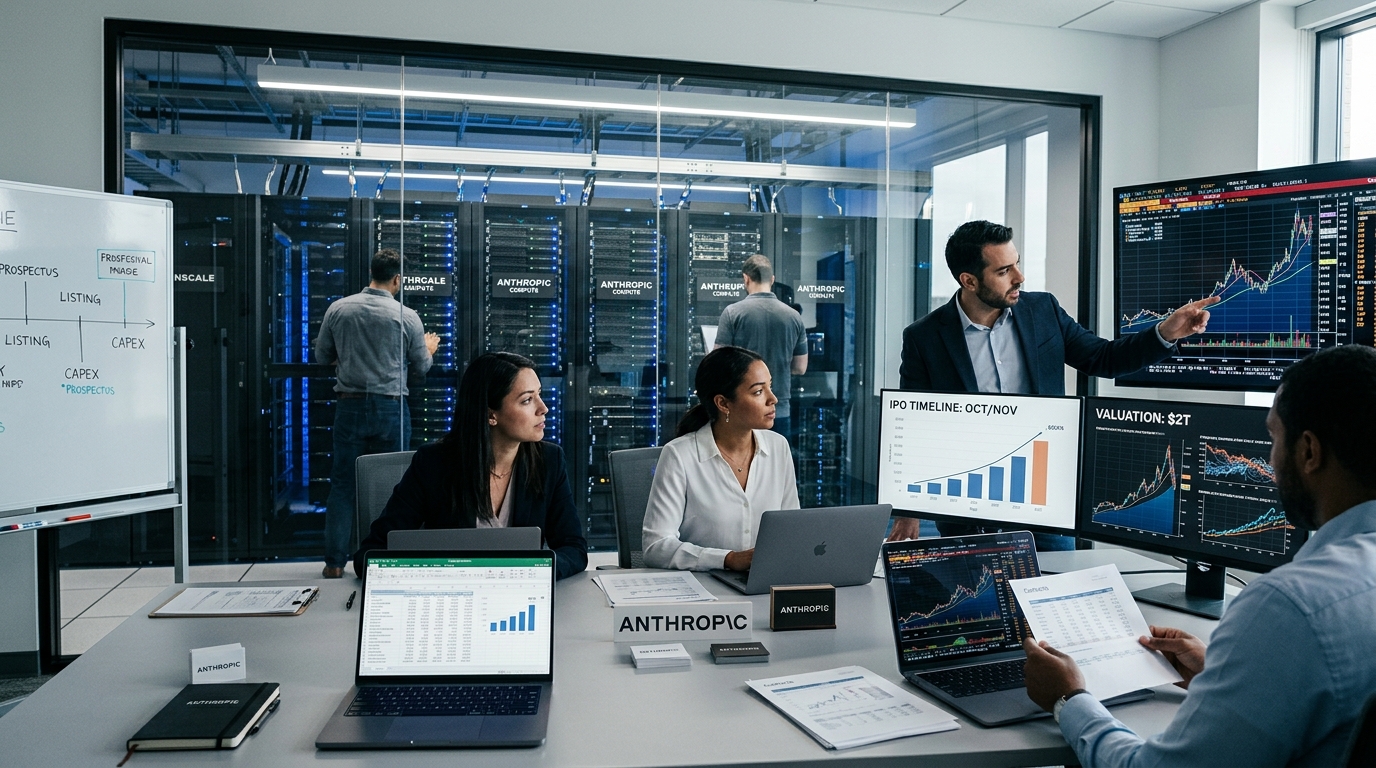
The prospectus is coming. Anthropic is expected to begin marketing its initial public offering in mid-October at the earliest and complete the listing days before the U.S. midterm elections in November. The company pushed its timeline from October to November specifically to present fresh third-quarter numbers to investors before locking in pricing. That is a reasonable choice. What is harder to explain is the number attached to it.
Investors anticipate a $2 trillion valuation, with the offering potentially raising up to $100 billion. For context, Anthropic closed a $65 billion Series H round at a $965 billion post-money valuation only four months ago. Doubling that figure before the first public share trades is not incremental. It is a leap that demands a very specific set of assumptions about the future.
The Bull Case
The revenue trajectory is genuinely unusual. Analysts estimate Anthropic posted its first-ever operating profit of about $559 million in the second quarter of 2026, on $10.9 billion in revenue, up from $4.8 billion in the first quarter. The company’s annual run rate topped $65 billion at the end of July, up from about $9 billion at the end of 2025. Investors cited by the Financial Times expect the annualized total to rise above $110 billion by year-end.
Analysts applying standard technology valuation multiples to projected 2028 revenues of $190 to $200 billion arrive at something in the $2 trillion range. On that reading, buying the IPO is simply buying the revenue curve before it becomes obvious to everyone else. Enterprise concentration strengthens the case: Anthropic has said about 80 percent of its revenue comes from corporate clients rather than consumer subscriptions, a stickier mix than a consumer app with volatile monthly actives.
The compute strategy is also more deliberate than it looks. The Nscale deal is the latest in a series of compute partnerships, following a $10 billion deal with cloud startup Volta and a strategic partnership with AMD that includes up to a $5 billion equity investment by AMD and a plan to deploy up to 2 gigawatts of AMD Instinct GPUs. Diversifying supply across multiple vendors reduces the single-provider risk that haunts hyperscaler-dependent AI companies.
The Bear Case
Here is where the Nscale S-1 becomes uncomfortable reading. On August 25, 2026, Anthropic entered into GPU Services Agreements with Nscale, under which Nscale will provide dedicated GPU infrastructure at its Monarch Compute Campus, with aggregate payments to Nscale of up to approximately $44.6 billion. That is a single contract. The deal is a six-year rental agreement. The West Virginia campus it depends on is expected to come online at the end of 2027, meaning Anthropic is committing tens of billions to infrastructure that does not yet exist.
Nscale is going public with a filing that shows a heavy near-term burn: the company disclosed a $1.02 billion first-half net loss, and said the Anthropic agreements are worth up to about $44.6 billion. In other words, the compute Anthropic needs to sustain its revenue growth will itself require capital markets to cooperate on two fronts simultaneously.
The pricing pressure is real too. Anthropic has cut prices for some workloads in 2026, including a 75 percent reduction in cache-read pricing on Claude Fable 5.1. In IPO terms, it is a bet that volume offsets unit economics, a bet that has to be proven rather than projected. Meanwhile, competition from open-weight Chinese models has amplified the pressure, and StepFun’s Step 5 Preview release underscored that the race to offer the best model at the lowest marginal cost is not slowing.
Where the Evidence Leads
The bull case rests on a growth rate that, if it holds, makes almost any valuation defensible. The bear case does not dispute the growth, it disputes whether the capital structure that supports the growth can be sustained without continuous market access. Investors expect Anthropic to need access to about five gigawatts of computing capacity by year-end, followed by close to twice that by end of 2027, an expansion that could significantly increase capital requirements for data centers, chips, and electricity.
The Nscale commitment is only one of eight compute corridors. Each carries its own obligations. When the public S-1 lands, investors should read the off-balance-sheet commitments section before looking at the revenue line.
What Could Change the Debate
Q3 results are the most important near-term variable. Some investors expect Anthropic to exit 2026 with annualized revenue above $100 billion. If the Q3 filing shows that trajectory holding, the $2 trillion argument firms up considerably. If growth decelerated, even slightly, mid-October roadshow investors will notice the gap between the revenue story and the valuation ask.
The other variable is OpenAI. OpenAI said it filed its own confidential S-1 on June 8, 2026. Whichever company prices first captures the AI-IPO premium. Whichever prices second inherits the comparison.
Final Verdict
The bull case is not unreasonable, the revenue acceleration has been real, the enterprise mix is defensible, and the operating profit signal in Q2 matters. But a $2 trillion valuation prices in a future that requires both continued exponential revenue growth and the successful construction of infrastructure that is not built yet, funded by a company going public partly to afford it. That is not a reason to dismiss the IPO. It is a reason to read every line of the S-1 before deciding what the shares are worth on day one.