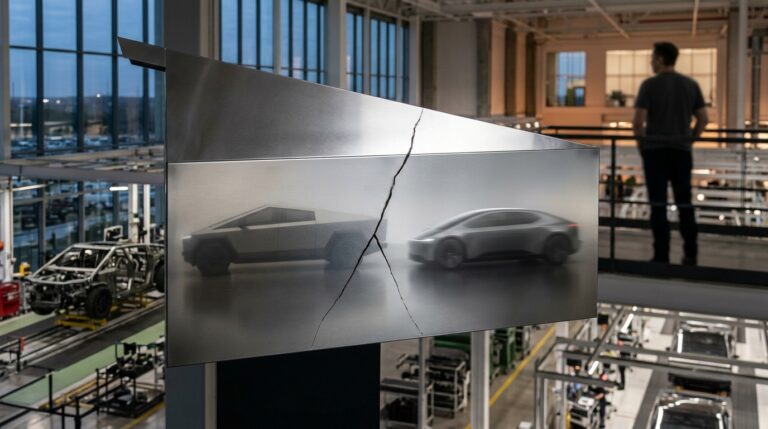
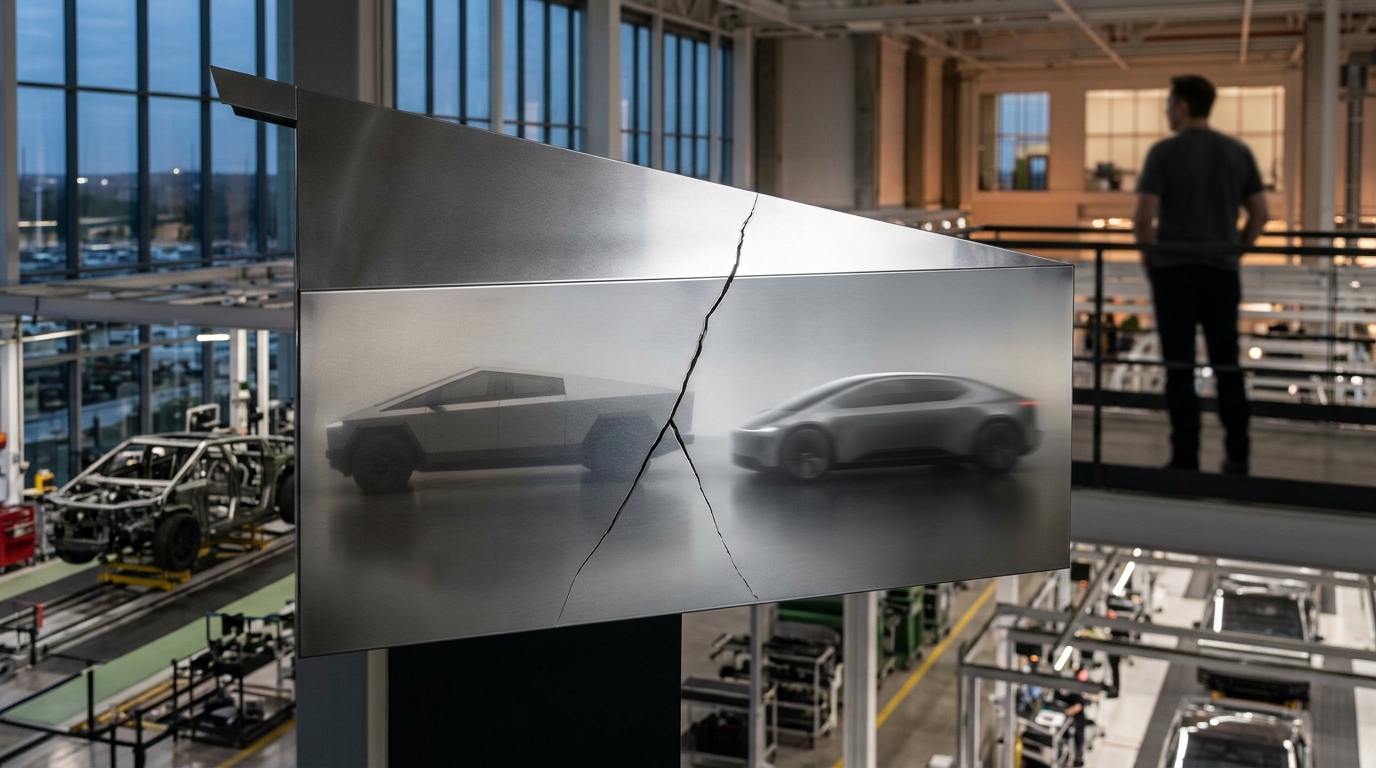
Elon Musk posted a single sentence on X Friday morning that ended, without fanfare, one of the most hyped vehicle launches in recent automotive history. Tesla will wind down Cybertruck production at Gigafactory Texas around the middle of next year to make room for increased Cybercab production. No transition plan for existing owners, no mention of another factory taking over the line. It was not immediately clear if Tesla plans to switch Cybertruck production to another factory or phase it out entirely, though the Cybertruck’s lead engineer, Wes Morrill, wrote that the Cybertruck “lives on through Cybercab.”
The numbers behind that silence are stark. The wind-down shows how far reality drifted from the original plan. Tesla built its Texas lines for a planned capacity of 250,000 trucks a year, and Musk once spoke of doubling that. Tesla delivered 8,295 “Other Models” in Q3 2026, down 48% year-over-year and the lowest since Q2 2021. With Model S and Model X production discontinued earlier in 2026, most of those deliveries were likely Cybertrucks alongside smaller volumes of Semi and early Cybercab deployment, a pace far below the pickup’s original ambition. Cox Automotive’s read is worse still: Cox estimates 3,519 Cybertruck sales in Q1 2026 and 3,744 in Q2, down from 14,416 in Q3 2024.
The Bull Case: Cutting Losses Is What Investors Asked For
There is a credible argument that this is exactly the kind of decision TSLA shareholders have been demanding for years. Capital was being consumed by a product running at a fraction of its designed throughput while a potentially transformational business was being starved of factory floor space. Giga Texas has over 10 million square feet of factory floor, by Tesla’s own count. Freeing that space is not irrational.
The Cybercab business it frees capacity for is real and growing. Tesla began offering paid Cybercab rides in Austin in early September 2026, and Tesla says Austin operating hours now run until midnight. Tesla has also publicly described rapid fleet growth in Austin since launch. Tesla has said the Cybercab should be cheaper and easier to manufacture, which should enable it to undercut Waymo and other robotaxi operators on price. If that holds, the Cybertruck’s factory floor becomes dramatically more valuable as Cybercab floor space than it ever was producing a stainless-steel pickup that buyers largely declined to purchase.
The Bear Case: Same Judgement, Different Vehicle
The bear case is not really about the Cybertruck. It is about who decided to build it in the first place and who is now asking investors to trust the replacement.
Multiple recalls early in the Cybertruck’s life, including actions tied to windshield wiper failures and exterior trim pieces that could detach, reinforced the perception that buyers were absorbing beta-test reliability at flagship prices. Traditional truck buyers who need a workhorse found the Ford F-150 Lightning and Rivian R1T considerably less risky. More than a million people once placed reservations. But reservations did not convert into anything close to a million buyers, and Tesla still does not report Cybertruck deliveries as a separate line item. That is a product judgment error of historic proportion.
The Cybercab carries its own open questions. Federal regulators opened an Audit Query into Tesla’s self-certification process following the Austin Cybercab deployment, focused on whether Tesla’s certification basis supports full compliance with applicable federal safety standards. Current service also remains operationally constrained by geography and conditions, and Tesla has not provided a clean revenue breakout for robotaxi operations. Reuters has reported Musk saying the revenue from this business will not be material until at least 2027. Investors are being asked to believe that the same executive whose product vision produced the Cybertruck debacle has now correctly identified autonomous ride-hailing as a scalable, profitable business at exactly the right moment.
Where the Evidence Leads
The bull case is stronger on capital allocation, weaker on trust. Ending a product that was selling far below its designed capacity and redirecting that factory toward a vehicle in genuine commercial deployment is the arithmetically correct call. The Cybercab rollout, whatever its regulatory and weather limitations, is operationally further along than skeptics expected twelve months ago.
The bear case is stronger on track record. The original Cybertruck forecast was not off by 10% or 20%; it was off by something closer to an order-of-magnitude. Investors who price Cybercab on Musk’s projections rather than current operational data are repeating the same mistake.
Execution risk is the common thread across every Tesla pivot. Tesla’s supply chain audits for Optimus show how the company is trying to move from promise to verified mass-production readiness.
What to Watch
The key question by mid-2027 is not whether Cybertruck production stops. It will. The question is whether Cybercab revenue is disclosed, growing, and generating margins that justify the factory conversion. Musk has talked publicly about Cybercab output on the order of millions per year. That target deserves the same scrutiny the 250,000-Cybertruck figure never received. Watch for NHTSA’s Audit Query outcome, city expansion pace, and whether Tesla begins breaking out robotaxi revenue as a standalone line. Those data points, not the wind-down announcement itself, are what will determine whether this pivot was disciplined or simply the next chapter in the same story.