
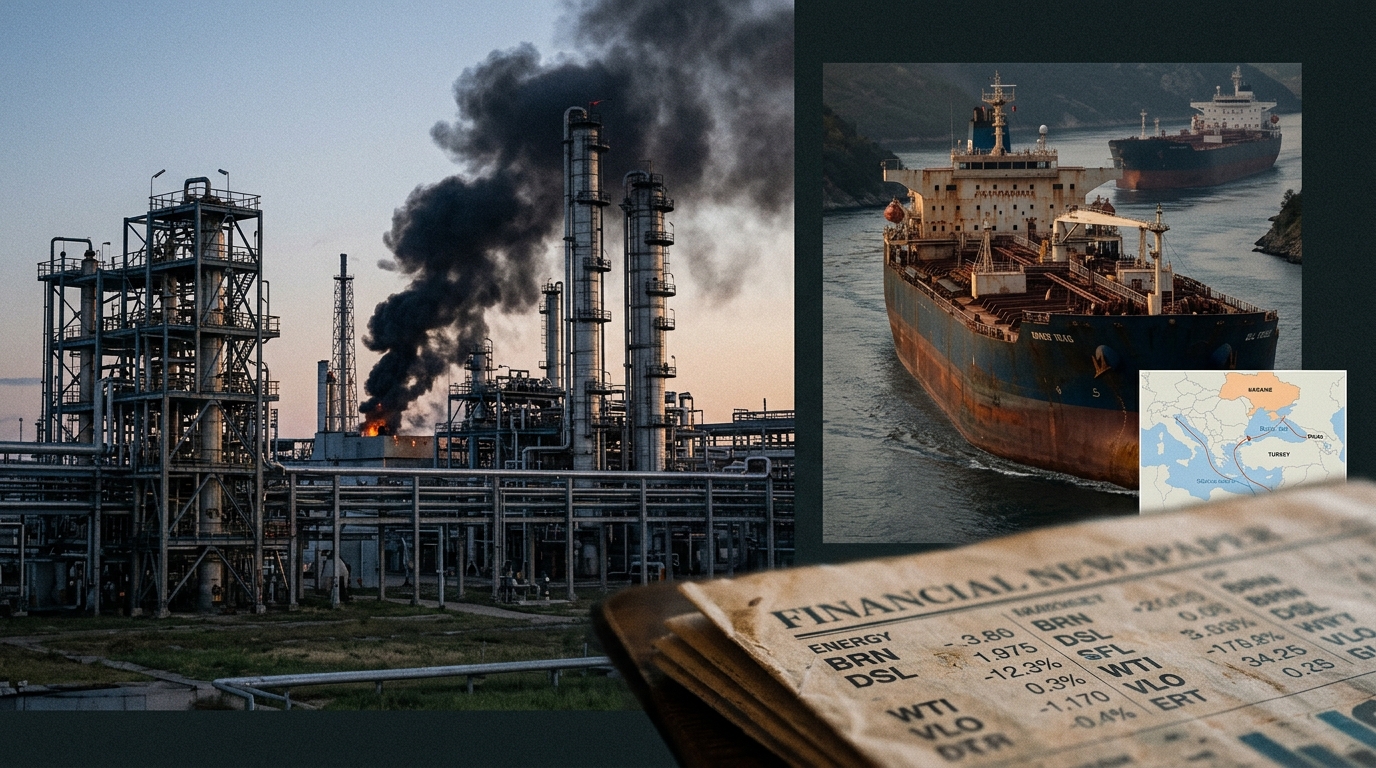
Two headlines landed simultaneously this morning, pulling the oil market in opposite directions. President Volodymyr Zelensky told the Financial Times that Ukraine has lifted its restriction on striking Russian refineries. Within hours, Reuters reported that the Trump administration is considering easing sanctions on shadow-fleet tankers. The question for anyone holding Brent, ULSD, VLO, MPC, or PSX into year end is simple: which development actually moves the price?
The Bull Case for Higher Prices
Ukraine had paused refinery strikes for three days at Washington’s request, yet Russia continued attacking the Ukrainian power grid throughout that period. That asymmetry is now resolved in Kyiv’s favor, and the strikes resume with no political constraints attached. Ukrainian drone strikes had already knocked out a meaningful share of Russian refining before the pause began, and Moscow has banned diesel exports by producers until October 31. Resuming strikes into that environment is not a marginal escalation. It is a direct hit on the single largest swing supply of European diesel.
The IEA’s October oil report cautioned that constrained middle distillate supplies are likely to persist well into 2027. The ULSD crack spread has been near record levels in recent weeks. Refiners running at full utilization to capture those margins, VLO, MPC, and PSX among them, benefit from every barrel of Russian capacity that stays offline. Valero reports earnings on October 22, and renewed refinery strikes give management a credible reason to guide margins higher, not lower.
The Bear Case: Washington Floods the Zone
Reuters reported that the Trump administration is discussing a partial easing of sanctions on the shadow fleet of tankers that transport oil from countries such as Russia, Iran, and Venezuela. The White House believes the move would lower freight rates, which Reuters described as record highs, allowing more oil and oil products to move out of the Persian Gulf. If that works, it partially offsets the refinery strike pressure by freeing bottlenecked supply.
The bear argument also points to Brent’s behavior today. Oil fell Thursday as traders assessed potential supply disruptions from attacks near the Strait of Hormuz, with Brent for December delivery down about 1.7% to around $104 a barrel. A market already pricing in multiple risk premia may struggle to sustain a further leg higher on news that has been circulating since dawn.
Where the Evidence Leads
The tanker sanctions proposal is the weaker of the two developments by a considerable margin. Experts quoted by Reuters said partially lifting sanctions on shadow-fleet vessels is unlikely to lower freight rates, because insurance companies will still have to comply with EU and UK law, which is not expected to ease restrictions on the shadow fleet. The plan is under discussion, not final. Under the proposal, shippers would have to apply to the US Treasury to use a sanctioned vessel, and no scope or timing has been announced. A proposal requiring Treasury permits is not new supply. It is a headline.
The insurance constraint is not theoretical. Tanker owners operating outside the shadow fleet have been capturing record freight rates precisely because compliant vessels remain scarce.
Zelensky’s announcement is neither a proposal nor a discussion. It is a presidential order that has immediate operational effect. During the three-day pause, Ukrainian officials said they received no early warning from partners about at least some Russian ballistic missile launches, and Ukrainian officials said Starlink restrictions disrupted some operations. The conditions that produced the ceasefire have collapsed entirely. There is no political mechanism in place to stop the strikes again absent a concrete exchange, and Zelensky has publicly pressed for additional Patriot air defense support. Washington has not paired today’s tanker-sanctions discussion with any announced commitment on that front.
What Could Change the Debate
The bear case strengthens if the Treasury acts quickly and formally on tanker sanctions, or if the October 31 Russian diesel export ban expires without renewal. The bull case deepens if Ukrainian strikes damage primary distillation capacity at a major refinery before Russian crews can redirect output to spare facilities. Russia showed in 2025 that it can use spare capacity to offset damage, with a 20% capacity reduction producing only a 6% drop in total refining volume. That resilience is real and it is the ceiling on how much any single strike campaign can tighten global diesel supply.
Final Verdict
The refinery strike resumption is the dominant variable for the oil price into year end, and the shadow-fleet discussion does not offset it. A proposal that needs Treasury sign-off, EU insurance compliance, and no timeline attached cannot compete with a presidential order that takes effect today. U.S. refiners holding record crack spreads are the cleaner trade on this news: Marathon Petroleum posted net income of $5.1 billion, or $17.73 per diluted share, in Q2 2026, and some coverage characterized it as its highest quarterly profit in four years. That kind of earnings power does not unwind because Washington floated a tanker-sanctions idea it has not yet finalized. Confidence level: moderately high, contingent on whether Russian spare capacity can again absorb the damage faster than markets expect.