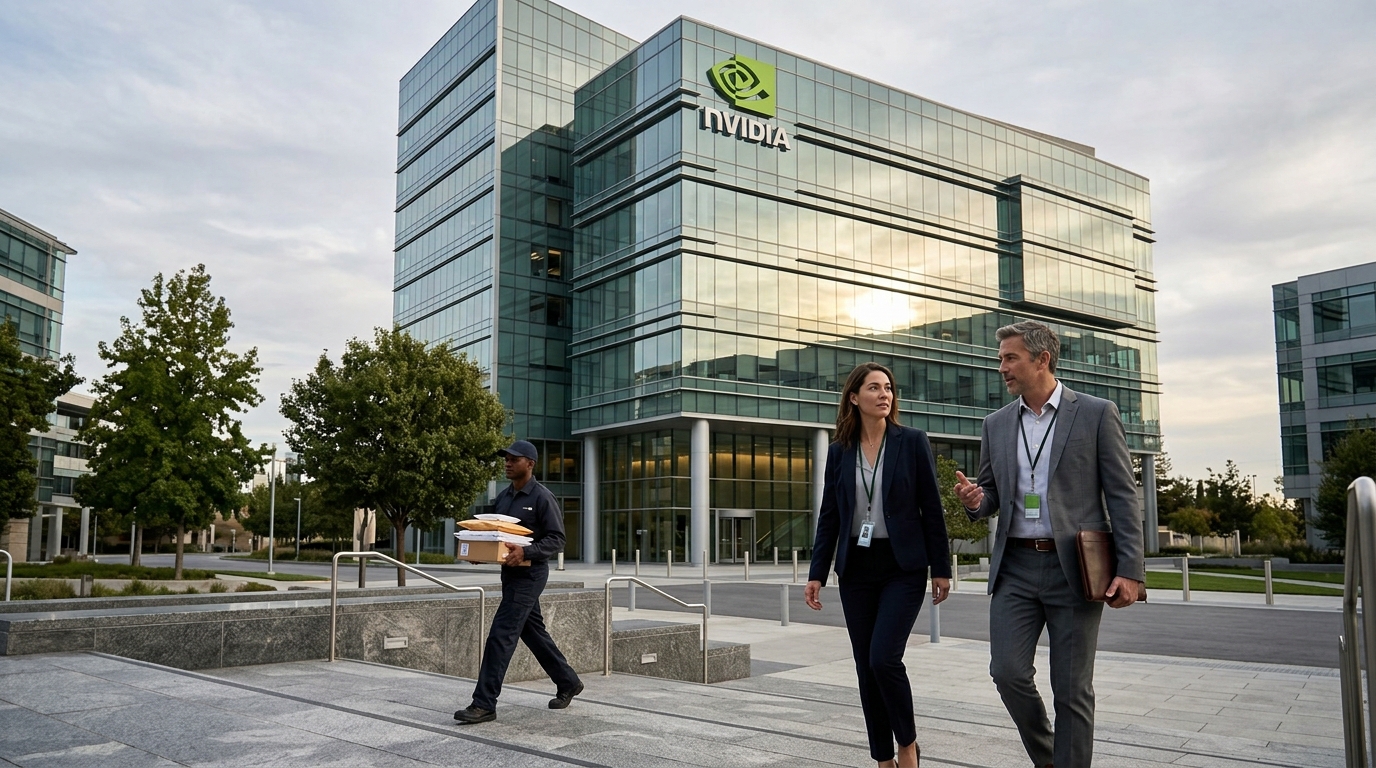
Nvidia has a preferred method for acquiring AI talent and technology without triggering a formal merger review: hire the engineers, license the intellectual property, and leave the corporate shell behind. It worked with Groq. Now, Nvidia is in early-stage talks to deepen its investment in open-weight startup Reflection AI or potentially acquire it outright, with an acqui-hire structure among the options being discussed. The question investors should be asking is not whether Nvidia can afford it. It is whether this playbook still has legal cover.
The Bull Case: Nvidia Is Locking Up the AI Stack
Nvidia is already a major financial backer of Reflection AI, having invested about $800 million in the startup, which was founded in 2024 by former DeepMind researchers Misha Laskin and Ioannis Antonoglou. On October 5, 2026, Reflection released its first model, called Beam, a 501-billion-parameter mixture-of-experts model pretrained on 23.8 trillion tokens. That is not a science project. That is a competitive open-weight model competing directly with DeepSeek and Qwen.
With its existing stake, Nvidia aims to enhance its capabilities in open-weight AI models, which are increasingly central to competing against cost-effective rivals like DeepSeek. Owning Reflection outright would let Nvidia bundle its GPU hardware with frontier model weights, creating a vertically integrated offering no pure-chip vendor can match. A deal could also align with U.S. government interests in strengthening domestic AI technology. Geopolitical tailwinds and commercial logic are pointing the same direction.
Structuring the deal as an acqui-hire, as Nvidia did with Groq, could help reduce the odds of the kind of regulatory process a conventional acquisition would attract. Speed matters here. The Financial Times reported on October 10, 2026, citing people familiar with the matter, that a deal could be reached within weeks, while cautioning talks could still fall apart.
The Bear Case: Delaware Is Watching
The Groq blueprint is now a live legal target. Two former Groq stockholders sued in the Delaware Court of Chancery, challenging what they describe as a roughly $20 billion reverse acqui-hire in which Nvidia obtained access to Groq’s technology through licensing and hired much of its engineering workforce. They argue the transaction should have been treated as a company sale requiring a stockholder vote under Delaware law.
The core allegation is structural. According to reporting on the complaint, it challenges the December 2025 transaction and argues that Groq’s board effectively sold the company without the stockholder vote Delaware law requires. The case turns on one question: whether a license plus a hired team is, in substance, a sale of the company. Courts have not answered that definitively. If they answer yes, every similar deal Nvidia executes could face retrospective scrutiny.
The shareholder lawsuit is not the only front. The New York Times reported on September 9, 2026, that the Department of Justice is investigating whether Nvidia tried to skirt antitrust scrutiny of its Groq arrangement, including whether the structure sidestepped premerger notification requirements under the Hart-Scott-Rodino law. A DOJ finding against Nvidia on Groq would make a structurally similar Reflection deal significantly harder to close quietly.
In the Delaware case, plaintiffs also allege breaches of fiduciary duty and contend that after the transaction the remaining Groq shell company was cashed out at an underpriced $3.5 billion. If Reflection AI shareholders are watching, they now have a fresh template to cite before any deal closes.
Where the Evidence Leads
Nvidia’s strategic logic for owning Reflection is sound. Open-weight models are a direct competitive response to Chinese labs, and Nvidia’s existing stake gives it inside visibility into the technology. The Financial Times said the potential deal structures range from an outright acquisition to an acqui-hire or an increased equity stake, possibly alongside expanded commercial agreements, giving Nvidia flexibility to calibrate risk.
But the Groq litigation has changed the calculus. The acqui-hire was invented partly to reduce the likelihood of conventional merger review. That design feature is now its central legal vulnerability. The Delaware lawsuit arrived amid reporting that the Justice Department is investigating whether Nvidia’s arrangement with Groq was structured to avoid standard antitrust scrutiny. Repeating the structure with Reflection AI, days after reporting that the Groq complaint was unsealed, would be an aggressive bet that courts will side with Nvidia’s interpretation.
Final Verdict
The bull case for Nvidia’s AI empire-building remains credible on fundamentals. The bear case is no longer hypothetical speculation: it is an active Delaware proceeding and a DOJ inquiry. Investors should treat the Reflection AI talks as confirmation of Nvidia’s strategic direction, and the Groq suit as the clearest signal yet that the legal bill for that strategy is being drawn up. Which side prevails depends on how aggressively Delaware courts are willing to look through deal structure to economic substance. That is not a question Nvidia’s GPU roadmap can answer.