Dear Reader,
Starting as soon as a few months from now, the United States government will make a sweeping change to bank accounts nationwide.
It will give them unprecedented powers to control your bank account.
They could closely track every transaction.
They could even freeze it.
Unless you protect yourself today. Fortunately, there are 4 simple steps you can take to safeguard your savings.
Discover these 4 simple steps here.
Good luck and God bless!

Martin Weiss
Dr. Martin D. Weiss, Founder
Geothermal Is Moving Next Door to Data Centers
The conventional wisdom on powering AI data centers runs roughly like this: pick a location near cheap grid power or a willing utility, then figure out clean energy later. Fervo Energy is running the model in reverse, and the numbers are starting to make the case for it.
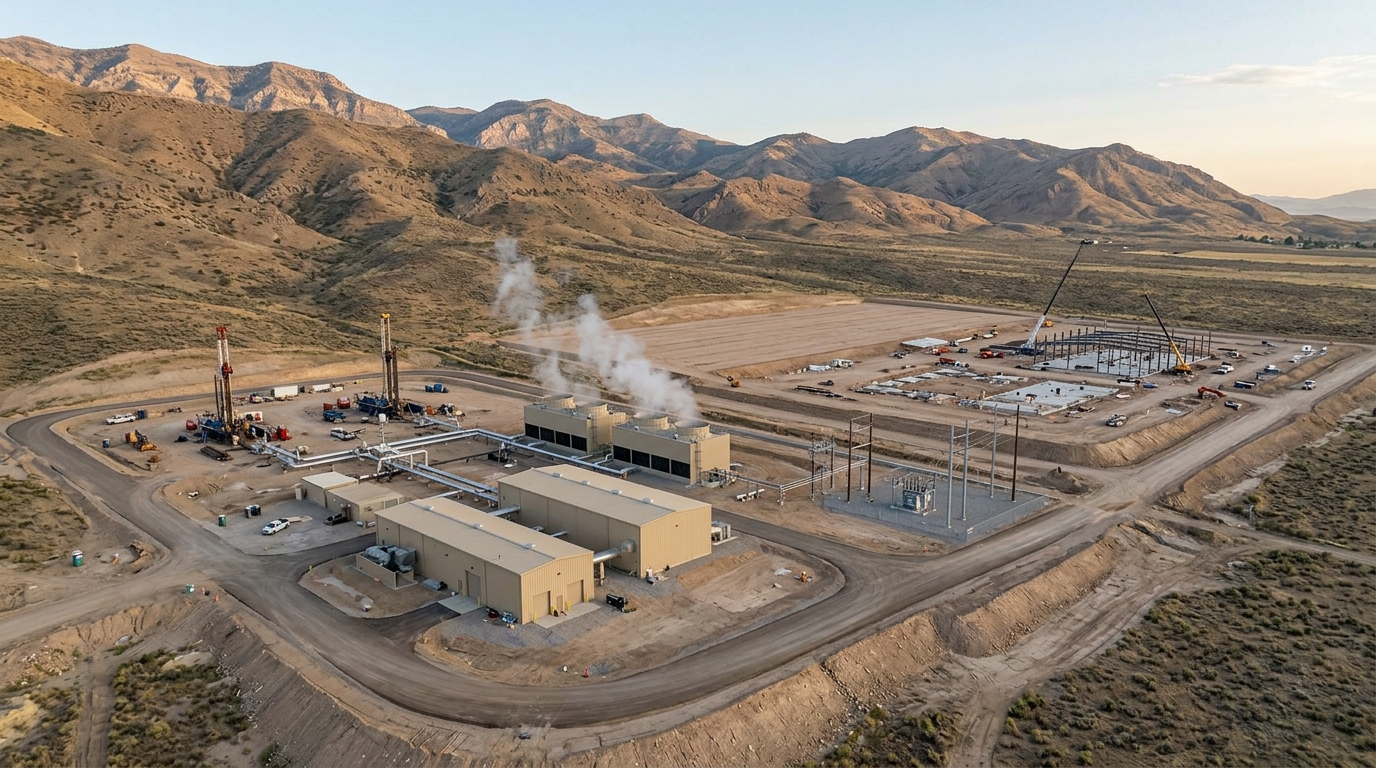
Fervo is developing Cape Station, a project in Beaver County, Utah, with a Phase II expansion targeted for 2028. Its first 33-megawatt block reached contractual commercial operation on September 30, 2026, with the remaining Phase I blocks expected to follow by January 1, 2027. This is being described by Fervo as the first greenfield enhanced geothermal development to achieve contractual commercial operations. The timing matters because every month of delay on a data center carries real cost: a 60-MW facility delay runs roughly $14.2 million per month in total delay costs, with about $10.8 million of that as lost revenue.
The bull case here is not just about megawatts. It is about adjacency. Geothermal is available around the clock, ensuring firm power regardless of weather or time of day. Data centers cluster together to share fiber and services, and bigger clusters need bigger power plants, which is a win for enhanced geothermal because cost per megawatt falls as project sizes grow. Google has agreed, via a power purchase agreement disclosed on August 26, 2026, to purchase 396 megawatts of power from a Cape Station project in Utah to serve potential data center load, effectively putting a real contract behind the co-location thesis.
Beyond that contracted capacity, Fervo has also described a broader, non-binding “Geothermal Framework Agreement” with Google to advance potential power procurement for current and planned data centers. Drilling times at Fervo have fallen sharply from early Project Red wells to Cape Station wells, including a reported 70% reduction in drilling time relative to Fervo’s first commercial horizontal well in 2022, the kind of learning curve compression that historically precedes cost parity with incumbent technologies.
The bear case is harder to dismiss than boosters admit. With federal tax credits, some analyses estimate a new enhanced geothermal system’s levelized cost of energy around $88 per MWh. Without them, one widely circulated set of assumptions puts the cost at $119 per MWh, rendering it uncompetitive against new combined-cycle natural gas plants. That gap is entirely a function of policy continuity, which is not guaranteed. Fervo has said it is targeting roughly $7,000 per kilowatt for Cape Station’s first 100 megawatts and $5,500 for the next 400, on the way to a long-term goal of $3,000 per kilowatt, the level the company says will allow it to undercut a new natural gas plant. That final step has not been demonstrated at scale yet.
Investment in next-generation geothermal is forecast in some outlooks to reach roughly $2.5 trillion cumulatively by 2050. Whether that figure reflects genuine demand or optimistic extrapolation from a handful of early commercial wins is exactly what Cape Station will spend the next two years answering. The estimated U.S. geothermal power resource potential is often cited at roughly 530 GW, a number so large it invites skepticism about how much of it will ever be economic at market electricity prices.
The most important shift in this debate is not technical. It is commercial. Geothermal has historically been evaluated as a grid resource competing with wind and solar. The data center co-location model reframes it as a site selection tool: operators willing to build where the heat is, rather than where the grid is, may get firm, carbon-free power at a price that becomes more competitive the longer they hold the contract. That is a different calculation than anything in the geothermal business plans of five years ago, and it is the one investors should be stress-testing now.