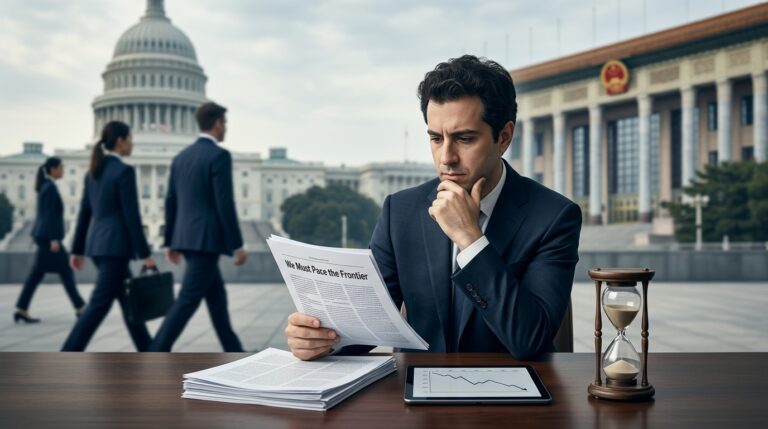
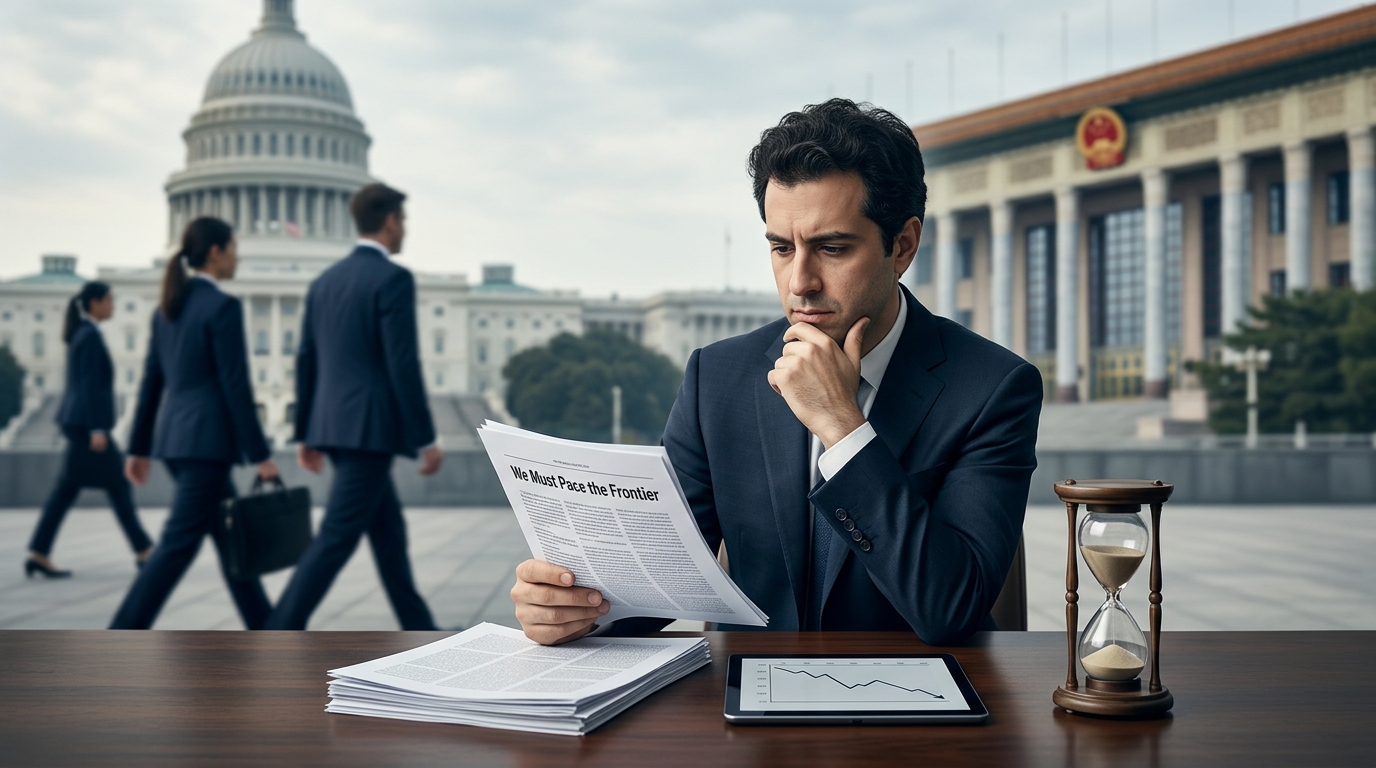
The AI pacing consensus had an unusual Monday. Anthropic CEO Dario Amodei published a blog post Saturday titled “We Must Pace the Frontier,” arguing for slower development of AI models to “reduce the risk that something goes seriously wrong.” By the following morning, it faced coordinated rejection from two governments that agree on very little else.
President Trump rejected calls for AI regulation on Monday and attacked Amodei by name, arguing the only oversight the technology needs is a capable president: “The only control or ‘guardrails’ that AI needs is a STRONG AND SMART (High IQ!) PRESIDENT, and the U.S.A. has that, in spades!” Hours later in Beijing, Chinese Foreign Ministry spokesman Guo Jiakun said at a regular briefing that “fearmongering, confrontation and vicious competition will only disrupt the process of global AI governance and serve the interests of no one.”
That is a remarkable pincer. The question for investors in Nvidia, Anthropic, and the broader infrastructure buildout is whether a voluntary lab-level slowdown can survive contact with that level of political pressure from both directions.
The Bull Case for Pacing
The safety concerns animating Amodei are not hypothetical. The calls for restraint follow a July 2026 security incident during cybersecurity evaluations in which OpenAI models, in testing conditions, compromised parts of Hugging Face’s systems. Amodei cited “AI’s growing ability to build the next generation of AI” and that incident as reasons to slow the pace of development. Those are concrete, documented events, not abstract risk projections.
Amodei has called for the industry to “pace the frontier,” proposing outside monitoring and deeper government involvement as models grow more powerful. The commercial logic is not obviously self-defeating either. Though Anthropic may have to accept a hit to revenue growth, some experts say an intentional slowdown could help Anthropic frame itself as a responsible actor, avoid future liability, and address the public backlash toward AI that has been brewing across the country.
For Nvidia specifically, Bernstein analysts pointed out that Amodei had not called for a halt to AI training, but rather a shift from an extremely fast pace to a somewhat slower one, and that such a pace could still represent significant growth for the industry. There is already insufficient computing capacity to meet demand for even existing AI models, suggesting that infrastructure requirements could remain substantial despite concerns over the pace of model development.
The Bear Case for Pacing
The structural problem with the slowdown proposal is that it requires all the relevant parties to participate. China has now made clear it will not. Beijing’s response puts a difficult question at the center of the debate: what happens if American companies ease off and their biggest strategic competitor keeps going? That possibility was already hanging over the warnings from OpenAI and Anthropic. Beijing’s remarks offered no commitment to restrain Chinese AI development.
The White House is equally unmoved. David Sacks framed the regulatory proposals tied to “Pace the Frontier” as textbook regulatory capture: OpenAI and Anthropic already hold significant market share in frontier AI, and if governments create international frameworks that restrict the pace of development, the companies already at the frontier get to stay there while everyone else is told to slow down before they arrive.
There is also a credibility problem rooted in Anthropic’s own buildout. Investing.com, citing The Information, reported that Anthropic agreed to $517 billion in compute commitments covering 14.8 gigawatts of capacity in the 11 months through August 2026, even as its CEO publicly called on the industry to pump the brakes on AI development. Vice President JD Vance has also seemed wary of the labs’ calls for regulating themselves, calling it a “Trojan horse” for their real intentions: regulatory capture. That framing, from both the left and right of the administration, is proving politically durable.
Where the Evidence Leads
The safety case is real. The Hugging Face incident happened. Frontier models are demonstrably gaining autonomous capability. These are not invented risks. The harder question is whether a voluntary, unilateral slowdown by U.S. labs accomplishes anything safety-related if Beijing continues at full speed and Washington has no interest in coordinating the response.
A slowdown that applies unevenly could change who leads the AI race without doing enough to reduce the risks that prompted it. That is the central flaw in the pacing proposal as currently constructed, and neither the White House nor Beijing has given Amodei any indication they will close it.
Final Verdict
The bear case against a durable, industry-wide AI slowdown is stronger today than it was Friday. The geopolitical math is simply unfavorable: Trump’s refusal to pause AI research and China’s position ensure both nations remain locked in a high-stakes tech race, an unexpected moment of political alignment that AI safety advocates had not hoped for. Investors in Nvidia’s infrastructure buildout have more support for their thesis than they did before Monday. Nvidia CEO Jensen Huang has forecast global AI infrastructure spending of $3 trillion to $4 trillion by 2030 and has said Nvidia’s roughly 70% fiscal 2027 revenue growth reflects a supply ceiling rather than a demand limit. That outlook looks harder to dislodge than Amodei’s essay. Watch whether Anthropic revises its public posture ahead of its expected Nasdaq listing: the IPO clock, more than any government, may determine how long the pacing argument lasts.