September 6, 2026
The market cheered 50,000 more job cuts. The math still needs a €19 billion EBIT lift.
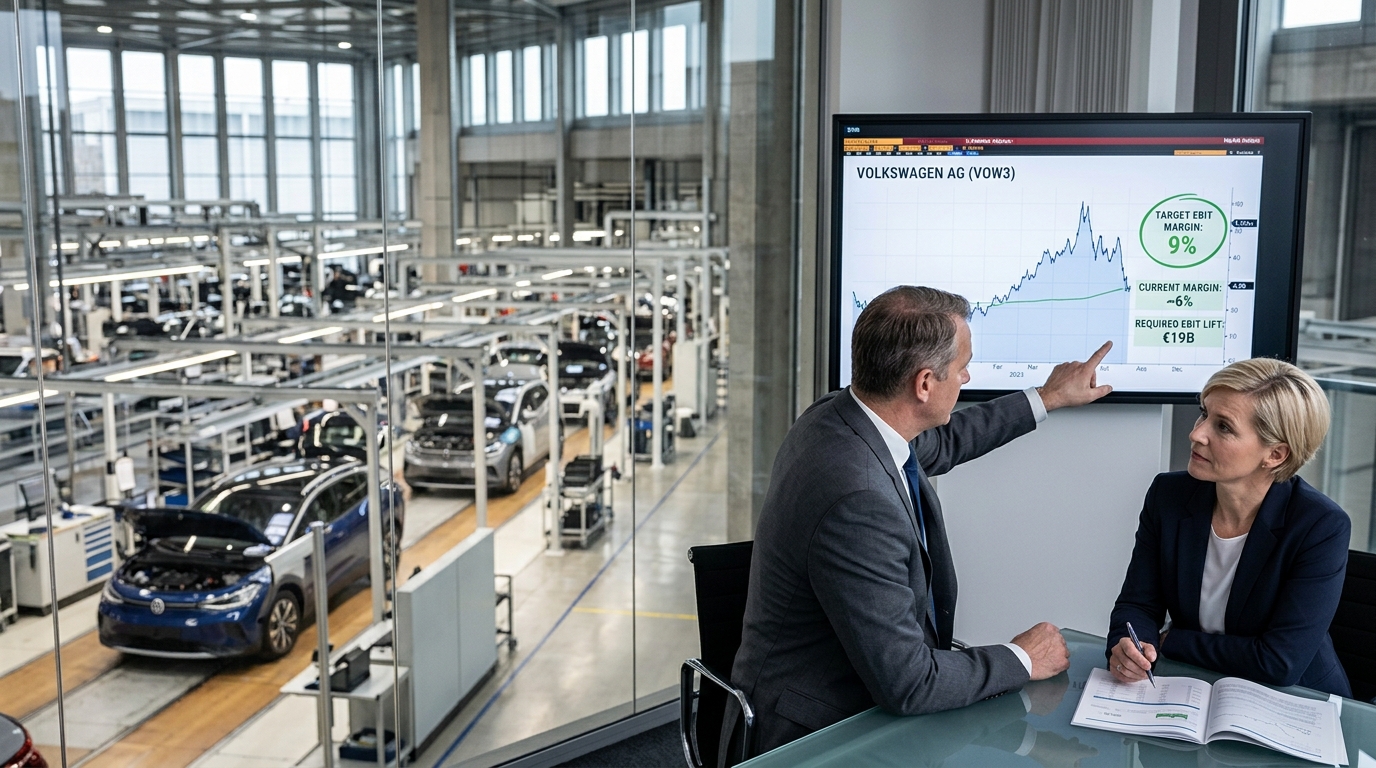
Markets have a straightforward way of judging corporate surgery: they price the plan, not the patient. Volkswagen shares closed at €81.30, up 6.47% on September 4, the morning after its supervisory board unanimously approved a transformation plan that would cut another 50,000 jobs in its attempt to counter tariffs, overcapacity, and Asian rivals. The automotive sector outperformed the broader Stoxx 600 as Volkswagen rallied as much as 9.7%, its biggest intraday move since March 2023. That is a large vote of confidence for a company whose operating margin sat at 3.8% in the first half of 2026.
Trading Legend Reveals “Make America Affordable Again” Project
Man who handed hundreds of millions in profits to clients says, “I’m revealing my ‘American Affordability Project’ to help folks adjust to higher prices.
My goal is to show my strategy to 50,000 people in the next 12 months.”
The Bull Case
The most important thing about September 3 was not the number of jobs cut. It was the unanimous vote. The board’s unanimous backing of CEO Oliver Blume’s plan matters because labor representatives and regional politicians have long held effective veto power over painful capacity decisions. That governance discount is now partially lifted.
Some analysts described the outcome as “much better than feared” and a “fundamental breakthrough,” arguing that investors had treated Volkswagen as “not fixable.” Clearing that expectations bar matters enormously at a stock that, even after Friday’s rally, remains sharply lower year to date.
The structural logic is real. Volkswagen says its European capacity currently exceeds demand by more than 500,000 units per year. The plan targets annual sales of 9 million vehicles and a 9% operating margin by 2030, which Volkswagen says corresponds to an operating result of approximately €31 billion. Getting there means fewer, higher-volume models generating better fixed-cost absorption across the same factories. Volkswagen’s total workforce including the Chinese joint ventures was 662,942 at the end of 2025. Blume has said around 37,000 contracts to reduce headcount had already been signed, mainly through early retirement. The machinery is moving.
5 Little-Known Stocks Behind Today’s Defense Tech Shift
Behind the headlines, a major transformation is underway.
Modern warfare is being driven by AI, autonomous systems, and next generation technology. A handful of lesser known companies are helping power this shift.
This report uncovers five stocks quietly playing a critical role in the future of defense.
The Bear Case
The gap between 3.8% and 9% is not a rounding error. The Future Plan targets roughly €31 billion of annual operating profit. Volkswagen produced €5.9 billion in the first half of 2026. Doubling that gives an €11.8 billion annualized figure, leaving the 2030 target €19.2 billion higher and requiring a 2.6-fold increase in earnings.
That is not a restructuring story. That is a revenue and volume story, and it is playing out in the worst external environment Volkswagen has faced in a generation. Reporting around the plan’s approval, the Associated Press said China’s auto market is down more than 20% this year and that roughly 500 new models have been launched amid fierce price competition. Volkswagen has also said the share of operating result from its equity-accounted companies in China fell sharply in the first half of 2026. A profit center becoming a rounding error is not a problem a model lineup reduction fixes by itself.
Volkswagen has not put hard public detail around where the new positions would be eliminated, when the reductions would happen, or whether they would come through layoffs, buyouts, or attrition. Despite the unanimous board vote, labor representatives and regional politicians have drawn strict red lines on plant closures. Emden, Zwickau, Hanover, and Neckarsulm face losing current production between 2031 and 2034, but formal closure decisions require further negotiation. The plan’s timeline gives adversaries years to reopen that debate.
5 Little-Known Stocks Behind Today’s Defense Tech Shift
Behind the headlines, a major transformation is underway.
Modern warfare is being driven by AI, autonomous systems, and next generation technology. A handful of lesser known companies are helping power this shift.
This report uncovers five stocks quietly playing a critical role in the future of defense.
Where the Evidence Leads
The bull case rests on two things that genuinely happened: a governance breakthrough and a credible scale of intent. The bear case rests on arithmetic, external market conditions, and a decade-long pattern of Volkswagen announcing targets it then misses. Volkswagen’s operating profit more than halved in 2025 to about €8.9 billion, and the group’s operating return on sales was 2.8% in 2025. Every restructuring iteration has been met with fresh headwinds.
The market is correctly pricing relief that the board did not deadlock. It is not yet pricing 9% margins, which is the right distinction to hold. Watch two things above all others: the pace at which those 37,000 early-retirement contracts translate into actual cost reduction in the H2 2026 results, and whether China joint venture profit stabilizes in 2027 as Antlitz has suggested. If both move favorably, the bull case earns its keep. If China keeps deteriorating and the cost savings lag, the 6% rally will look like a relief trade that got ahead of the fundamentals.
The verdict at this stage: the governance shift is real, but the margin target remains a forecast, not a fact. Volkswagen deserves more credit than it was getting in the mid-€70s. It does not yet deserve credit for €31 billion of operating profit it has not produced.