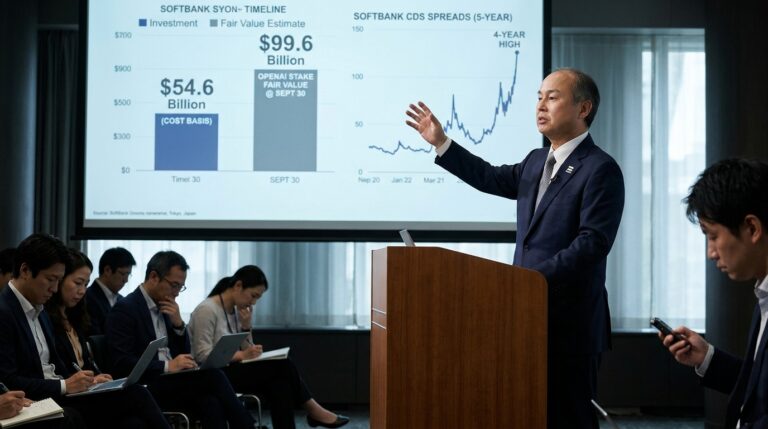
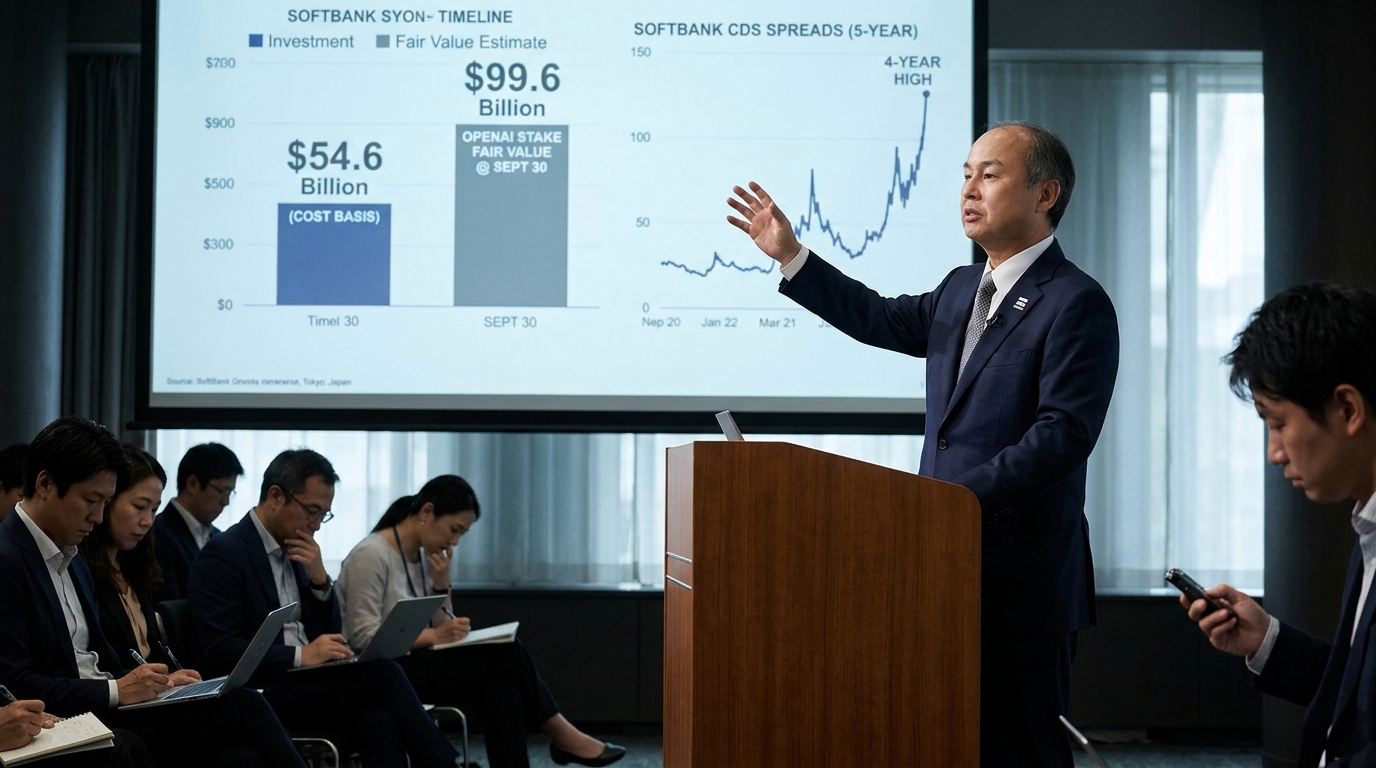
There is a number at the center of SoftBank’s results today, and it demands a verdict. In its financial report released Tuesday, SoftBank Group carried its OpenAI stake at a fair value of $99.6 billion on 30 September, against a cumulative investment of $54.6 billion. That is roughly a $45 billion paper gain. It is also a number the market is treating with open skepticism, given that Reuters reported SoftBank’s five-year credit default swap spread rose as high as 466 basis points on 6 November 2026, the widest since October 2022. The question is not whether the gain exists on paper. It is whether it means anything.
The Bull Case
Start with what SoftBank actually owns. SoftBank has disclosed that, after it executed the third and final tranche of its follow-on investment on 1 October 2026, its cumulative investment in OpenAI totals $64.6 billion and its ownership interest is approximately 13%. It also disclosed that its preferred shares are subject to customary automatic conversion provisions in connection with a future go-public transaction. That conversion feature matters. It means SoftBank is not a passive creditor hoping for distributions; it is an equity holder positioned for a full public-market exit.
The company it owns a slice of is growing fast. OpenAI itself has said it reached $1 billion in revenue within a year of launching ChatGPT. And the market is still willing to pay up: multiple outlets reported on 6 November 2026 that OpenAI has raised about $11 billion so far in a new funding round that values the company at about $1.25 trillion, coming after OpenAI’s earlier announcement this year of a $122 billion round at a post-money valuation of $852 billion. At a $1.25 trillion figure, a 13% stake would imply a value well above the $99.6 billion on the books. The 30 September mark may actually be conservative.
SoftBank’s operating business is not collapsing. The company reported net sales up 13.3% in the six months ended September 30, supported by its telecommunications and other operations, which helps explain why some investors still view the OpenAI position as an upside lever rather than a make-or-break lifeline.
The Bear Case
The valuation is stale and the exit is not visible. SoftBank disclosed that the OpenAI stake recorded no gain or loss because its valuation was unchanged from March. That is six months of zero mark-to-market movement on what is supposed to be a high-growth asset. Meanwhile, CEO Sam Altman said in a September 2026 interview reported by Fortune that OpenAI will not go public in 2026, citing AI safety work as a priority. A locked-up preferred stake in a company that cannot IPO is not $99.6 billion you can spend.
The funding round itself told a story. Reporting around the 6 November 2026 financing said OpenAI has raised $11 billion so far at the stated valuation. The gap between “so far” and “fully funded” matters when the valuation is the whole point of the bull case.
SoftBank’s own credit is flashing red. Reuters reported in September that SoftBank raised $11.1 billion in dollar- and euro-denominated bonds, described as the largest high-yield corporate bond sale globally on record, with tranches paying interest rates including a 9.75% coupon. Servicing that debt requires real cash. The OpenAI stake, carried at $99.6 billion, produces none. SoftBank also reported a net loss attributable to owners of the parent of about 1.12 trillion yen for the three months to September 30, versus market expectations cited by Investing.com for a profit of 129.32 billion yen.
The bond market’s exposure to this mismatch runs deeper than institutional holders. SoftBank’s record retail bond sale pushed OpenAI-backed risk directly onto Japanese household investors at coupons the wholesale market had already declined.
Where the Evidence Leads
The bull case depends on OpenAI’s trajectory and an eventual liquidity event. The revenue growth appears real, and the reported $1.25 trillion private valuation suggests deep-pocketed buyers still believe in the story. If OpenAI prices an IPO anywhere near that level in a later year, SoftBank’s unrealized gain could grow substantially from the current book figure.
The bear case depends on the gap between paper wealth and cash. That gap is wide and widening. Reuters reported SoftBank’s financing costs surged to 461.9 billion yen in the July to September quarter, citing a margin loan backed by Arm holdings, heavy bond issuance, and higher funding rates. You cannot pay bond coupons with a preferred-share position in a private company.
The valuation SoftBank is waiting on does not exist in isolation. Anthropic’s parallel IPO filing puts a competing trillion-dollar AI valuation in front of the same institutional buyers OpenAI needs for its own exit.
Final Verdict
The $99.6 billion mark is neither fiction nor fact in its current form. It is a frozen number on a genuinely valuable asset, surrounded by a capital structure that can deteriorate faster than an IPO can arrive. The bear case carries more weight today, not because OpenAI is failing, but because SoftBank’s cost of time is rising every quarter and the exit remains out of reach. Investors should watch two things: whether OpenAI’s reported $1.25 trillion round closes in full, and whether SoftBank’s loan-to-value ratio approaches its self-imposed 25% ceiling. The first would strengthen the bull case; the second would force uncomfortable decisions regardless of what the stake is worth on paper.