October 29, 2026
Bonus Content: Anthropic’s $518B Tab Could Outlast the AI Boom
Hi,
Here’s an idea that sounds easy: swap harsh pest-control chemicals for plant-based ones.
Plenty of plant-based ingredients look promising.
But “promising” isn’t the hard part.
The hard part is turning an interesting ingredient into a product a professional will trust, buy again and use every week, in homes, restaurants and food facilities where results aren’t optional.
That gap is where most ideas stall. It’s also where real businesses get built.
And if pressure on conventional pesticides keeps building, whoever has already crossed that gap may be worth a close look.
Our latest investor letter digs into that gap, and into one small private business that has spent years trying to close it.
Who’s already trying to close the gap? →
P.S. There’s also a second business inside this story that most readers never see coming. Read the letter →
Anthropic’s $518B Tab Could Outlast the AI Boom
Anthropic’s S-1, filed October 26, is already being called one of the most consequential IPO documents in tech history. The headline numbers are hard to argue with: revenue grew roughly 1,300% in the first half of 2026, totaling $16.3 billion, driven by booming demand for its Claude family of AI products. That kind of growth rate belongs on a different planet from most public companies.
But the filing also contains a sentence that deserves more attention than it has received. Buried in Anthropic’s own risk language: “In order to operate and grow our business, including to fund our substantial compute commitments, we have incurred a substantial amount of debt, which requires significant interest and principal payments,” and the company “may be required to use a substantial portion of our cash flows from operations to pay interest, principal, or other required payments on our indebtedness.” That is not boilerplate. That is a company telling you its debt load is a genuine constraint on how it operates.
The Bull Case: Debt as a Growth Engine
Supporters read the financing structure differently. The immense compute commitments have not only allowed Anthropic to lock in what it needs to deliver growth but are also partly responsible for the gross margins it reports, because they shift a large portion of compute from a purely variable constraint into contracted capacity the company can plan around. That is a real advantage: certainty over chip access in a market where supply is rationed.
The operating picture also improved sharply. On the company’s adjusted measure that backs out items like stock-based compensation and other non-cash charges, Anthropic reported $1.6 billion of operating profit in the first half, an operating margin of about 10%, from a company that grew second-quarter revenue 1,368% year over year. In Q2 alone, Anthropic spent $5.6 billion on compute and infrastructure while generating about $11.6 billion in revenue, or about $2.08 of revenue for every dollar spent on compute. The unit economics are moving in the right direction.
The Bear Case: Fixed Obligations in a Variable World
The bear argument is not about the accounting loss. Most of that $80.7 billion loss, specifically $72.4 billion, reflects a non-cash accounting charge tied to changes in the fair value of convertible notes and related instruments, not cash incinerated on servers. The real concern is structural.
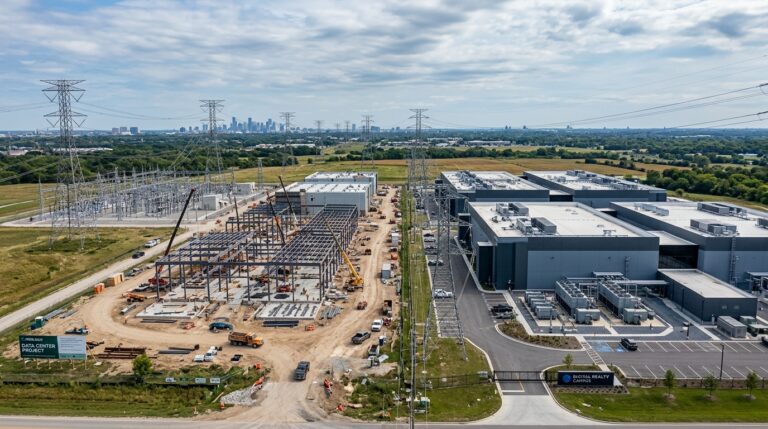
Anthropic has said it expects to spend at least $518 billion over a decade building AI infrastructure with six partners, and it also carries about $161.2 billion of Broadcom-related equipment lease obligations that are largely noncancelable. Meanwhile, the S-1 states: “We must forecast our compute requirements well in advance of their deployment and commit capital accordingly, often with limited ability to adjust commitments if our needs change.” In plain terms: if AI demand slows, or if a lower-cost competitor erodes Claude’s pricing power, those obligations do not shrink. The compute commitments create fixed costs that can be a drag on profitability if revenue growth falls short of expectations, and they raise the stakes of a downturn.
Anthropic is not alone in locking in infrastructure spend before demand is proven. Meta’s leadership has acknowledged committing up to $200 billion on AI infrastructure without confirmed proof points that the technology will pay off.
The credit markets have noticed. Parts of Anthropic-linked financing have drawn a BB+ rating from KBRA, one notch below investment grade, and Reuters reported in mid-October that Anthropic was offering Blackstone a yield of more than 10% in a chip-financing deal that the Financial Times said was under discussion. That is not the rate of a company investors consider risk-free.
Where the Evidence Leads
Investor valuation expectations have already started to reflect the tension. Reuters reported October 15 that some investors and prospective investors discussed a valuation of around $1.5 trillion, a significant step down from the roughly $2 trillion valuation that investors had previously expected for a November share sale.
The company’s own filing warns: “Our business may not be able to generate cash flows from operations in the future that are sufficient to service our debt and make necessary capital expenditures.” That line does not belong in a confident growth story. It belongs in a company that knows its fixed liabilities could overwhelm it if the growth trajectory bends even slightly.
The bull case requires near-perfect execution for a decade. The bear case only requires one bad year. That asymmetry is the real debate heading into what could be the largest IPO in stock market history.