September 2, 2026
The AI brain drain is a distraction. Search and the DOJ are the real risk.
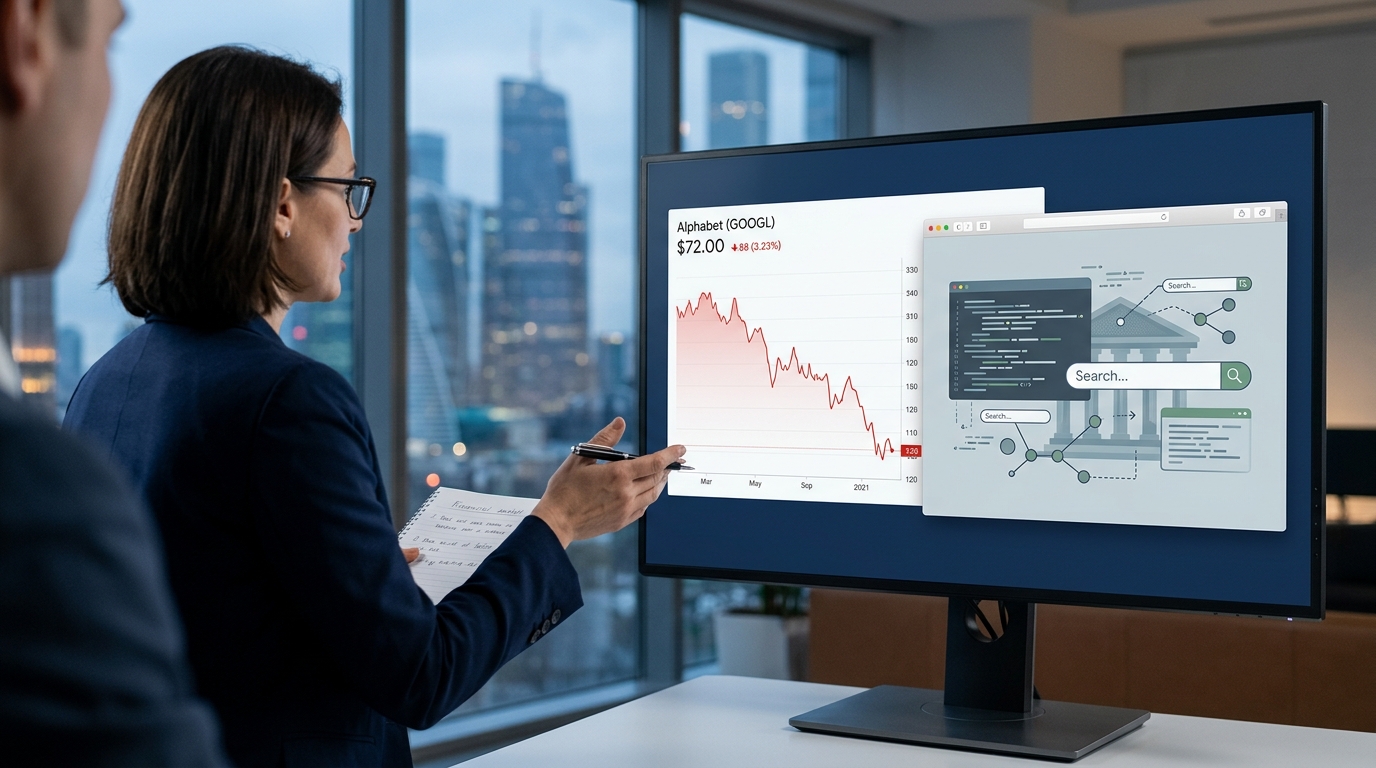
Alphabet shares are down 6% over the past month while the S&P 500 advanced 3%. The stock hit an all-time high on May 13 after soaring more than 150% in the previous 12 months, putting it among the 25 best performers in the S&P 500 over that stretch. Four consecutive monthly declines later, the question is whether the market has correctly identified the problem, or priced in the wrong risk entirely.
Inside the SpaceX S-1, Elon’s New AI Disruption Revealed
You will NOT believe what Elon Musk is doing next. Hidden inside the SpaceX S-1 is the master plan for Elon’s next big disruption.
It could transform the world… rewrite the rules of AI… And create the most valuable company EVER. This is the AI story no one’s talking about… yet.
Get the name and ticker here of the No. 1 way to play it, free of charge.
The Bull Case
Start with what the sell-side keeps overlooking. Jeff Dean, Sanjay Ghemawat, Oriol Vinyals, and Quoc Le departed to launch a startup called Discovery Loop. That is four names, not four divisions. Rather than severing ties, Alphabet participated as an investor in Discovery Loop’s initial funding round, and Discovery Loop has said it is working with Google Cloud. The arrangement is unusual enough to complicate the brain-drain reading: Google is backing the very startup its former researchers are building, which means the relationship looks less like defection and more like a structured spin-out.
The financials reinforce the bull argument. Google Cloud revenue surged 82% to $24.8 billion. EPS came in at $9.11, but that result was flattered by a large unrealized gain in other income. YouTube ads revenue rose 13% year over year in the quarter. A company putting up those operating trends does not look like one whose AI capability has structurally deteriorated because four researchers left.
Demis Hassabis is handing off day-to-day leadership of Google DeepMind to become its chair and Alphabet’s chief scientist, while CTO Koray Kavukcuoglu steps up as SVP, overseeing Gemini model development. That is a succession plan, not a collapse. Institutions willing to look past the August headlines can buy a cloud hyperscaler at a meaningful discount to its May peak.
The Bear Case
The departure story is the distraction. The real bear case has two sharper edges: search monetization and the legal calendar.
$38.4 Trillion Debt + AI = The Biggest Wealth Transfer Ever
BlackRock’s Bitcoin ETF just became their #1 revenue source. JPMorgan processes $1 billion daily through digital asset rails. 170 public companies have repositioned their treasuries. Meanwhile, the U.S. debt-to-GDP ratio is projected to hit 143.4% by 2035, higher than Greece before their collapse. The government’s only mathematical escape is AI-driven GDP growth, but AI at scale needs new financial infrastructure. In this live presentation, Ex-Wall Street CFA Tan Gera reveals the exact convergence and how early investors caught 12,480% gains last time.
There are two debates weighing on Alphabet shares, and the first is that search slowed more than investors expected in the second quarter. Departures from the Gemini team have coincided with delays around Gemini 3.5 Pro, the model’s next-generation upgrade. A stalled model roadmap is the kind of problem that compounds: rivals ship, enterprise customers notice, and switching costs in cloud contracts are lower than they look.
Then there is the legal exposure. The U.S. Justice Department and a group of states are appealing a federal judge’s ruling that imposed only modest limits on Alphabet’s Google contracts related to its search engine and the Gemini app. The DOJ is pushing the D.C. Circuit to reinstate a ban on the large payments Google makes to distributors like Apple to secure default placement. Separately, Alphabet’s Android antitrust fine in Europe became legally final on July 2, 2026, when the EU’s top court upheld a fine of about €4.1 billion. Losing the default-placement payments on appeal would force Google to compete for search distribution rather than buy it, a structurally different business than the one the market has valued for a decade.
Operating cash flow was $39.07 billion, but purchases of property and equipment reached $44.92 billion, producing negative quarterly free cash flow of $5.86 billion, even as Alphabet raised its full-year capital expenditure guidance. That is an uncomfortable combination when the legal outcome that threatens the top line is still unresolved.
Where the Evidence Leads
The brain drain is real but overstated as a standalone catalyst. Alphabet’s decision to invest in Discovery Loop makes this more complicated than a straightforward talent exodus. Google may have lost four accomplished AI researchers, but it has positioned itself close to their next company through capital and cloud infrastructure, blurring the line between former employer, investor, and potential research partner.
Get Into Anthropic Before the IPO
Anthropic is heading for a huge AI IPO.
A little-known public company already owns nearly 1% of it.
Because the shares are already trading, there’s no six-month lockup.
You could position yourself now and decide later whether to hold or sell on day one.
The stronger bear case sits in search and the courts. The DOJ appeal targets the Apple default-search arrangement specifically. That deal is one of Google’s most reliable search-volume guarantors. If the D.C. Circuit reinstates the payment ban, the impact on search query volume would be direct and measurable, not hypothetical.
What to Watch
The D.C. Circuit’s ruling on the DOJ appeal is the single most important event on Alphabet’s calendar. A decision in the government’s favor on default-search payments would hit the core business, not the AI research pipeline. On the other side, Gemini 4’s release timeline matters more than who is running the team that builds it. Full-year capital expenditure guidance has been raised to $195 billion to $205 billion, with a significant increase expected for 2027, which means the free cash flow gap will widen before it closes.
The brain drain moved the stock. The court case could move the business. Those are different things, and right now the market is treating them as the same.