Before Kevin Warsh said a word at Jackson Hole on Friday morning, gold was holding near $4,600 and silver had just crossed $70 for the first time in weeks. Within 25 minutes of his speech, spot gold had skidded to an intraday low near $4,531 and silver was on its way to a 4.5% loss on the session. The question worth answering is not what just happened. It is whether this is a trend break or a shakeout, and the answer depends entirely on which gold market you think you are trading.
The Real-Rate Shock
Warsh delivered a clear message: the Fed’s 2% PCE objective is a “firm, fixed target,” and “we have work to do.” With July headline PCE running at 3.7% year-over-year and core PCE at 3.3%, that was not an idle warning. The two-year Treasury yield moved higher and the dollar index also rose. That combination is the precise mechanism that makes gold expensive to hold: higher yields lift the opportunity cost, and a stronger dollar compresses dollar-priced commodities from both ends. Markets responded by lifting September hike odds to roughly a coin flip, based on CME FedWatch.
This is a genuine headwind, not noise. Warsh doubled down on limiting forward guidance, yet investors moved to price in a meaningful chance of a September hike. That shift in expectations, if it sticks through next week’s payrolls data, will keep pressure on metals through September.
The Structural Bid That Doesn’t Flinch
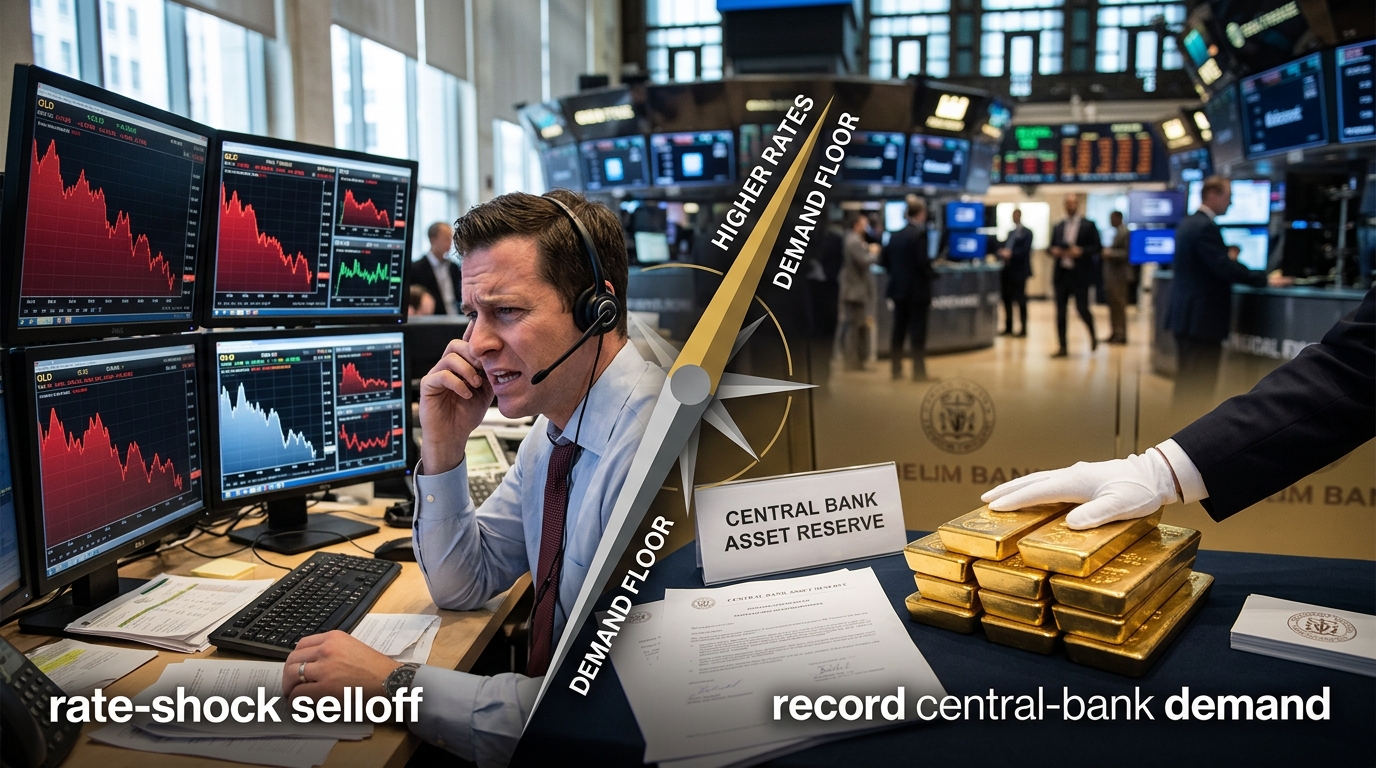
Here is where the buy-the-dip case lives. The World Gold Council’s Gold Demand Trends Q2 2026 report showed central banks adding a net 289 tonnes of gold in Q2, up 62% year-over-year. Prices eased from Q1’s record highs, and central banks accelerated purchases into that pullback. That is price-insensitive accumulation driven by reserve diversification, not yield-chasing. No single central bank policy decision by the Fed is likely to redirect the multi-year reserve diversification strategy underpinning official-sector gold accumulation.
That structural floor is what separates this pullback from a trend reversal. Momentum traders sold gold on Warsh’s words. Central bank reserve managers will not.
Miners: The Leverage Goes Both Ways
Before Warsh took the stage, gold and silver miners were having the kind of month investors do not easily forget. GDX was up nearly 40% month-to-date, on track for its strongest monthly performance since 2020. Within 25 minutes of his speech, precious-metals miners became one of the worst-performing corners of the U.S. market, with First Majestic Silver (AG) leading the decline, down 5.09% to $20.82. AngloGold Ashanti (AU) fell 3.31%.
Operating leverage runs in both directions. The same amplification that pushed GDX up 40% in a month will keep selling pressure elevated if spot metal stays under stress. Miners are not the place to hide if the rate-hike reset deepens. GDX traded with a wide intraday range on Friday, and that session range tells the story: the bid exists, but it is shallow right now.
Levels That Define the Trade
For gold, the line between dip and break sits near $4,500 to $4,530. Despite the pullback, moving averages maintain a bullish alignment, with key support located near $4,530. A hawkish signal could trigger further correction toward the $4,500 to $4,520 support zone, though downside may remain limited ahead of next week’s nonfarm payroll data. A weekly close below $4,500 on heavy volume would be a different conversation. Above it, this is positioning noise after a 13%-plus month.
For silver, prices are still up sharply year-to-date, and the Silver Institute expects a market deficit for the sixth consecutive year in 2026, driven largely by industrial demand. A metal with a structural supply gap does not reverse on one speech. The key watch is whether silver holds above the $65 area on a closing basis.
For GDX, the $100 level is now the line. StoneX senior analyst Matt Simpson noted that any decline could attract buyers who missed the initial rally and were targeting higher levels. That dip-buying impulse is real, but it requires gold to stabilize first. High-conviction miner exposure belongs after the metal base-builds, not before.
Trader’s Action Plan
Separate the trades. The rate-shock move is real and may have another leg if September rate hike expectations continue building ahead of payrolls. That argues for patience on new entries in GDX, First Majestic, and AngloGold Ashanti. Gold itself, backed by sovereign buying that does not respond to Warsh’s press conferences, is a different asset than the miners right now. Watch $4,500 as the line in the sand. Hold above it with stabilizing yields and the uptrend is intact. Break it on rising volume and the correction deepens toward $4,350. The trend only breaks when sovereign demand flinches. So far, it has not.