Trump’s About to Unleash His $16 Trillion Midterm Weapon?
Dear Reader,
I just received an urgent FedEx package from one of my closest contacts… a former CIA insider who knows Trump personally.
I now believe Trump is about to deploy a $16 trillion chess move… just as folks head to the polls for the midterm elections.
This move could help him secure a big win on November 3.
To put the size of this move into perspective…
$16 trillion works out to roughly $46,650 for every man, woman and child in America.
Inside that FedEx package, Trump’s plan is laid out in black and white.
It could be the most important public document I’ve come across in my entire career…
In my new presentation, I open it LIVE on camera for everyone to see.
Click here to see the cold, hard proof.
Matt McCall
P.S. This move could result in a HUGE WIN for Trump, America, and savvy investors who can connect the dots. Click here for the details.
Applied Materials Reports Thursday. Its Numbers Look Great. Its Stock Doesn’t.
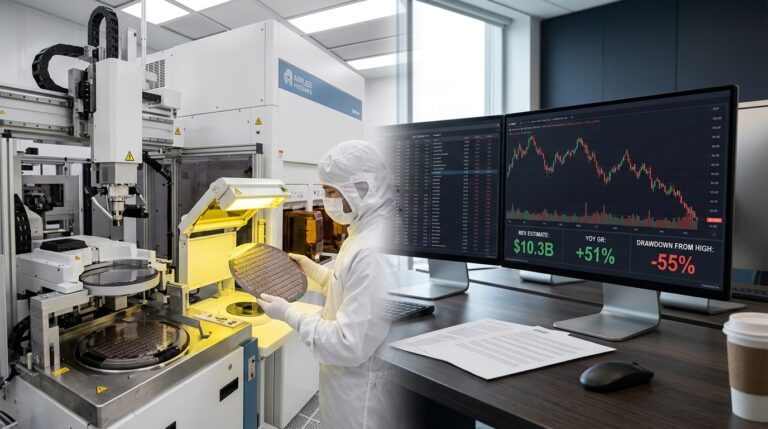
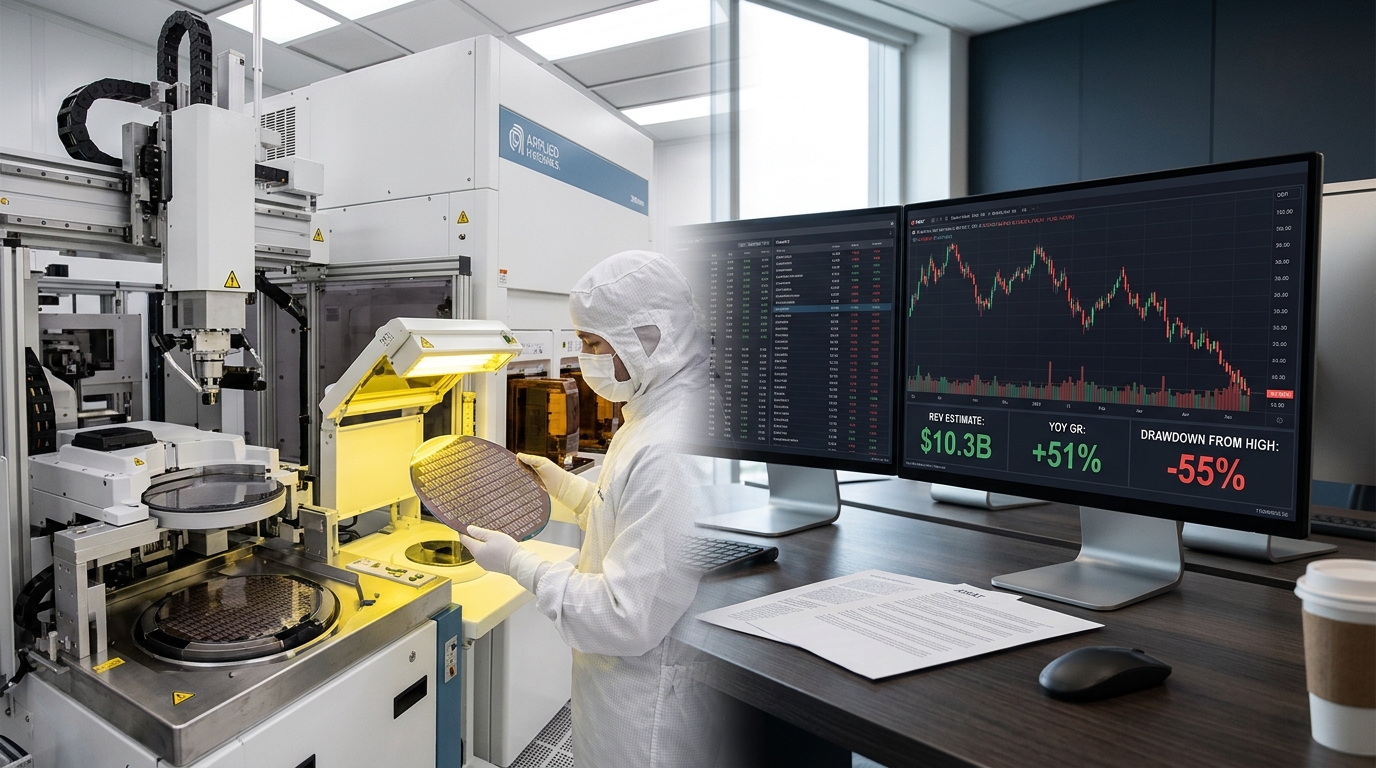
Applied Materials closes its fiscal year this Thursday, November 12, with a quarter that looks, on paper, like a crescendo. Consensus expects revenue of $10.3 billion, up 51% year over year, with EPS of roughly $4.00. Management raised its Semiconductor Systems growth outlook for calendar 2026 multiple times: from more than 20%, to more than 30%, and then again to an even higher level. The machinery for a bullish argument is fully assembled. The debate, entering Thursday, is whether the stock already knew.
The Bull Case
Applied posted record Q3 fiscal 2026 revenue of $9.12 billion, up 25% year over year, along with record non-GAAP EPS of $3.50. Management said it expects continued strong growth in the second half of the calendar year, particularly in DRAM, leading-edge foundry-logic, and advanced packaging. These aren’t cyclical pops; they reflect structural demand from AI chip fabrication, where each new generation of logic and memory requires more process steps and more equipment spend per wafer.
Leading-edge foundry-logic, DRAM including high-bandwidth memory, and advanced packaging are expected to drive roughly 80% of wafer fab equipment growth, and all three are areas where AMAT says it is positioned to outgrow the market. CEO Gary Dickerson also said the company has strong customer pull and a pipeline that extends into 2027 and beyond. That forward visibility is not typical for capital equipment makers, which usually live and die on 90-day guidance windows.
AMAT is up year to date, yet plunged nearly 55% from its June 30 intraday high of $739.67 to close at $332.71 on November 6. One data service put AMAT’s forward price-to-earnings ratio at about 19.5x as of the November 6 close, a compressed multiple for a company that just delivered year-over-year non-GAAP EPS growth of 41% in Q3. The bull case is simply that the selloff overshot the fundamentals.
The Bear Case
The stock’s collapse from June is not arbitrary noise. Applied Materials has said U.S. export controls could reduce net revenue for fiscal 2026 by approximately $600 million. China’s share of Q3 fiscal 2026 revenue fell to 28% from 35% a year earlier. That compression is a managed retreat, not a resolution. The restrictions are broadening, not narrowing.
AMAT’s recent slide has also tracked renewed investor anxiety about the durability of AI-related spending and the policy risk around China-exposed semiconductor equipment names. And when a company in a record growth phase withholds a forward spending number, the market tends to fill the gap with pessimism.
The same dynamic has played out across the equipment sector. Lam Research fell roughly 19% from its peak despite record revenue and a raised WFE outlook, as sector-wide anxiety overwhelmed the fundamentals.
The stock’s last quarterly report highlighted just how sensitive the market can be to guidance, particularly around margins. Even a clean beat on Thursday could provoke the same response if gross margin guidance for fiscal Q1 2027 falls short of what investors are baking in.
Where the Evidence Leads
The fundamental case is unusually strong. A 51% revenue surge, expanding margins, record DRAM-related momentum, and a CEO willing to talk confidently about growth beyond the current fiscal year: that combination is rare in cyclical industrials. The risk is not that Thursday’s numbers disappoint. The risk is that the guidance for fiscal Q1 2027 becomes the story, particularly around China licensing and gross margin trajectory.
At roughly 19.5 times forward earnings, the stock is not obviously expensive. But it is exposed to a category of risk, geopolitical and regulatory, that earnings beats alone cannot neutralize. Thursday resolves the revenue question. The harder one, whether Washington is finished tightening the screws, stays open.
Verdict: The bull case carries more weight on the fundamentals today. The bearish argument requires a deterioration in forward guidance that the numbers, so far, have not delivered. Watch Q1 2027 gross margin guidance closely. That is the number most likely to move the stock, in either direction, after the close on Thursday.