November 2, 2026
Bonus Content: Anthropic Is Going Public Into a Brutal Tech Week
Trump’s About to Unleash His $16 Trillion Midterm Weapon?
Dear Reader,
I just received an urgent FedEx package from one of my closest contacts… a former CIA insider who knows Trump personally.
I now believe Trump is about to deploy a $16 trillion chess move… just as folks head to the polls for the midterm elections.
This move could help him secure a big win on November 3.
To put the size of this move into perspective…
$16 trillion works out to roughly $46,650 for every man, woman and child in America.
Inside that FedEx package, Trump’s plan is laid out in black and white.
It could be the most important public document I’ve come across in my entire career…
In my new presentation, I open it LIVE on camera for everyone to see.
Click here to see the cold, hard proof.
Matt McCall
P.S. This move could result in a HUGE WIN for Trump, America, and savvy investors who can connect the dots. Click here for the details.
Anthropic Is Going Public Into a Brutal Tech Week
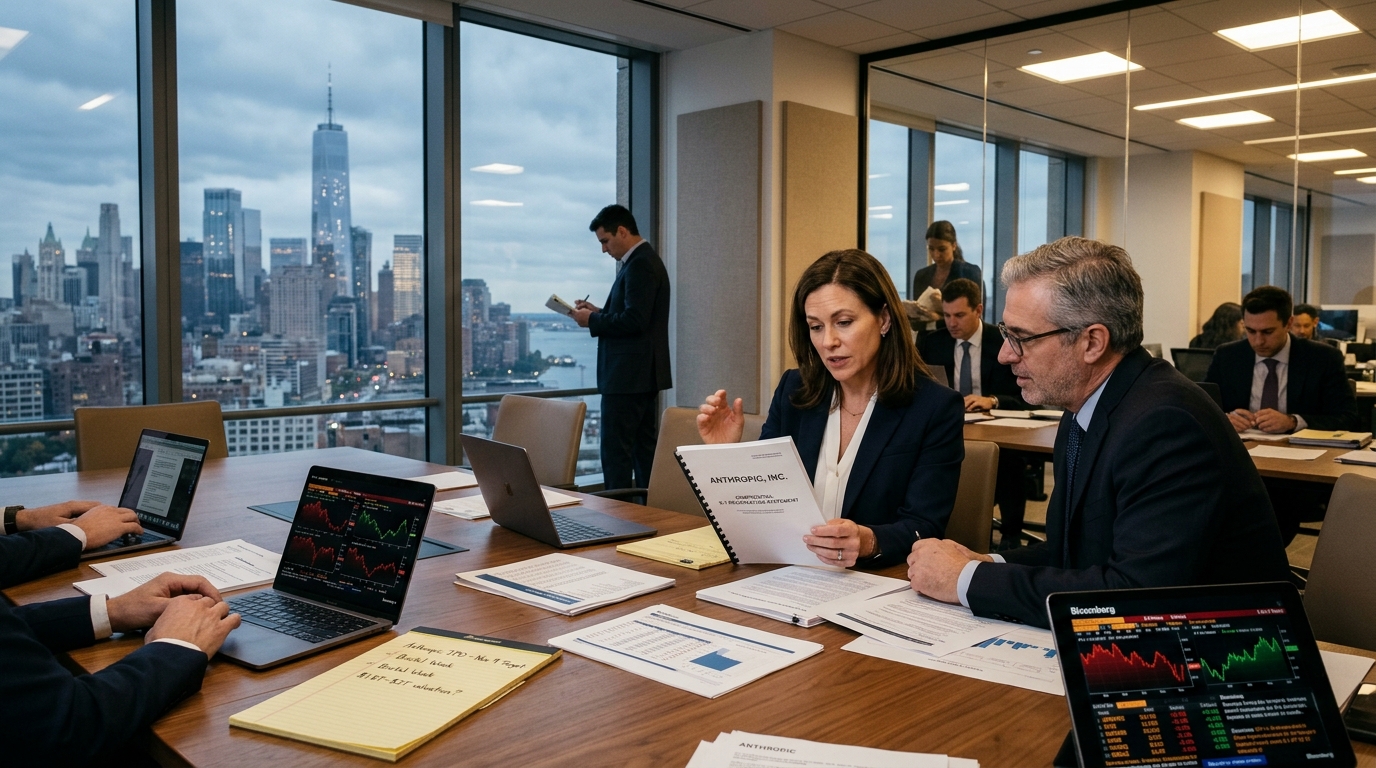
The roadshow for what would be one of the largest initial public offerings ever is expected to begin as early as the week of November 9. Anthropic’s debut is targeted before Thanksgiving, according to Bloomberg. No price range has been filed, but reporting has put the target between $1.8 trillion and $2 trillion before Reuters reported on October 15 that investors at Anthropic’s investor day discussed around $1.5 trillion after third-quarter growth slowed. Between those two data points sits an unusually loud question: does Anthropic deserve a generational franchise multiple, or is the window that matters simply closed?
The Bull Case
Start with the revenue. Anthropic’s revenue jumped to $16.3 billion in the six months ended June 30, fourteen times what it brought in a year earlier. That is not a rounding error. Quarter-over-quarter revenue growth ran at 132% in Q1 2026 and 144% in Q2, while compute as a percentage of revenue collapsed from 251% in Q1 2025 to 48% by Q2 2026. The efficiency story is just as important as the growth story.
Third-quarter 2026 revenue reached $16.8 billion, up about 45% from the second quarter, with an adjusted operating margin of 11%, according to Reuters reporting on the investor day. Net revenue retention reached about 900% as of the end of September 2026, excluding Claude Pro and Max subscriptions, meaning customers already paying a year earlier were spending about nine times as much in Q3 2026. That figure is the kind institutional buyers underwrite franchises around.
The competitive moat is structural, not accidental. Anthropic has disclosed minimum compute purchase commitments of at least about $114.5 billion with Google running from April 2026 through July 2033, alongside similarly large commitments with other major cloud partners. Google (GOOGL), Microsoft (MSFT), and Amazon (AMZN) are simultaneously critical suppliers and major strategic validators. That alignment is difficult for a competitor to replicate quickly.
The Bear Case
OPay is the first piece of evidence the bears will reach for. The SoftBank-backed payments company was scheduled to begin trading on October 30, 2026, before halting the offering to respond to a regulatory inquiry. The circumstances differ from Anthropic’s, but the timing does not: a deal that was on track to list still failed to reach the market on schedule. That is what the window produced last week.
The Nasdaq 100 also just dipped into correction territory. Investors dumped big tech stocks following a slew of disappointing earnings, with the index sliding enough to mark a 10% drop from a recent peak, according to market reporting at the end of October. Alphabet reported negative free cash flow of about $9.1 billion during the third quarter as capital expenditures rose to $51.4 billion, and that result rattled the entire sector.
OpenAI adds a more direct signal. OpenAI lowered its funding target from $30 billion to $20 billion, and the round values the company at $1.25 trillion, down from the roughly $1.4 trillion valuation discussed earlier. The Wall Street Journal reported that OpenAI had secured only about $11 billion so far, and that its fundraising efforts had met with a tepid response from some large investors. The closest AI peer in the market just discovered that appetite has a ceiling.
The infrastructure liability deserves its own sentence. One analysis of Anthropic’s disclosed minimum commitments estimates that, if spread evenly over their terms, the firm commitments would amount to roughly $103 billion per year, compared with annualized compute costs of $17.9 billion and estimated 2026 revenue of around $50 billion. Anthropic also discloses that some dedicated power and data center arrangements have initial terms of 20 years, can include take-or-pay obligations, and can pass through fuel costs without cost caps, with annual escalators. At $1.5 trillion, the market is being asked to trust that those commitments accelerate revenue rather than consume it.
Where the Evidence Leads
The bull case rests on a verifiable compound: revenue growing faster than costs, margins expanding quarter after quarter, and a retention figure that implies customers are not leaving, they are spending more. Those are real numbers in a public filing, plus investor-day disclosures reported by Reuters. The bear case rests on timing and sentiment, both of which are real too. Some current and prospective investors now value Anthropic at about $1.5 trillion, versus roughly $2 trillion earlier, after the company disclosed financial details at a recent investor event. The valuation is already moving the wrong direction before the roadshow opens.
The valuation compression also has a public-market read-through that predates the roadshow. Anthropic’s contracted compute demand with Amazon and Google already flows through public infrastructure tickers before a single ANT share trades.
OPay’s failure is not a direct analogue: its halt stemmed from a regulatory inquiry, not from investor rejection of its price. Treating it as a referendum on AI valuations is an overreach. What it does confirm is that this market will not absorb a stumble quietly. Anthropic gets one pricing moment.
Final Verdict
The business behind ANT is exceptional by almost any measure applied to a company at this stage. The timing is not. The more credible risk is not that the company is worth less than $1.5 trillion in ten years; it may well be worth more. The risk is that it prices into a corrected index, a sector rattled by hyperscaler cash-flow misses, and a peer that just learned the hard way that AI appetite has limits. A $1.5 trillion valuation implies roughly 46 times annualized first-half revenue, which is defensible only if the 45% sequential growth in Q3 is the floor, not the ceiling. Watch whether the roadshow is delayed past Thanksgiving. If it is, that tells you what the banks think about the window more clearly than any analyst note will.