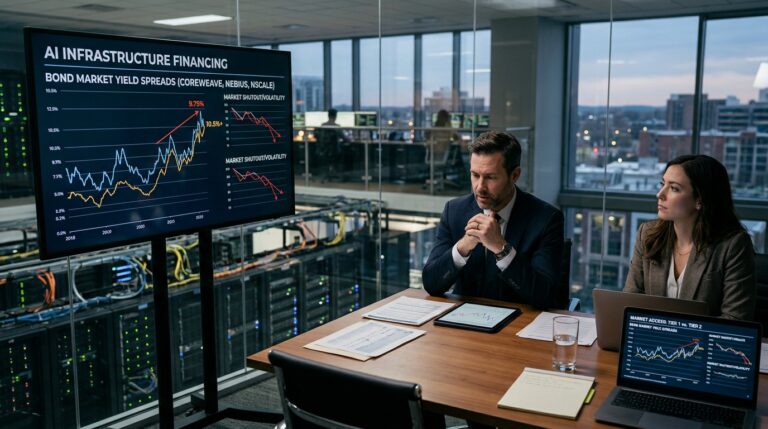
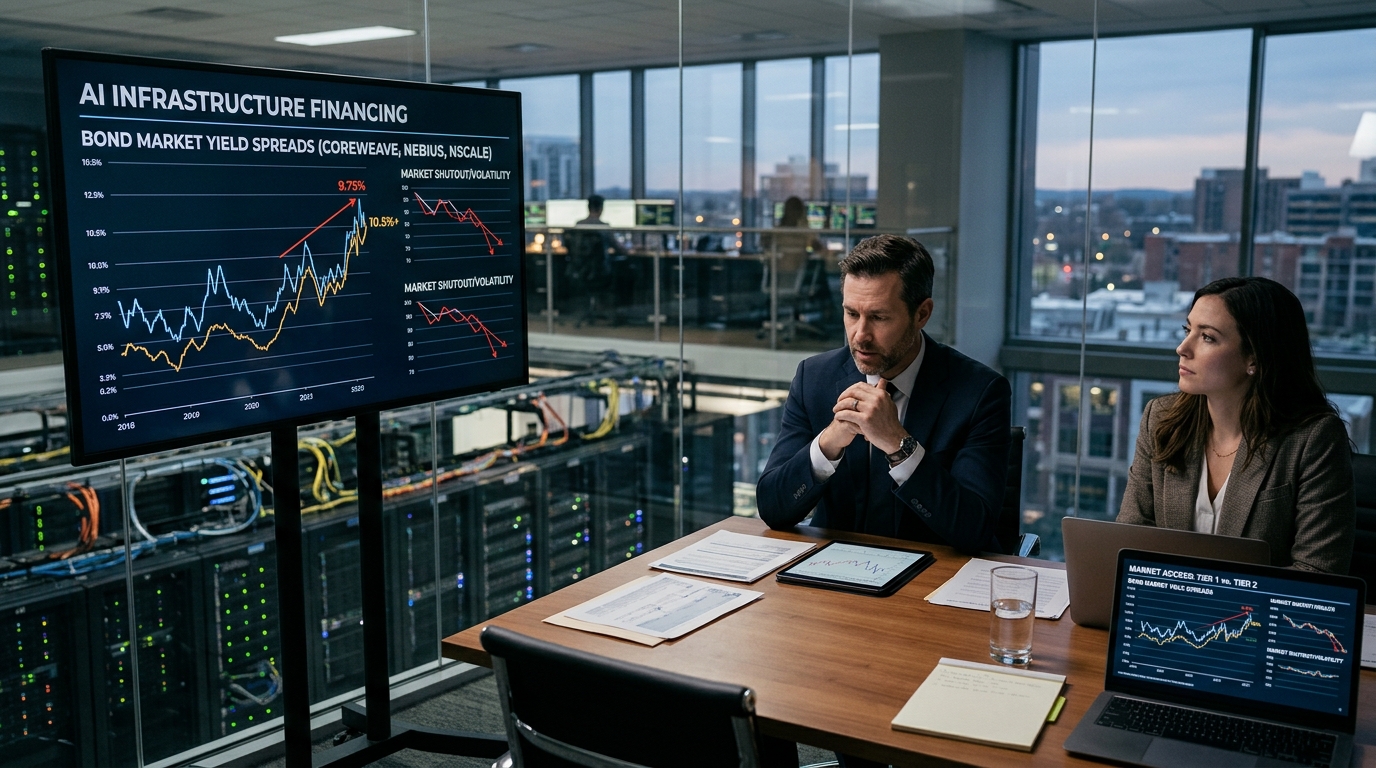
The Wall Street Journal reported this weekend that CoreWeave, Nebius, and Nscale have effectively been shut out of the bond market as lenders harden terms. Lenders and investors are demanding tougher conditions in a tightening that is becoming a new bottleneck for the AI buildout. The stress is visible in the prices: bonds CoreWeave issued earlier this year carried a 9.75% coupon, and recently traded at yields in the mid-teens in the secondary market, signaling a sharp rise in borrowing costs. Bankers have reminded clients in recent weeks that the high-yield debt market for new cloud vendors is essentially closed to new issuances at those levels.
The Bull Case: Brutal, Necessary, and Ultimately Healthy
The optimistic read is that this is a credit market doing exactly what credit markets are supposed to do: sorting operators by financial quality rather than enthusiasm. Neoclouds borrow heavily to buy expensive Nvidia chips and build data centers, then lease that capacity to model developers. If borrowing costs rise or customers cut spending, neoclouds will struggle to service their debt. Markets are simply pricing that risk honestly now.
The survivors will be the better businesses. Musk noted on X that lenders had largely stopped financing companies without substantial revenue streams outside AI data centers, pointing to SpaceX’s ability to secure $40 billion in GPU debt because of its investment-grade status and revenue from Starlink and rocket operations. That logic does not condemn the whole sector. It condemns the weakest parts of it.
Demand from the hyperscalers has not wavered. At Nvidia’s GTC event in Berlin on October 22, 2026, CEO Jensen Huang told CNBC that demand for neoclouds is “off the charts.” Oracle continues to sign long-duration compute contracts. If demand is real, the operators with defensible contract books and secured financing will consolidate market share as weaker rivals exit. Concentration, not collapse.
The Bear Case: The Model Was Always the Problem
The harder argument is that the funding withdrawal is not cyclical discipline but structural recognition that the GPU-leasing business was never as durable as its backers claimed. CoreWeave’s credit default swap spreads have spiked in recent weeks, alongside secondary-market yields in the mid-teens on its unsecured notes. That is distress pricing, not a speed bump.
The numbers behind the broader buildout are alarming. Gartner says more than $3.5 trillion in AI infrastructure spending could be exposed to impairment by the end of 2030 if providers continue at their current pace, with nearly $1 trillion expected to be spent on AI infrastructure in 2026 alone. To generate a 12% return on invested capital, Gartner estimates data center owners would need about $8.5 trillion in cumulative revenue through 2030. Gartner forecasts revenue of roughly $3.6 trillion at current growth rates, leaving a nearly $5 trillion gap.
The capital gap Gartner describes is already reshaping who gets to build. Large asset managers with balance-sheet depth are moving to displace pure-play neoclouds by owning the full stack from data center to chip lease.
Gartner expects 80% of neocloud providers to cease independent operations by 2030. Elon Musk’s prediction that more than 200 neocloud companies could collapse, with neoclouds facing “guppy-level death and consolidation,” is consistent with that forecast, not an outlier view. Neocloud stocks have already taken a hammering over the past month, with CoreWeave down about 35%, Nebius down about 30%, and Iren down roughly the mid-40% range. Equity markets are catching up slowly to what bond markets figured out weeks ago.
Where the Evidence Leads
The bull case requires believing that demand stays firm, contract durations hold, and secured facilities like Nebius’s $3.5 billion senior secured facility provided by Citi, earmarked for data center development and GPU procurement, bridge companies through the bond drought. That is possible. It is also a very tight sequence of assumptions.
The bear case requires only one of those links to break. The tighter credit market has shifted the standard: it is not only the business promised that counts, but whether it can be financed into existence. At mid-teens yields, the math on GPU leasing gets difficult fast.
Final Verdict
This looks less like healthy consolidation and more like a funding regime change. A few well-contracted, asset-backed operators will survive and may prosper as the field thins. But the bond market is not running a selective audition; it has largely closed the door. Investors holding CoreWeave or Nebius equity on the theory that demand solves the financing problem need to watch one thing above all: whether asset-backed lending remains open at serviceable rates, because the unsecured bond market is no longer an option. Medium confidence. The data leans bearish on the cohort; it is agnostic on the one or two names that emerge from it.