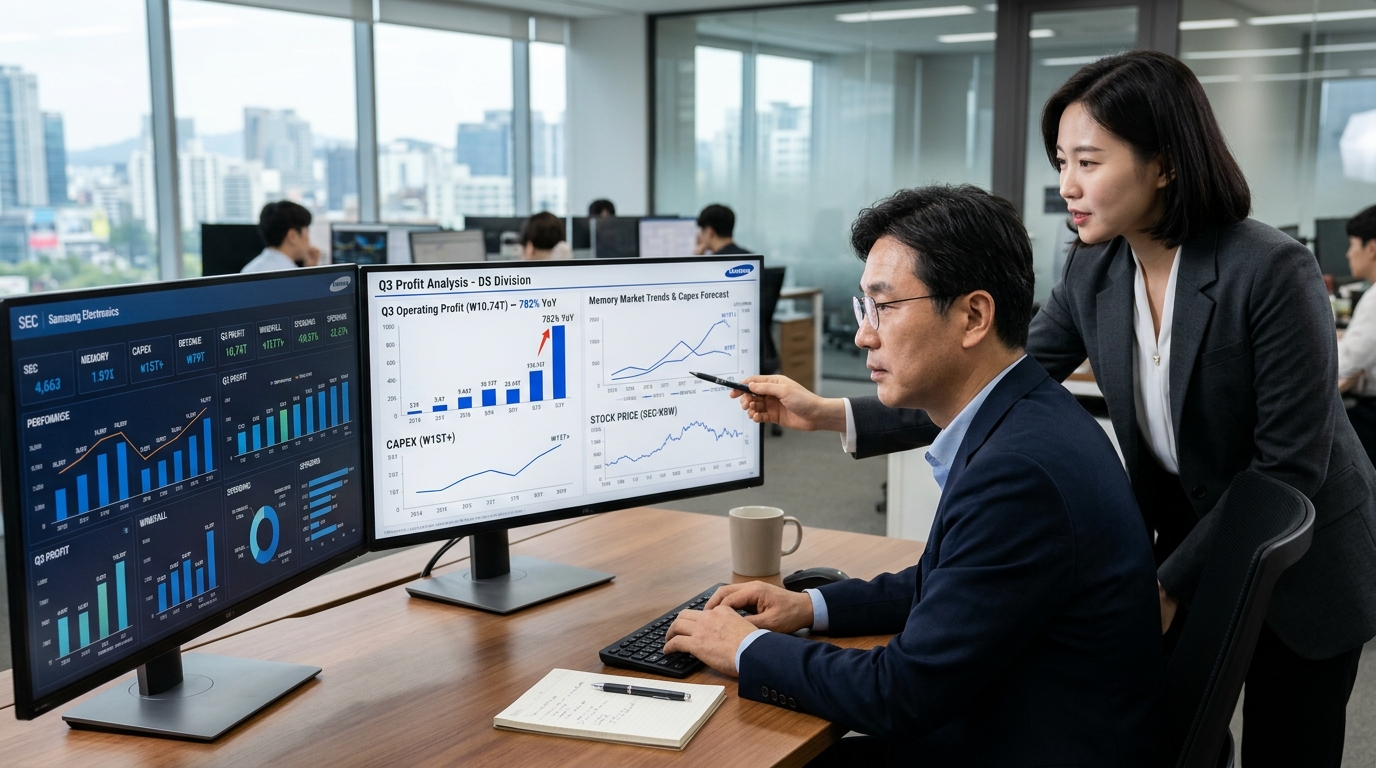
The number that arrives Thursday is not the debate. Samsung’s ₩107.4 trillion Q3 operating profit, a 782.5% jump year over year and the fourth consecutive quarterly record, was already confirmed on October 8. What investors get on the October 29 call is the detail that actually matters: how much came from memory, how much is being reinvested, and whether the capital spending figure buried in that release makes the bull case or quietly dismantles it.
The Bull Case
Soaring demand for AI infrastructure has outstripped memory chip supply growth, a gap expected by some industry forecasters to persist into 2027. The numbers behind that claim are striking. Conventional DRAM contract prices rose roughly 93% to 98% in Q1 2026, and while the pace has slowed, TrendForce still forecasts gains of 10% to 15% in Q4 2026.
In Q2, Samsung’s Device Solutions division generated essentially all of the company’s ₩89.4 trillion operating profit, and analyst estimates suggest HBM bit shipments rose about 50% from the prior quarter. August data and industry commentary have suggested Samsung’s HBM revenue growth could outpace SK hynix’s in Q3, with a possibility of taking a share lead. SK hynix reports the day before Samsung, on October 28, and if SK hynix’s results and guidance stay robust, it sets a constructive floor heading into the Samsung call.
Capex growth is unlikely to significantly affect bit output, because the emphasis is shifting from capacity expansion toward process technology upgrades, higher-layer stacking, and high-value products such as HBM. That is the bull’s core structural argument: money is being spent on margin improvement, not a supply flood.
The Bear Case
Here is the problem. Samsung has said it plans to invest more than ₩110 trillion in 2026 across capital expenditure and research and development. The magnitude of that commitment is exactly what prior memory cycles looked like at their peak.
TrendForce reported that Samsung invested about ₩25.6 trillion in its Device Solutions division in the first half of 2026, up 23.5% year on year. Analysts cited by Reuters have said Samsung’s mobile business posted a loss of more than $1 billion in the quarter, which would mean one of the world’s best-known phone makers is being subsidized by its memory lines. A company cross-subsidizing its consumer business with memory profits has every incentive to keep production high, not discipline supply. Markets have already flagged two overhangs: a stronger Korean won weakening overseas earnings, and concerns over a potential slowdown in AI-driven chip demand following reports of data center delays in the United States.
The cross-subsidy pressure Samsung faces is not unique to one balance sheet. Micron’s own revenue trajectory shows how completely AI-driven memory demand has restructured the economics of the entire three-player DRAM oligopoly.
The deceleration in price gains is also worth naming plainly. TrendForce expects conventional DRAM contract prices to rise 10% to 15% in Q4 2026, a gentler increase than the roughly 58% to 63% jump TrendForce estimated for Q2 2026. That is still positive, but the direction of the rate of change is downward. Samsung shares fell 2.42% on October 8 despite the record guidance, which tells you the market is already doing this math.
Where the Evidence Leads
The bull and bear cases are not actually arguing about whether memory is profitable right now. They agree it is. The argument is about what the capex in Thursday’s release signals. If Samsung breaks out spending that is concentrated on HBM yield and advanced packaging, the bull case holds: pricing stays firm, supply stays constrained, and the cycle is genuinely structural. If the release shows broad capacity additions at the Pyeongtaek campus, the historical pattern is clear enough.
Cleanroom capacity in the DRAM industry remains limited, and TrendForce has argued that additional capex is expected to have minimal impact on bit supply growth in 2026. That is the structural backstop bears need to explain away.
Capex allocation decisions at Samsung ripple outward to the equipment layer. Memory capital expenditure recovery is one of three simultaneous demand drivers now lifting Applied Materials, Lam Research, and KLA.
What Could Change the Debate
The memory industry faces growing concerns over technological advances by Chinese rivals, potential HBM specification changes, and the sustainability of AI capital spending. Any Thursday disclosure pointing to aggressive conventional DRAM wafer additions, or to margin compression in the DS division below analyst models, would sharpen the bear case considerably. Conversely, HBM revenue growth outpacing SK hynix and a capex mix tilted toward advanced packaging would validate the structural argument.
Final Verdict
The bull case is better supported today, but narrowly and conditionally. The supply constraint is real, price gains continue into Q4, and the capex allocation across the industry favors yield over volume. The risk is that Samsung’s own Thursday disclosure complicates that picture. At ₩107.4 trillion in quarterly profit, the temptation to accelerate spending is not theoretical. Watch the HBM versus conventional DRAM capex split. That number, more than the headline profit, will settle the cycle debate.