New to Trading Options? Try THIS
An Easy Options Strategy For Beginners:
Get the Strategy + the “Battle-Tested” ticker today – FREE

✓ How the 11-Hour Options Strategy works – explained in plain English, from A to Z…
✓ The three things you need to start trading options today.
✓ Why this single-focused window has so much more potential than grinding through charts all day (and lets you actively trade while still LIVING your life).
✓ See a simple 3-question filter you can use to help protect yourself before ever placing a trade.
✓ And the exact “rinse and repeat” ticker used nearly 900 times with a 95.3% win rate, just to get you started.
Send me my Free Copy of the 11-Hour Options For Beginners Guide – NOW
To your trading success,
Dave Aquino
Base Camp Trading
India Just Raised Rates for the First Time Since 2023. Is the Rupee Any Safer?
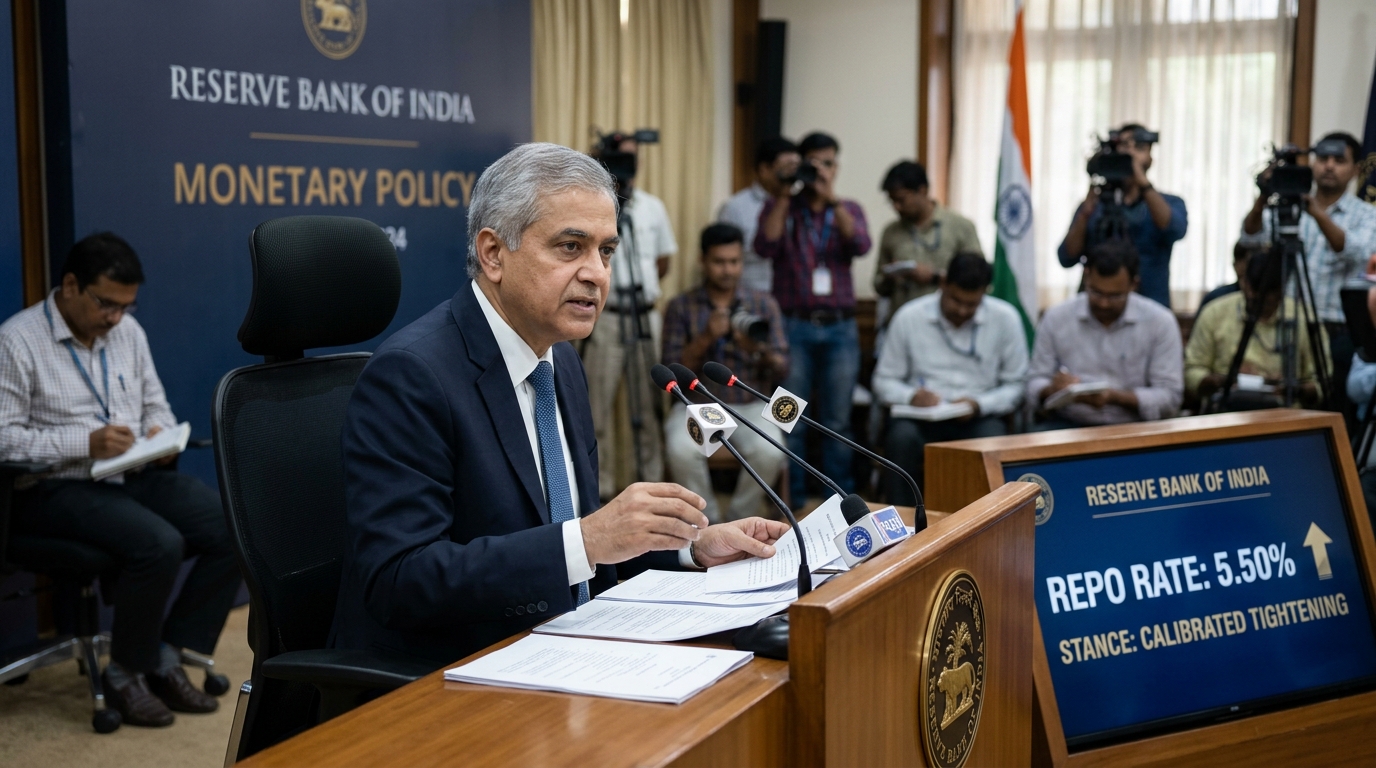
The Reserve Bank of India did what most of the market expected this morning: raised the repo rate 25 basis points to 5.50%, shifted its stance from neutral to calibrated tightening, and declared rate cuts off the table for the foreseeable future. Governor Sanjay Malhotra was unambiguous: the next policy action can only be a hike or a pause.
The hike did not hold the rupee. After an initially subdued market reaction, USD/INR pushed up toward the day’s highs around 96.72, a level that matched the session’s peak. That is the tension at the center of today’s debate.
The Bull Case: A Central Bank Acting From Strength
The optimistic read is straightforward. The RBI had lowered the repo rate by a cumulative 125 basis points in 2025, taking it from 6.50% to 5.25%, where it sat going into this meeting. A central bank willing to begin reversing that easing cycle is not panicking. It is managing.
The growth numbers support confidence. The economy expanded 7.8% in the April-to-June quarter, above the RBI’s own 7.0% projection for Q1 FY27. The new FY27 GDP forecast of 7.1% reflects genuine underlying momentum. Tightening into that kind of growth is not reckless; it is textbook. The RBI is acting before inflation becomes entrenched, not after.
Headline CPI inflation accelerated to 4.82% in August from 4.45% in July, moving above the central bank’s 4% target for a third consecutive month. Inflation moved from 3.93% in May to 4.82% in August, with food inflation rising from 4.78% to 5.95% over the same period. Hiking now, while inflation is still manageable, is the prudent move.
The Bear Case: A Hike That Cannot Fix the Actual Problem
The rupee’s behavior today is the bear case’s strongest exhibit. The hike was already substantially priced in, while foreign outflows, elevated crude prices, and firm dollar demand all remained in place, leaving the rupee little reason to hold an initial gain. A rate hike that the currency market shrugs off is a policy tool hitting diminishing returns.
The rupee remains near historically weak levels, and Brent crude has been trading above $100 a barrel, adding to inflation risks. Much of that inflation is supply-driven, from crude oil and a monsoon deficit. Analysts often note that rate hikes have limited impact on such pressures. Higher interest rates also risk choking overall economic growth and increasing the government’s fiscal deficit by raising debt-servicing costs. That is a genuine dilemma: tighten enough to matter, and the 7.1% growth forecast starts to look optimistic.
The voting record at today’s MPC also signals internal uncertainty. All six committee members backed the hike, but the stance change passed only 4-2, showing less agreement over how firmly the RBI should commit to further tightening.
Where the Evidence Leads
Analysts distinguish between the purpose of today’s rate increase and any currency defense. As one forecast noted: “We do not think RBI is raising rates to support the INR, but rather to offset the weak currency’s upward pressure on inflation.” That framing matters. If the hike is about second-round inflation effects rather than rupee support, the currency’s muted response is not a failure; it was never the target.
The relatively measured equity market reaction suggested that a 25-basis-point increase had already been largely factored into stock prices. Earlier in the session, benchmarks were down in morning trade and rate-sensitive pockets saw pressure, with autos and realty among the laggards. Those sector moves are telling. The market is not pricing a recession; it is adjusting to the cost of credit.
What Could Change the Debate
Two variables dominate. First, crude oil: if Brent retreats from $100-plus, the RBI’s FY27 CPI forecast of 5.2% could prove too pessimistic, removing the case for a December follow-up hike. Second, the rupee: a sustained move above 97 on USD/INR would force the RBI’s hand more aggressively than inflation alone.
Verdict
The bull case holds more weight today. The RBI is tightening from a position of genuine economic strength, with 7.8% quarterly growth providing cover for a policy reversal that would have been far harder in a slowing economy. The rupee’s weakness is a real concern, but it is better addressed by the RBI’s roughly $786 billion reserve buffer and intervention toolkit than by rate moves alone. Watch the December meeting: if inflation stays below 5.2% and crude eases, this may prove to be a one-and-done cycle rather than the start of a sustained squeeze.