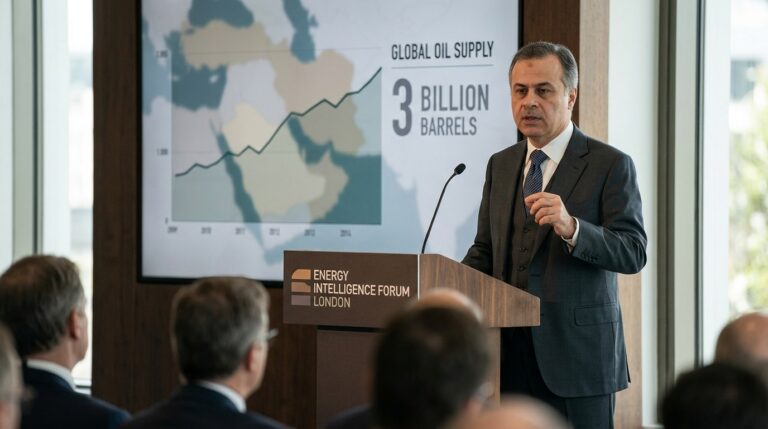
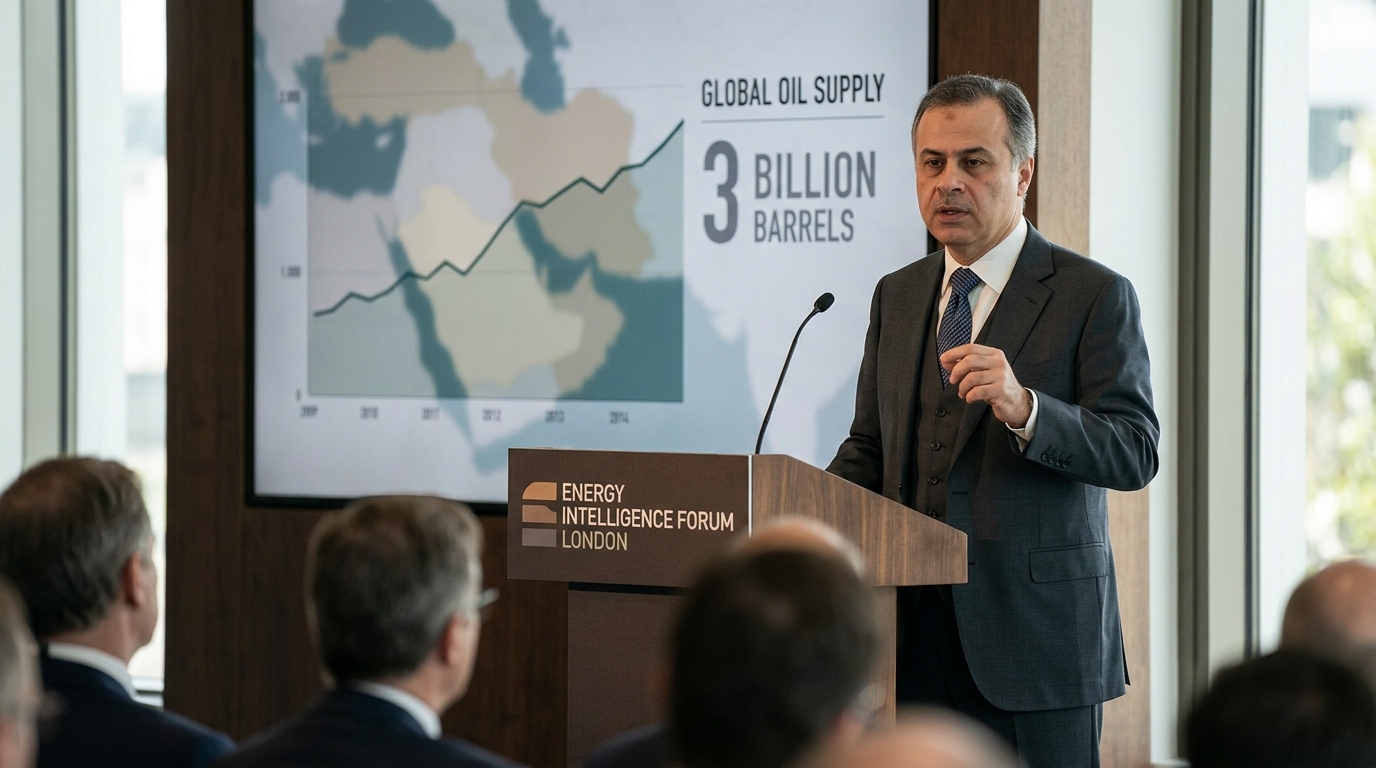
Brent crude is trading around $100.40 this morning, roughly 54% above where it sat a year ago. Into that market, Saudi Aramco CEO Amin Nasser stepped Monday at the Energy Intelligence Forum in London with a number designed to concentrate minds: nearly 3 billion barrels of gross oil supply have been lost since the Iran war began, equivalent to roughly half of what would normally have moved through the Strait of Hormuz over that period.
The EIA publishes its October Short-Term Energy Outlook today. That report, scheduled since September 9, will give investors an independent read on inventory levels at a moment when one side of this debate is being made by the world’s largest producer.
The Bull Case
Nasser’s numbers are striking even before you reach the headline figure. Global commercial oil inventories stood at roughly 10 billion barrels entering the crisis, he said, and more than 1 billion barrels have since been drawn down to offset supply losses. That leaves fewer than 6 billion barrels in commercial stocks worldwide, and Nasser said less than 10% of that total is practically accessible, because the majority represents minimum volumes needed to keep pipelines and ports operational.
The on-the-ground data supports the alarm. UKMTO logged five separate Hormuz incidents Monday, including four tanker attacks. Brent’s year-over-year gain of 54% did not arrive from a vacuum: the EIA’s own September outlook estimated global inventories had fallen by 400 million barrels in 2026 alone, and forecast continued draws through year-end. Saudi Arabia’s East-West pipeline was halted again Monday after a fresh attack, according to a report carried by AFP. Nasser’s warning that rebuilding depleted inventories could take up to two years even after Hormuz fully reopens is not a forecast built on optimistic assumptions.
For energy equities, the supply argument favors producers with Western Hemisphere exposure, Exxon Mobil, Chevron, and Occidental among them, and refiners like Valero that benefit from margin expansion when product stocks are thin.
The Bear Case
The source matters. Amin Nasser runs the company that profits most directly from elevated prices, and he was speaking to a room full of industry peers at a conference designed for exactly this kind of signaling. Aramco also cut its November official selling price for Arab Light to Asian buyers by $5 a barrel below the regional benchmark, a far steeper discount than the $2 offered for October loads. That pricing move suggests Riyadh sees demand softening and supply recovering, which sits awkwardly alongside a simultaneous warning of catastrophic scarcity.
Trump said last week the war would end “very soon, probably right after the midterms,” and his counterterrorism chief described the standoff with Iran as “imminently” resolved. The G7 has already announced a plan to release 100 million barrels from emergency reserves. The EIA’s September outlook forecast Brent averaging around $90 a barrel in the second half of 2026, well below current levels, partly because demand has fallen by an estimated 1.2 million barrels per day globally as high prices and Hormuz disruptions suppress consumption. A ceasefire, even an imperfect one, could flood the market with deferred supply before inventories have been rebuilt.
Where the Evidence Leads
The structural inventory story is real. The EIA’s own September data, before today’s update, already confirmed the draw-down trajectory Nasser described. The repeat attacks on Saudi infrastructure, including Monday’s reported halt on the East-West line, confirm the supply risk is not theoretical.
What is speculative is the duration. Nasser’s two-year rebuild timeline assumes no meaningful ceasefire and full, uninterrupted demand recovery. Trump’s midterm-linked optimism has no operational specifics behind it, but a single credible peace signal has historically been enough to move crude $10 to $15 a barrel within days.
Final Verdict
The bull case on oil inventories is better supported by current data than the bear case. The EIA’s September numbers, the persistent shipping incidents, and the repeated attacks on Saudi Arabia’s export infrastructure all point to a supply situation that is genuinely strained. Today’s October STEO is the most important data release of the week: if the EIA raises its inventory-draw estimate and revises its Brent forecast above September’s $90 projection, the bears lose their most credible institutional counterargument. Watch the report closely. Confidence: moderate-to-high on the supply squeeze, low on price trajectory beyond 60 days given the ceasefire wildcard.