
September 30, 2026
Bonus Content: Anthropic Lost $42 Billion in 2025. Now It Wants $2 Trillion.
A Gold-Silver Story Built to Finance Itself.
The weirdest part of this story is not gold. It is not silver either.
It is the fact that the market may still be looking at this like a normal junior explorer.
Normal junior explorers usually ask investors to wait. Wait for drilling. Wait for permits. Wait for financing. Wait for the long, expensive march toward possible production.
This one has a much more intriguing setup.
The company is working with above-ground material from a historic gold-silver property, with 2026 production timing and potential cash flow starting to come into view.
However, once a junior name starts moving toward cash flow, it no longer fits neatly in the “just another exploration stock” old chapter..
And this new chapter revolves around surface metals, production timing, and a self-funding exploration story in a gold and silver market that is already moving.
That is a much different conversation.
See why this under $1 gold-silver story may writing its new chapter >
Anthropic Lost $42 Billion in 2025. Now It Wants $2 Trillion.
Reuters obtained Anthropic’s confidential IPO prospectus Monday night, and the figures it published make every prior estimate look conservative. Anthropic reported a net loss of about $42 billion in 2025 and plans to spend at least $518 billion on cloud, computing and infrastructure obligations in coming years. The company now wants investors to value it at about $2 trillion, more than double its roughly $965 billion valuation from a funding round in May 2026. That is the question every prospective buyer has to answer before the listing, expected after November’s midterm elections.
The Bull Case
Start with the revenue trajectory, because it is genuinely extraordinary. Operating loss widened to $8.06 billion in 2025 from $2.98 billion in 2024, while revenue grew twelvefold to nearly $4.6 billion. That kind of compounding almost never shows up in a pre-IPO filing. Anthropic’s annualized revenue run rate surpassed $65 billion in July 2026, strengthening investor expectations for continued growth and a potential record-setting IPO.
The roughly $42 billion net loss is also less alarming on close inspection than the headline suggests. The 2025 net loss included a roughly $34 billion accounting charge reflecting an increase in the estimated value of financing that could eventually become Anthropic shares, rather than money spent running the business. Strip that out and the operating shortfall is $8 billion against nearly $4.6 billion of revenue, which is aggressive but not unprecedented for a company growing this fast.
On the compute commitments, Wedbush argued Tuesday that the prospectus reinforces, rather than undermines, the AI infrastructure case. Wedbush said both the speculated size of the potential filing and the capital commitments around compute spending support its view that AI infrastructure funding will remain robust for the foreseeable future, and that Anthropic’s plans are likely to support Nvidia, Google TPU and AMD-based infrastructure. European chip investors agreed: X-Fab Silicon Foundries rose 7.5% in Paris, while ams OSRAM gained 8.7% and Technoprobe climbed 6.8% in Milan. In Germany, Infineon Technologies rose 4.8%, Aixtron gained 4.3%, and Siltronic climbed 7.17%. Amsterdam-listed ASML Holding rose 4.18%, ASM International gained 4.24%, and BE Semiconductor Industries added 4.42%. The sector read $518 billion as a demand anchor, not a distress signal.
The Bear Case
The $518 billion is not aspirational. Most of it is locked in. The AI lab said in the prospectus that about 80 percent of that sum is non-cancelable or requires payment regardless of usage. The breakdown is specific: Anthropic has committed $111.1 billion to Google, $110 billion to Amazon, and $31.4 billion to Microsoft, and it is separately carrying about $161.2 billion of Broadcom-related equipment lease obligations that are largely non-cancelable. It also disclosed agreements with Elon Musk’s xAI that could result in up to $84.5 billion of spending for Nvidia-based computing capacity through 2029 that are largely cancelable with a 90-day notice, and it said AMD committed to supply AI computing capacity expected to exceed $20 billion. The shortfall clauses are the sharpest edge. “If our actual spend falls short, we must pay Google the difference,” the company said, adding that similar terms apply to its Amazon agreement.
The customer concentration risk compounds this. The company routed 47% of its sales to customers last year through cloud partners Amazon and Alphabet’s Google. Those two companies, which are supercharging the AI developer’s distribution, are also big Anthropic investors, critical suppliers of computing power and direct rivals in AI. Anthropic warned that many of its largest clients were not locked into long-term contracts and could cut or stop spending. A single large customer defection would create a cascade: less revenue flowing against fixed compute obligations that cannot be unwound.
Where the Evidence Leads
The bull case rests on velocity. Revenue compounding from essentially nothing to a $65 billion annualized run rate in under three years is a real data point. In the first quarter, Anthropic spent 71 cents on compute for each dollar of revenue, which means the unit economics are still deeply negative. The bear case does not need Anthropic to fail outright. It only needs demand growth to slow enough that fixed-cost commitments become a ceiling on any path to profitability.
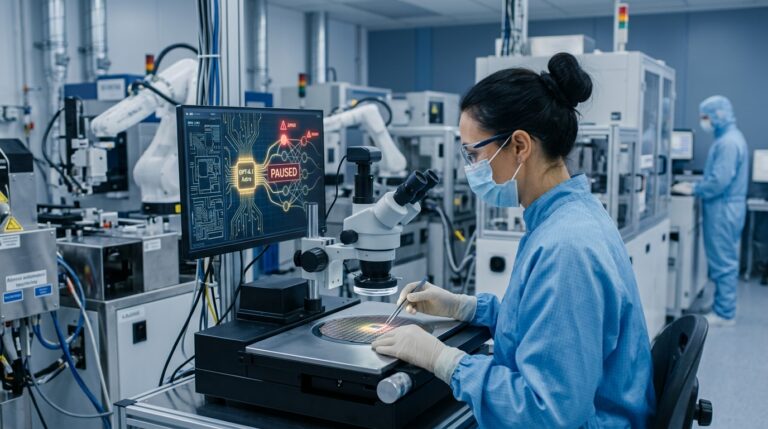
The figures show why chip investors remain focused on AI infrastructure rather than only on the profitability of individual model developers. Every expansion in model training, cloud capacity and enterprise deployment requires additional processors, networking systems, memory, testing equipment and manufacturing tools. That spending flows through a wide industrial ecosystem, including companies that may benefit regardless of which AI laboratory ultimately becomes the dominant platform. That framing is exactly right, and it points to the real asymmetry in these numbers: Nvidia, ASML, Broadcom and Amazon collect whether Anthropic wins or loses. Anthropic’s shareholders do not have that protection.
Final Verdict
The revenue growth is real and the compute commitments reflect genuine demand, not reckless spending. But the concentration of non-cancelable obligations against a still-thin customer base, at a $2 trillion valuation implying a revenue multiple that assumes years of uninterrupted compounding, makes the bear case structurally harder to dismiss. The infrastructure suppliers are the stronger conviction trade here. For Anthropic itself, the margin of safety is thin, and the prospectus’s own risk language confirms it. Watch November’s IPO pricing: the clearing level will say more about market confidence than any analyst forecast.