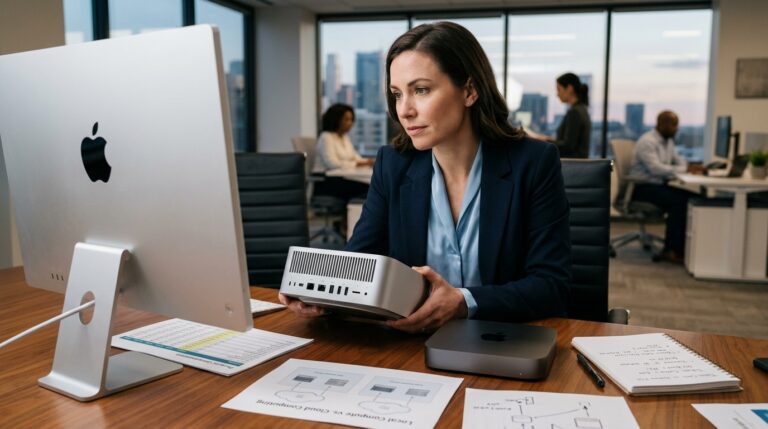

Apple’s upgraded Mac minis and Mac Studios began shipping Tuesday, September 22, 2026, and the company’s argument to corporate procurement teams is blunter than anything it has tried before: buy the box once, stop paying every month.
By running models locally, businesses can bypass cloud AI providers and avoid paying for tokens, the fundamental unit many AI services bill on. That is not a modest claim. It is a direct challenge to the billing model that has defined enterprise AI spending for the last three years.
The Hardware Behind the Pitch
Apple introduced the M6, its first 2-nanometer chip, inside a redesigned Mac mini, and paired it with the M5 Ultra, a four-die chip that tops out at an 80-core GPU and 512GB of unified memory inside the new Mac Studio. The M5 Ultra’s 1.2TB/s memory bandwidth is the key figure for large-model token generation.
At its WWDC 2026 presentation, Apple showed four Mac Studios strung together to run a frontier open-weight model with a trillion parameters. That cluster demonstration is doing real work: it shows developers a path to frontier-scale inference without a data center contract.
When Apple rolled out its first Apple Silicon chips in 2020, it combined computing and memory into a unified architecture, originally for battery life. That close connection between computing and memory had the side effect of making Macs good at AI. The enterprise pitch now running is, in a sense, a six-year accident finally monetized.
The Math That Actually Matters
The cost comparison cuts two ways, and traders should know both sides. The bull case comes from Asymco’s analysis: agentic coding using an 80B parameter model running 12 hours a day consumes 300 million tokens a month, costing between $900 and $1,500 per user monthly. The alternative is a Mac Studio M5 Ultra at $11,219. The payback period is 7 to 12 months, saving $11,000 to $18,000 every year afterward.
The bear case is real too. For lighter usage, a pricing breakdown shows the payback stretching into years, not months. A developer running moderate workloads against today’s cheap hosted inference may not break even before the machine needs replacing. The unit economics depend almost entirely on usage intensity, and Apple’s pitch is strongest for the heaviest users.
The Competitive Gap Apple Has to Close
Apple holds a small share of the enterprise desktop market versus Microsoft’s dominant position, but its unified memory architecture has made Macs unexpectedly well-suited for AI inference. That starting position matters. Winning even a few percentage points of the enterprise AI hardware budget from cloud spending would represent billions in shifted revenue.
Microsoft is aiming at the same buyers with on-device AI and plans to merge many of its AI features into a single super app for Windows, CEO Satya Nadella has said. Nvidia’s Jensen Huang has downplayed any intention to compete directly with Apple, saying Nvidia is focused on Windows PCs. Nvidia’s stronghold remains the data center, which means these two stories are not fully colliding yet.
What Traders Should Watch
Mac revenue grew 29% year over year, reaching $10.4 billion, during Apple’s fiscal third quarter of 2026. Reports have pointed to Disney using Mac for on-device AI workflows that reduce cloud token costs, and French retail bank Credit Agricole using on-device AI to streamline regulatory workflows. Those are named enterprise customers, not marketing slides.
The session-level question is whether Apple’s shipping day generates any revision to Mac revenue estimates heading into the October earnings cycle. Reports also point to an M8 Ultra project that would mark Apple’s first return to commercial server hardware since discontinuing the Xserve in 2011, with plans to sell servers directly to AI developers, corporations, and governments. That is the longer-term catalyst the market has not fully priced.