Dear Reader,
Former Wall Street Journal reporter Jeff Opdyke has spent decades tracking global wealth shifts.
And right now, he believes most people are looking in the wrong place when it comes to AI.
They think the opportunity is in AI stocks.
He strongly disagrees.
In fact, Jeff says the biggest retirement opportunity tied to AI may have nothing to do with tech stocks at all.
Instead, he believes it’s happening somewhere much less obvious…
In a part of the system that becomes more valuable the bigger AI gets.
That may sound surprising.
But it’s the same kind of thinking Jeff used years ago when he identified America’s natural gas boom long before it became obvious – including pointing readers toward Cheniere Energy when it was trading around $5 a share in 2011.
Today, it trades above $250.
Now he believes another major shift is forming.
And this time, he says everyday Americans may be able to position themselves starting with less than $150.
He calls it The Surprising AI Retirement Strategy.
You can see his full presentation here.
It’s one of the more interesting retirement ideas we’ve seen in a long time.
Sincerely,
Ben Murnane
Producer, The Surprising AI Retirement Strategy
Verizon Rents Fiber to the Giants Cutting It Out
There is a structural contradiction inside Verizon’s 2026 investment story, and it deserves more attention than the market has given it.
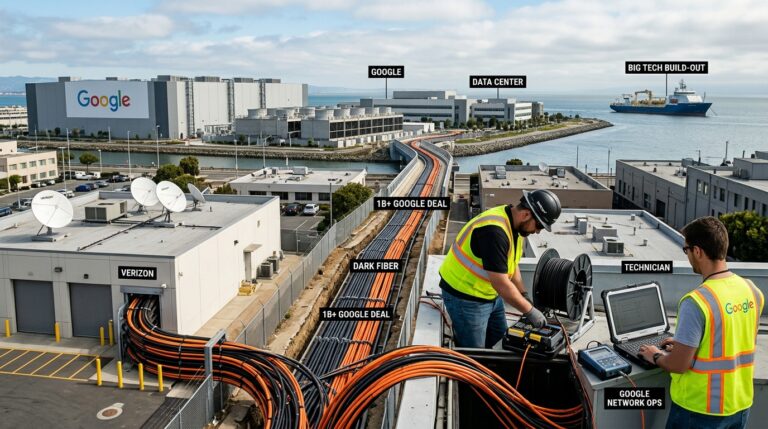
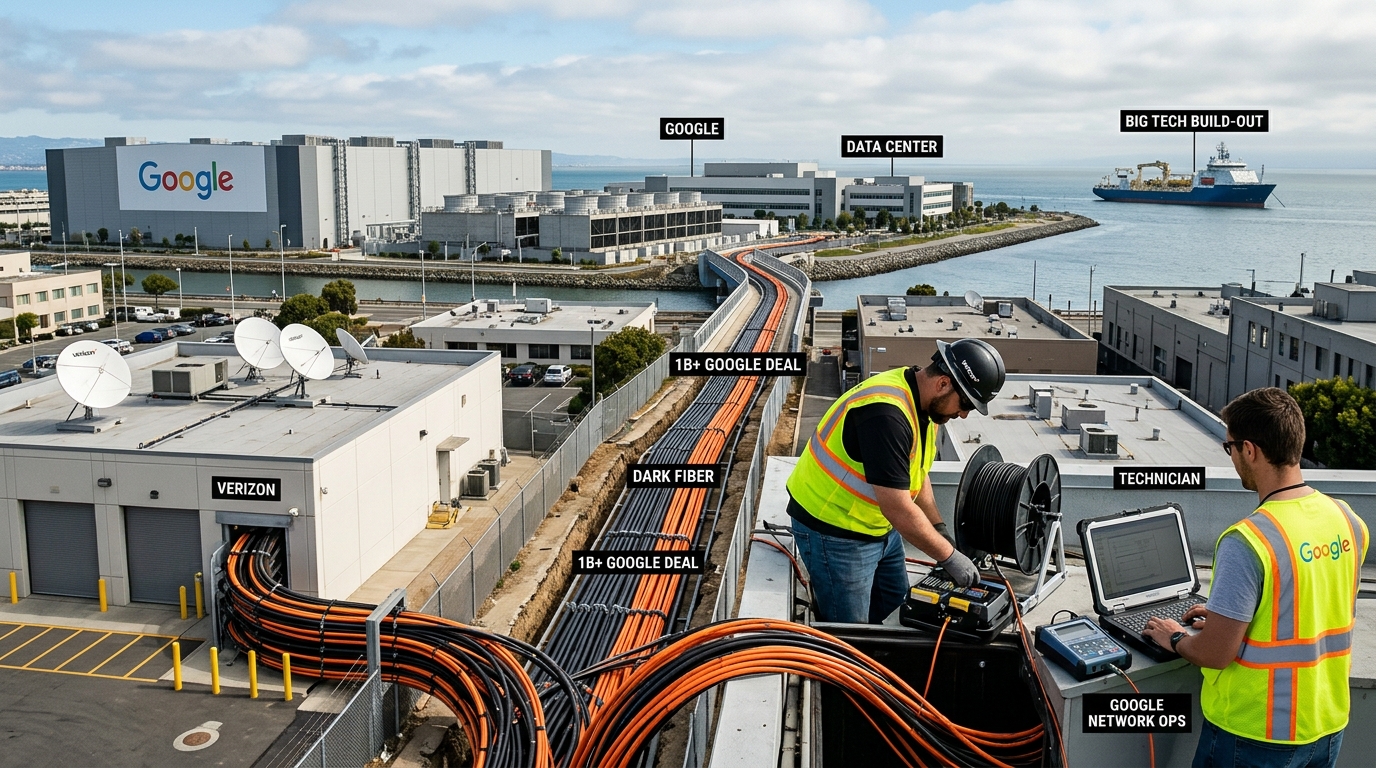
On July 24, CEO Dan Schulman disclosed a dark fiber agreement with Google worth more than $1 billion, under which Verizon supplies the physical glass connecting Google’s data centers while Google operates it with its own equipment. Schulman called it the start of a multi-billion-dollar pipeline, signaling additional deals with other hyperscalers before year-end. VZ shares jumped 4.5% that day, and the company raised its 2026 adjusted EPS guidance to $4.99 to $5.04, with free cash flow growth now expected at 9% to 10%.
The bull case writes itself from that single data point. Verizon’s decades-old fiber network, long treated as a depreciating asset on a balance sheet burdened by the $20 billion Frontier acquisition, is suddenly being valued as scarce AI infrastructure. Verizon now includes Frontier from a January 20, 2026 close, has locked in more than 80 million miles of Corning fiber supply from 2027 through 2032, and signed a joint venture with BT that the companies say will represent approximately $4 billion in combined annual revenue serving customers across more than 180 countries. The convergence thesis, fiber plus wireless plus AI, is no longer theoretical.
The Bear Case Lives in the Ocean
Here is what that reading skips: the same companies paying Verizon to light its terrestrial fiber are systematically cutting traditional telecoms out of the intercontinental layer.
According to TeleGeography, content providers already accounted for 71% of used international capacity in 2022, and hyperscalers are participating in the majority of planned new cable builds. Google holds ownership stakes in many subsea cable systems, and Meta is building Project Waterworth, a multi-year, multi-billion-dollar system the company has described as spanning more than 50,000 km. In September 2026, AWS announced Fastnet, its first wholly-owned transatlantic cable, with a design capacity exceeding 320 terabits per second, due to come online in 2029.
New subsea cable investment from 2026 to 2029 is projected to exceed $16 billion, per TeleGeography. Hyperscalers are driving most of it. They are not inviting legacy carriers as co-investors. They are inviting them as landing partners, a subordinate role that generates no equity and no capacity ownership.
That subordinate role matters more when you understand the scale of what hyperscalers are deploying. AWS raised its full-year capital expenditure outlook to roughly $220 billion while simultaneously expanding operating margins — a combination that signals infrastructure spending is accelerating, not plateauing.
Verizon’s international posture reflects the bind. The BT joint venture, while strategically tidy, amounts to combining two underperforming international businesses. BT has pointed to consensus estimates for BT International of £108 million in adjusted EBITDA on £1.821 billion in adjusted revenue, a margin that explains why both companies wanted to share the pain.
Where the Evidence Points
The terrestrial dark fiber opportunity is real and the Google deal is not a one-off. Alphabet raised its 2026 capital expenditure guidance to between $195 billion and $205 billion, and AI data center interconnection is where much of it lands. Verizon is credibly positioned to capture a share of that spend domestically, and the capital efficiency is compelling: dark fiber requires almost no incremental Verizon capex against a $16 to $16.5 billion annual base already committed.
That capex wave does not stop at fiber. The physical infrastructure layer beneath AI data centers — power, cooling, and the supply chains behind them — is where the buildout gets concrete.
The risk is longer-cycle. Hyperscalers are building the next generation of the global internet themselves, bypassing the consortium model that kept telcos relevant for three decades. Verizon’s edge is fiber that hyperscalers need now. Whether it persists as private cable ownership concentrates in four Silicon Valley balance sheets is the question the market is not pricing with any precision.
Watch two things: whether Schulman announces a second anchor deal, ideally with AWS or Microsoft, before year-end, and whether the FCC’s new submarine cable rules, adopted June 25, 2026 and with key parts effective September 25, 2026, create any friction that redirects hyperscaler cable routes back through traditional carrier partnerships. Either development would materially shift the balance of this debate.