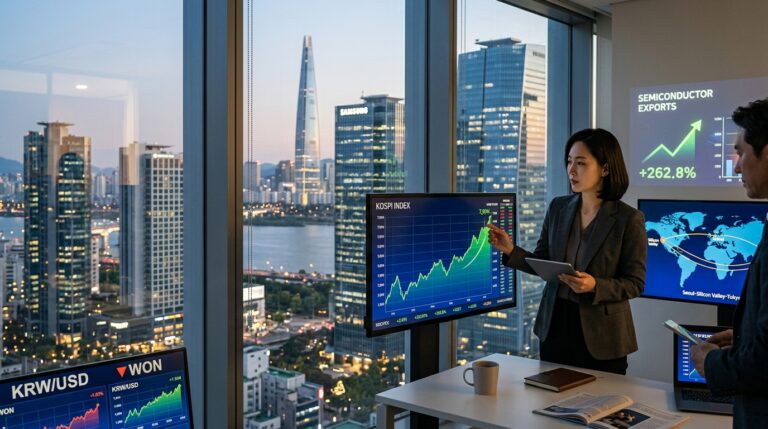
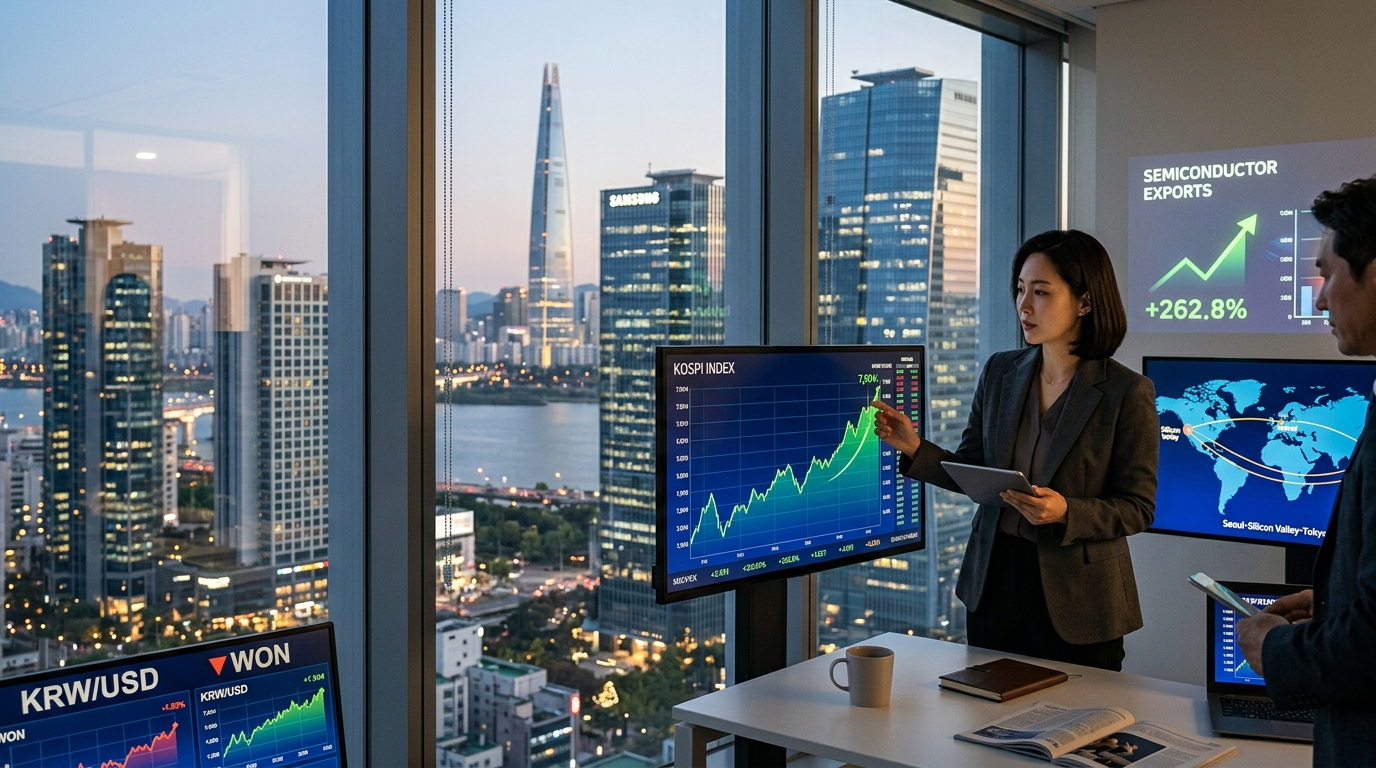
South Korea’s Kospi closed October 2 at about 7,004, up nearly 94% over the past twelve months. That is not a rounding error in a frontier market. It is a near-doubling in a fully developed, liquid index, and the overwhelming majority of American retail portfolios have zero exposure to it.
The catalyst is not subtle. South Korea’s semiconductor exports rose 262.8% from a year earlier to $60.3 billion in September, topping $60 billion for the first time. Chip exports more than tripled to $34.12 billion in the first twenty days of the month alone, a 259.4% increase that set a record for the September 1 to 20 period. When one industry accounts for nearly half a country’s exports and those exports triple in a year, the index that houses the two dominant players in that industry tends to notice.
The Memory Cycle, Unfiltered
South Korea dominates the AI-driven memory boom. SK Hynix, Nvidia’s key HBM supplier, and Samsung, a leader in DRAM and enterprise SSD storage, are both riding the AI infrastructure wave. Micron’s fiscal fourth-quarter results, released September 30, confirmed the cycle has further to run. Management said more than 75% of its 2027 output is already committed and that most customer discussions are now focused on 2028, with supply-demand conditions expected to be tighter in the next two years than in 2026. That guidance hit Korean markets the following morning like a catalyst. The Kospi climbed nearly 2% to close within reach of the 7,000 mark on October 1, lifted by record semiconductor exports and strong results from Micron.
Samsung Electronics gained 2.79% and SK Hynix 3.21% on that session. The Kospi reclaimed 7,000 in the days that followed. This is the memory cycle with nothing else in the frame.
How an American Gets There, and What the Won Does to Returns
The most direct U.S.-listed vehicle is EWY, the iShares MSCI South Korea ETF. Its top holdings are Samsung Electronics at 23.50% and SK Hynix at 22.66%, giving the two memory giants a combined weight of roughly 46% of the fund. EWY carries a 0.59% expense ratio and holds 83 positions in total. Depending on the measurement window and pricing source, its one-year total return has been roughly in the mid-130% range including dividends, outpacing the Kospi’s local-currency gain because the won strengthened alongside equities.
That currency dimension cuts both ways. The USD/KRW exchange rate was about 1,343.84 on October 2, meaning the won has strengthened by roughly 7% against the dollar year to date, using that October 2 level versus early-January levels. Currency tailwinds amplified EWY’s returns in dollar terms this cycle. The same mechanism runs in reverse if the won weakens, and it has been volatile: the USD/KRW rate swung between roughly 1,427.93 and 1,559.36 in 2026 alone. A 9% band in a single year is meaningful when the local index is already priced for a favorable outcome.
The Case for Patience, Not Chasing
The structural case for Korean memory is genuinely compelling. Micron anticipates that HBM shipments will outpace traditional DRAM through 2028, driven by surging demand from AI accelerators and data centers, and SK Hynix sits at the center of that supply chain. The Kospi’s rise has also been driven by South Korea’s Corporate Value-Up program, aimed at reducing the historical Korea Discount through tougher rules and disclosures around treasury shares and shareholder returns, including a shift toward mandatory treasury-share retirement under revisions to the Commercial Act that took effect in 2026. These are durable structural shifts, not temporary momentum.
But a 94% move in twelve months in a major index deserves a clear-eyed reading. Momentum at this scale tends to pull in buyers who are pricing continuation, not fair value. Analysts have noted that some profit-taking is emerging ahead of U.S. employment data and domestic holidays, with upward momentum expected to be limited near term. Foreign investors have been net sellers at multiple points during this rally even as the index pushed higher, a divergence worth watching.
Where This Fits in a Long-Term Portfolio
For a long-term investor, EWY offers real exposure to a structural technology cycle at a price-to-earnings ratio of roughly 13, modest by any global comparison for a market growing this fast. A position sized at 3% to 5% of a diversified portfolio captures the memory supercycle without making your wealth dependent on a single country’s chip export cycle.
The wealth-building lesson here is one that applies to every parabolic market: the quality of the underlying trend and the wisdom of buying after a near-doubling are separate questions. Korea’s memory industry is the real thing. Whether the Kospi at 7,000 is the right entry point is a different conversation entirely.