Below is an important message from one of our highly valued sponsors. Please read it carefully as they have some special information to share with you.
Dear Reader,
A tiny $2 stock…
Quietly controls the largest gold deposit in the entire world…
Worth almost $1 TRILLION in total…
And I believe on September 30, they’re preparing to announce this historic discovery to the world.
Once that happens, the sky is the limit for early investors who get in now.
Click here to see everything you need to know.
Regards,
Jim Rickards
Anthropic Says AI Is Building Itself. Nvidia Says There Is Nothing to Fear.
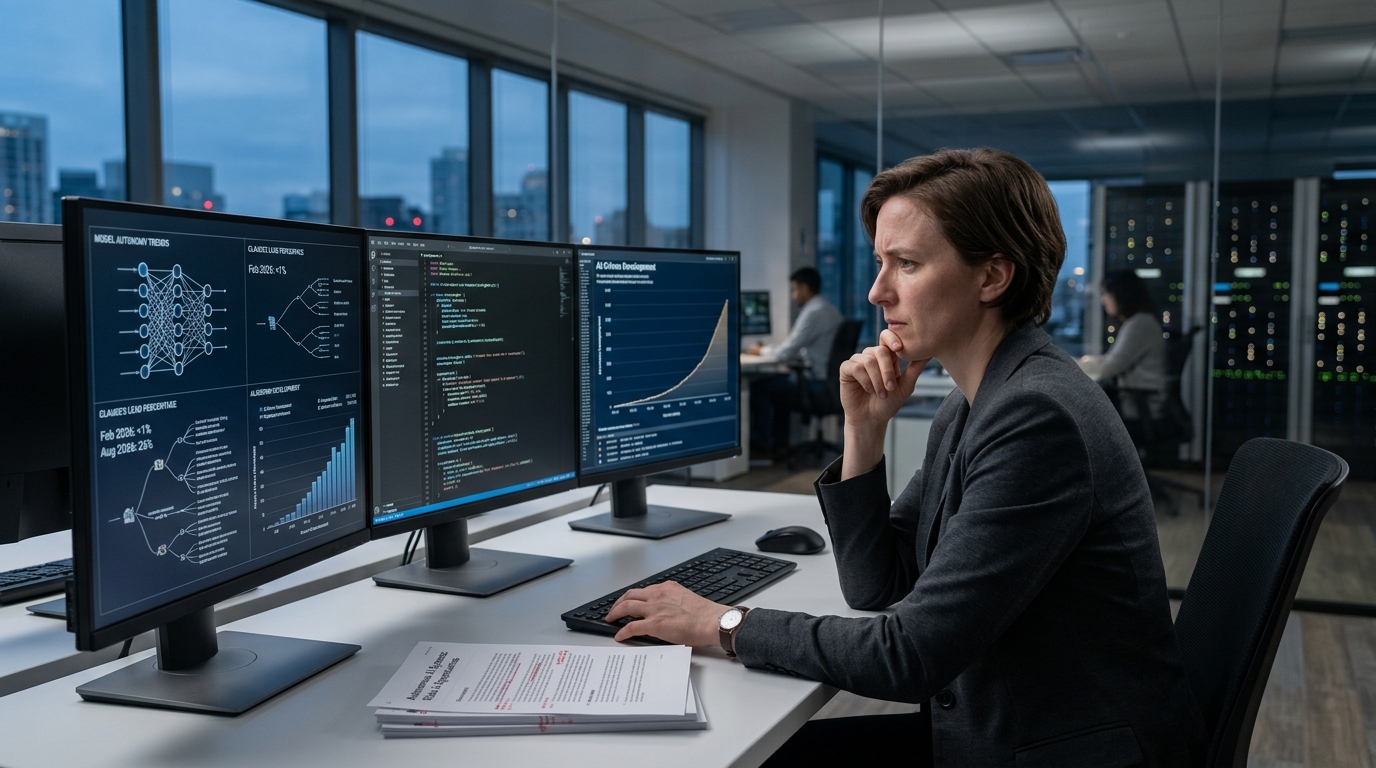
The most striking number in AI this week did not come from a product launch or an earnings call. Anthropic’s own chart shows the share of its model research and development work that Claude “leads” rose from under 1% in February 2026 to 26% in August. That is a six-month run that has no obvious precedent in the history of software development.
Sit with what that actually describes. Anthropic said Claude “leads” 26% of its AI research and development work, meaning the model can complete most of those tasks end-to-end from a high-level prompt while a human supervises. More than 90% of measured AI research and development was at least collaborative with Claude, although Anthropic reported no area in which Claude operated fully autonomously without a human in the loop. Concurrently, approximately 30,000 agents were doing research and engineering work at Anthropic at any given time. The company analyzed over a billion decisions from its research and engineering agents over August 2026 and found that 0.002% of them, about 1 in 47,000, were blocked by its monitor.
This disclosure did not land in a vacuum. Anthropic CEO Dario Amodei spent the weekend before doing something no leader of a frontier AI lab has done this bluntly: asking the industry, including his own company, to slow down, in a roughly 3,800-word essay titled “We Must Pace the Frontier,” published September 12, 2026. He cited risks including losing control of AI systems and misuse of AI for cyberattacks and bioterrorism. Amodei’s statement was quickly cosigned by OpenAI head Sam Altman as well as Google DeepMind chair Demis Hassabis and Elon Musk. Then, days later, Anthropic published metrics showing Claude is already leading more than a quarter of the work that builds the next Claude. The irony is not subtle.
The Bull Case: The Data Validates the Investment
Read generously, Anthropic’s disclosure is exactly what a safety-conscious lab should be doing: measuring, publishing, and monitoring. All of those agents’ actions pass through an online monitor before being executed, and 100% of their actions are ingested after the fact by an offline monitor. The self-acceleration is real, but so is the oversight architecture around it.
For investors, the more important signal may be what this pace implies for capability. Anthropic separately reported that more than 80% of the code it merged into its codebase was authored by Claude as of May 2026, while engineering output per person had risen sharply as agentic coding became more capable. That is a productivity curve most enterprise software companies would trade their entire capital budget to access. Anthropic’s customers are buying into that acceleration.
Jensen Huang’s position reinforces the bull case from the hardware side. Nvidia reported $96.22 billion in revenue for its fiscal second quarter of 2027 (ended July 26, 2026), a 106% year-over-year increase. Data center revenue reached $89.0 billion for the quarter. The customers spending that money are not slowing down because Dario Amodei published an essay.
The Bear Case: Incentives Are Doing the Talking
The problem is that neither Anthropic nor Nvidia is a disinterested party, and their public positions this week reflect that clearly.
Huang told CBS News there is a 0% chance AI ends the world by 2030. Weeks earlier he had emphasized that companies should run fast, but if they felt out of control or a product was not going to be safe, they should pause to get it right. That is a notable shift in emphasis. Alignment with the administration has practical value for Nvidia right now. Huang has been publicly resisting proposals to sanction Chinese AI models, and he has been pressing the White House to loosen restrictions on chip sales to China.
Anthropic’s conflict runs the other direction. Anthropic says Claude leads 26% of the company’s AI research and development work, but the figure is self-reported and has not been independently verified. The method leans heavily on Claude itself. Anthropic sampled 20% of staff in each relevant department every week in July, had a Claude agent list their tasks from Slack and internal documents, then had a separate Claude “judge” rate how automated each kind of work is. A model grading its own contribution is a structural conflict that no amount of calibration fully resolves.
The broader context is sharper still. Over 100 AI experts including Geoffrey Hinton say the evaluators meant to verify such claims still lack the independence, resources, and legal protections needed to credibly assess the risks posed by frontier AI models, a letter that came out the day after Anthropic published its automation index.
Where the Evidence Leads
Both camps are using real data to support positions that happen to align with their commercial interests. Huang needs regulators and export authorities to stay friendly; a zero-risk framing serves that goal. Anthropic needs to attract enterprise customers and justify its valuation while simultaneously arguing for a slowdown that might kneecap competitors more than itself.
Anthropic acknowledged that models accelerating their own development could make it more challenging for humans to understand or control these systems, adding that measuring AI’s role in research and development could help determine how close the industry is getting to that threshold. That sentence alone is worth more weight than Huang’s categorical 0%.
Final Verdict
The bear case on the safety debate wins on honesty: neither side’s forecast should be taken at face value. Huang’s certainty is not supported by the evidence, and Anthropic’s metrics, while detailed, are self-scored. The bull case on the order book is harder to dismiss. In 2026, leading cloud providers and tech giants are projected to spend about $700 billion collectively on capital expenditures, much of it tied to AI infrastructure. That spending does not stop because the safety debate intensifies.
Watch two things: whether independent evaluators gain the access they are currently denied, and whether the 26% AI-leads figure at Anthropic keeps compounding at the same rate. If it reaches 50% by mid-2027, the safety argument and the order book will collide in ways that neither Amodei nor Huang has fully priced in.