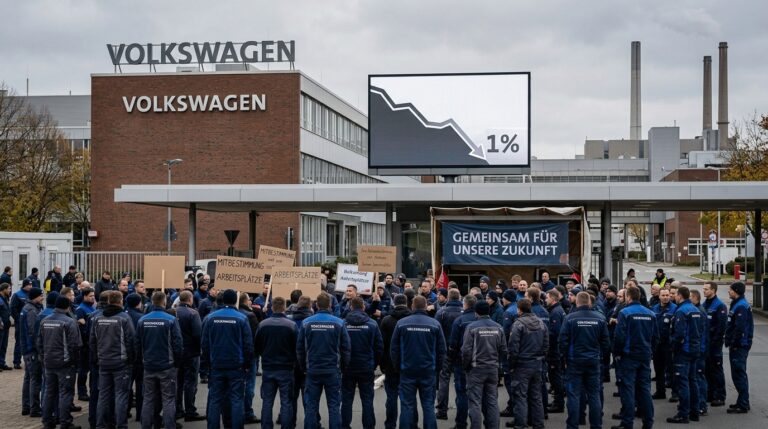

The headline unemployment rate fell to 4.1% this morning. On any other Friday, that would be a win. Today it is the most misleading number in the report. The U.S. economy shed 23,000 nonfarm payroll jobs in July, the Bureau of Labor Statistics confirmed at 8:30 a.m. ET, a result that arrived 106,000 jobs below the Dow Jones consensus of +83,000. The unemployment rate slipped not because the labor market found its footing, but because workers left it. The labor force participation rate fell further to 61.4%, its lowest level in more than five years. That is the number traders need to anchor everything else to this morning.
Market Context Analysis
Going into today’s release, the environment was already complicated. The Federal Reserve held its benchmark rate at 3.50% to 3.75% at last week’s July meeting, a 9-3 vote, with three dissenters favoring an immediate hike. Fed Chair Kevin Warsh had made clear he would move in September if inflation readings stayed hot. Before 8:30 a.m., rate futures assigned a 57% probability to a September hike, according to LSEG data.
That calculus changed the moment payrolls printed. Rate futures now price just a 43.9% chance of Fed tightening in September, down from 57% before the report. The probability of a hold at the September 16 meeting jumped to 60.4% versus 43.2% just prior to the data. The 10-year Treasury yield, which had been trading near 4.67% just before the report, dropped to about 4.60% on the news. Equity futures responded: the S&P 500 gained about 0.3%, the Nasdaq Composite climbed 0.8%, and the Dow edged up roughly 0.1% as the dovish reset worked through markets.
The macro backdrop behind today’s number matters as much as the number itself. Headline CPI for June came in at 3.5% year-over-year, below the 3.8% consensus, partly because the energy component fell 5.7% in a single month as Middle East tensions briefly eased. Core PCE sits at 3.3%. Core CPI is at 2.6%. Neither is at the Fed’s 2% target. The U.S.-Iran conflict that drove energy prices sharply higher earlier in the year remains unresolved. That means the inflation picture is not clean, and today’s weak payrolls number lands in an economy where price pressures still run above target, with a central bank that was already split on the next move.
The revision story compounds the damage. May’s jobs total was cut by 66,000, from 129,000 to 63,000. June’s was revised down 37,000, from 57,000 to 20,000. Taken together, employment in May and June was 103,000 lower than previously reported. After those revisions, the trailing 12-month average for nonfarm payroll gains collapsed to just 34,000 per month. Six months ago, that average stood at 92,000. This is not noise.
Sector Breakdown
The sector composition of July’s losses matters for active traders because it tells you where the pressure is structural versus where it reflects distortion that could reverse.
Local government education shed 50,000 positions in July, the single largest drag on the headline number. This sector is notoriously susceptible to seasonal adjustment distortions in July, when school calendars create large swings in raw employment counts. Traders should treat that 50,000 as partially statistical. The remaining jobs lost elsewhere in the economy reflect a softer underlying trend but do not constitute broad-based deterioration.
Retail trade lost 19,000 jobs, with declines in supercenters and general merchandise retailers of 21,000 and gas stations down 5,000, partially offset by gains in sporting goods and specialty retail of +10,000. The supercenter and general merchandise collapse reflects the consumer spending slowdown that is showing up across earnings reports this season. Retail employment has shown little net change over the trailing 12 months, meaning this is not a new trend, it is a confirmation of one.
Financial activities shed 14,000 jobs, split between credit intermediaries losing 9,000 and insurance carriers down 7,000. Financial sector employment now sits 121,000 below its May 2025 peak. That is a meaningful drawdown in a rate-sensitive sector that has been contracting as the yield curve configuration and lending demand have shifted.
Healthcare, the economy’s most consistent hiring engine in 2026, added only 22,000 jobs in July, below its 12-month average of 36,000. That deceleration is worth monitoring. Manufacturing added 5,000 jobs, slightly above the 4,000 estimate. Private payrolls overall added 30,000 against a consensus expectation of 78,000, a 48,000 miss on the private side alone.
The temporary layoff signal deserves its own paragraph. The number of workers on temporary layoff rose by 153,000 to 921,000 in July. That is not a trivial move. Temporary layoffs at that level historically precede either a reversal in the next one to two months, if companies rehire, or a transition to permanent separations if demand does not recover. The August and September payroll reads will tell the story.
Stock-Specific Financial Breakdown
Traders need to think about which equity categories are reset by today’s data, not just which ones moved in the first 30 minutes.
Regional Banks: The financial sector’s 14,000 job loss in July is a symptom of what is happening to loan demand and credit intermediation. The KBW Regional Banking Index has been under pressure as the yield curve dynamic and credit quality concerns weigh on net interest margins. A dovish reset of September Fed expectations is a tailwind for rate-sensitive regionals, but the underlying weakness in credit intermediation employment suggests loan book expansion is not accelerating. Watch KRE (the SPDR S&P Regional Banking ETF) for how the sector digests the rate reset against fundamentals.
Consumer Discretionary: The retail job losses at supercenters and general merchandise retailers confirm what Target, Walmart, and the broader mass-market complex have been signaling in recent earnings. Average hourly earnings for private-sector workers rose just 2 cents to $37.62 in July, with year-over-year wage growth slowing to 3.2% against a consensus expectation of 3.5%. Consumer spending power is not expanding at a rate that supports aggressive discretionary exposure. The XLY (Consumer Discretionary Select Sector SPDR) is a sector to watch, but the wage deceleration is a fundamental headwind, not just a technical one.
Homebuilders and REITs: The 10-year Treasury yield falling to about 4.60% is the most direct transmission mechanism for rate-sensitive real estate equities. Mortgage rates are derived partly from the 10-year, and any sustained move lower in yields, if the labor market continues to disappoint, creates a tailwind for homebuilders like D.R. Horton (DHI), Lennar (LEN), and the broader ITB (iShares U.S. Home Construction ETF). However, the current environment still features headline CPI at 3.5% and core PCE at 3.3%, not an environment where the Fed is cutting. The yield relief may be temporary if the July CPI reading, due August 12, comes in hot.
Healthcare: The sector added 22,000 jobs in July, well below its 12-month average of 36,000. Companies like HCA Healthcare and Kaiser Permanente have been among the largest contributors to healthcare hiring through 2026. A broad labor market slowdown reduces elective procedure volume and could compress same-store revenue trends at hospital operators. But healthcare employment deceleration also signals cost control opportunities. Watch HCA’s next update for guidance on staffing costs against volume trends.
Technical / Trading Framework
The immediate market reaction, equities higher on dovish reset, is not necessarily the durable signal. Traders should be calibrating multiple timeframes simultaneously.
S&P 500: Futures are up approximately 0.3% post-report. The index has been in a constructive trend since the record closes set earlier this week on strong corporate earnings. The key level to monitor is whether the index can hold above the prior week’s high on the close today. A failure to hold gains, despite the dovish rate reset, would suggest the growth concern from a negative payroll change is beginning to compete with the rate-relief trade.
10-Year Treasury: The yield dropped sharply to about 4.60% from roughly 4.67% pre-report. The near-term resistance for a further rally in bonds (lower yield) is whether the August 12 CPI reading continues the disinflationary trend seen in June. If CPI comes in above the 3.5% June level, the bond rally stalls and September hike odds rebuild. The 4.5% level on the 10-year is the next meaningful technical support (yield floor from the trader’s perspective).
VIX and options positioning: The VIX was trading in the low-to-mid teens before the report. A dovish shock of this magnitude, without a concurrent recession signal, typically compresses volatility rather than expanding it. But the temporary layoff spike to 921,000 introduces uncertainty about August and September payrolls. Traders using options to position around the August 12 CPI should note that implied volatility on short-dated SPY contracts may remain elevated into that date.
Gold: Spot gold was trading near $4,307 per ounce this morning before the report. A dovish reset is constructive for non-yielding assets. But gold has already run significantly in 2026, driven by geopolitical risk and inflation hedging. The directional signal from today’s jobs miss is modestly bullish for gold, but the magnitude of additional upside depends on whether the Strait of Hormuz situation re-escalates and drives energy back toward the highs of the year.
Scenario Modeling
Bull Case: The Seasonal Distortion Reverses
The 50,000 decline in local government education is attributed partly to seasonal adjustment anomalies around school calendars. If August payrolls correct that distortion, adding back 20,000 to 30,000 jobs in the education sector, the trailing 12-month average recovers toward 50,000 to 60,000, weak, but not alarming. Combined with a June-like CPI print in August (CPI due August 12), the Fed holds in September, the 10-year stabilizes near 4.5%, and the S&P 500 extends the run that produced record closes earlier this week. In this scenario, rate-sensitive sectors, homebuilders, regional banks, and REITs see sustained relief. The S&P 500 tests 5,700 to 5,800 by the end of August.
Base Case: Stagflationary Limbo Persists
The most probable outcome over the next six to eight weeks: payrolls recover modestly in August (roughly +40,000 to +60,000), but the trailing average remains around 40,000 per month, well below the pace needed to signal labor market strength. The August 12 CPI reading comes in near 3.6% to 3.8% year-over-year as energy prices stabilize at elevated levels following ongoing Hormuz uncertainty. The Fed holds at the September 16 meeting but signals a hike remains on the table for November if inflation does not continue lower. The 10-year yield oscillates between 4.5% and 4.7%. Equities drift sideways to modestly lower as the growth/inflation tension keeps institutional positioning cautious. The S&P 500 trades in a 5,400 to 5,600 range through September.
Bear Case: The Temporary Layoffs Convert
The 153,000 jump in temporary layoffs to 921,000 is the key risk indicator to monitor. If demand does not recover by August, a portion of those temporary separations convert to permanent layoffs. August payrolls come in flat or negative for the second consecutive month. Simultaneously, if the Strait of Hormuz situation re-escalates, energy prices move back toward the cycle highs, CPI for July (due August 12) surprises to the upside above 3.8%, and the Fed faces a genuine stagflationary dilemma: a weakening labor market with still-hot inflation. In this scenario, the September meeting becomes the most consequential in years. Bond yields move in an unpredictable direction as growth and inflation pulls compete. The S&P 500 tests the 5,000 to 5,200 range, with financials, consumer discretionary, and rate-sensitive real estate leading the decline. The VIX spikes to the mid-20s.
Active Trader Strategy Framework
Today’s report introduces at minimum three decision points traders should build frameworks around before next Friday.
August 12 CPI is the next gate. The Fed’s September decision is not settled by today’s payroll miss. If CPI for July comes in above 3.5%, the June reading, the dovish reset in rate futures partially reverses. Traders who got long rate-sensitive equities on today’s jobs report need to have a clear view on CPI risk. The June energy index drop of 5.7% that drove the disinflationary print is not guaranteed to repeat. Energy prices have remained elevated due to ongoing Hormuz restrictions.
The temporary layoff count is a leading indicator, not lagging. The 921,000 workers on temporary layoff is the highest single-month reading of 2026. Monitor August WARN filings and the next ADP report (due September 2) for whether those temporary separations are reversing or deepening. A conversion of even one-third of that number to permanent layoffs would change the August payroll read materially.
Sector rotation logic: The rate reset today is real, but duration. Lean into rate-sensitive relief trades, homebuilders, short-duration bonds, REITs, only if you have a clear CPI view for August 12. The 10-year at about 4.60% is not historically low; the relief trade has a ceiling if inflation does not cooperate. Consumer discretionary remains a sector where the fundamentals, slowing wage growth at 3.2% year-over-year and declining retail employment, argue against aggressive long positioning on a bounce.
Long-term unemployment as a structural signal: Long-term unemployment, defined as joblessness lasting 27 weeks or more, accounted for 25.5% of all unemployed workers in July, at 1.8 million people. That figure does not respond to a single month’s payroll revision. It represents structural disengagement from the labor market. Combined with a participation rate at a more-than-five-year low of 61.4%, this is a labor market that is cooling at the margins, not one in freefall. Traders positioning for a recession outcome should wait for August payrolls and the temporary layoff trajectory before committing to that framework.
Professional Conclusion
The July jobs report delivered the first nonfarm payroll contraction since February, a miss of 106,000 against the Dow Jones consensus, downward revisions totaling 103,000 for the prior two months, and a trailing 12-month average that has now compressed to 34,000 per month. The unemployment rate fell to 4.1% for the wrong reasons: a participation rate at 61.4% reflects workers exiting the labor force, not workers finding jobs.
The market’s initial reaction, equities higher, bond yields lower, September hike odds falling to 44%, is a rational response to the dovish signal embedded in a negative payroll change. Whether that reaction proves durable depends entirely on August 12. If CPI for July prints above 3.5%, the Fed’s dual mandate tension intensifies. A weak labor market and above-target inflation simultaneously is not a scenario most models handle cleanly.
Disciplined traders do not position for the headline. They position for what the next data point reveals about the trajectory. The trajectory here is a labor market that was already weaker than reported and a Fed that remains split on what to do about it. August 12 is the next real decision point. Prepare accordingly.
For informational and educational purposes only. Not investment advice. Trading involves risk, including loss of principal.