
Revenue up 85% year over year. U.S. commercial revenue up 133%. Full-year guidance raised by 10 full percentage points in a single earnings call. And the stock is still down more than 20% year-to-date.
Something doesn’t add up. Or maybe it does – and it’s the valuation that’s the real issue, not the business.
This is the Palantir question that keeps coming up. And right now, with the stock trading well below its late-2025 highs while the underlying business accelerates at a pace few software companies have ever sustained, it’s worth working through what you’re actually owning here.
What the Q1 Numbers Actually Say
Palantir’s Q1 2026 results were not subtle. Revenue came in at $1.63 billion, beating consensus, with adjusted EPS of $0.33 against a $0.27 estimate. The company raised full-year 2026 revenue guidance to approximately $7.650–$7.662 billion, which represents roughly 71% year-over-year growth. That’s not rounding error. That’s a business operating at a different speed than its peers.
U.S. total revenue grew 104% year over year. The company’s Rule of 40 score hit 145% – an extraordinary reading that reflects both growth rate and profitability margin combined. Free cash flow margin for the quarter came in at 57%. These are not the metrics of a company that is losing the AI race. These are the metrics of a company that may be winning it in ways that don’t yet show up in investor sentiment.
What’s interesting is how the commercial side of the business has evolved. U.S. commercial revenue – the part of the business that matters most for long-term valuation, because it’s not dependent on government budget cycles – grew 133% year over year and is now guided to grow at least 120% for the full year. That’s the piece that used to be the knock on Palantir: too government-dependent, too hard to replicate commercially. That criticism is increasingly hard to sustain.
The Defense Side Is a Different Story
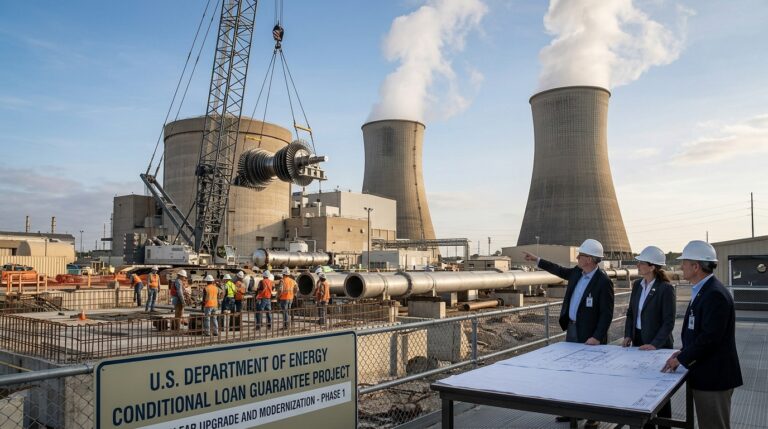
And then there’s the government business, which is accelerating in its own right. Palantir holds a contract with the U.S. Army worth up to $10 billion over the next decade for its “future software and data needs.”
U.S. Government revenue reached $570 million in Q4 2025, up 66% year over year. The proposed defense budget request for fiscal 2027 sits at $1.5 trillion – a dramatic jump from current levels – and Palantir’s software is embedded at every layer of the architecture that budget would fund. It’s not a weapons contractor. It’s the operating system that makes the weapons contractors more effective. That’s a fundamentally different and more durable business model.
One more thing on the defense angle: classified government environments don’t run on commercial AI APIs. Anthropic can’t compete here. Microsoft’s consumer Azure tools can’t compete here. Palantir’s Gotham platform operates in environments where none of those alternatives are allowed. That’s a structural moat, not a temporary advantage.
The Valuation Tension Is Real
Here’s where I’m not going to pretend the bear case doesn’t exist. It does. Palantir trades at a forward price-to-earnings multiple of roughly 97x and a forward price-to-sales multiple of approximately 46. Those are numbers that leave zero margin for error. Even with 85% revenue growth, any deceleration in commercial momentum, any government contract cancellation, any broader multiple compression in software, and the stock reacts fast. It already has – 20%-plus from its highs is not a minor correction.
The insider selling is also worth acknowledging. Over the past six months, insiders have made hundreds of open-market sales, with few (if any) purchases reported over that span by common insider-tracking services. CEO Alex Karp has also continued to sell stock under pre-established trading plans, including sales tied to RSU vesting and tax obligations. That’s not a signal you can dismiss outright, even in a company where Karp is known for long-term conviction.
What’s different here from most high-multiple software names is the durability of the contracts. The company reported total remaining deal value of $11.2 billion as of December 31, 2025, providing forward revenue visibility that most software companies can’t point to. And the AIP boot camp model – where enterprises trial the platform in short, intensive sessions and convert to multi-year contracts – is a distribution strategy that scales in ways traditional enterprise sales doesn’t.
The Bigger Picture
Palantir hosted AIPCon 10 earlier this month, showcasing real-world deployments across companies like Hertz, Accenture, the U.S. Department of Agriculture, and law firm Kirkland and Ellis. That last one is interesting – a PE fundraising platform built jointly with one of the world’s largest law firms suggests the commercial expansion is reaching corners of the market that weren’t on the radar a year ago.
The gap between where the stock is and what the business is doing is unusually wide right now. Whether that gap closes up or down depends almost entirely on whether U.S. commercial growth stays above 100% through Q3. If it does, the multiple will be easier for the market to digest. If it slips, the stock will reprice quickly.
The business, though – the actual operating machine underneath the valuation debate – is running as well as it ever has. And in a market where most AI software names are still trying to prove revenue traction, that’s not nothing.
Full breakdown worth a closer look.
This editorial is for informational purposes only and does not constitute investment advice. All financial data is sourced from public company filings, analyst research, and earnings reports as of June 29, 2026. Investing involves risk, including potential loss of principal. Past performance is not indicative of future results.