
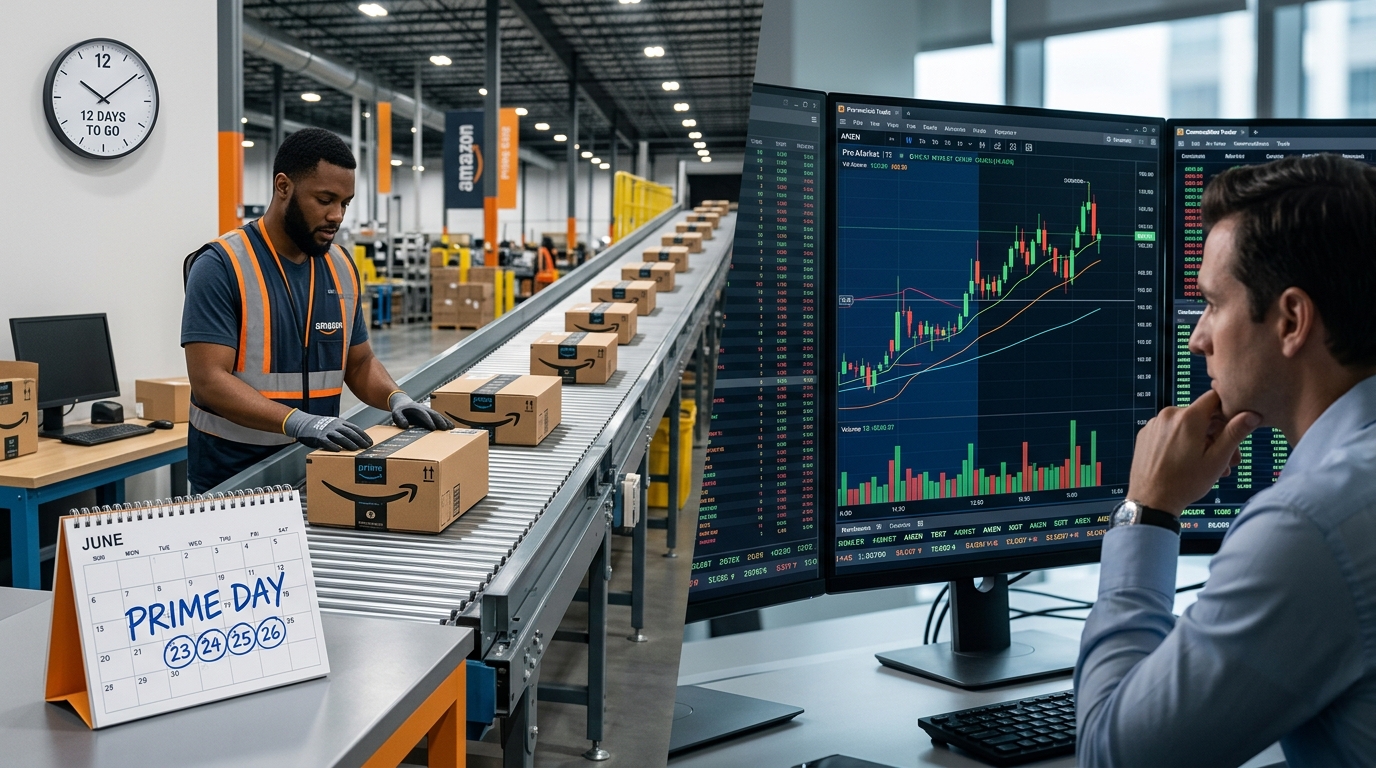
Amazon quietly made a decision that didn’t get nearly enough attention in the options community: it moved Prime Day to June.
Not July. June 23 through June 26 — a full four-day window, earlier than any prior edition, landing squarely inside Q2’s closing stretch. That calendar shift isn’t just a retail scheduling note. It’s an earnings variable. Revenue and high-margin advertising dollars that historically appeared in Q3 results will now show up in Q2. The reporting math changes. So does the setup for options traders.
The Numbers That Frame the Trade
Amazon’s Q1 2026 results were already strong before Prime Day enters the picture. Unit volume grew 15% in Q1 — the strongest quarterly pace since the tail end of the pandemic — while North America sales rose 12% to $104.1 billion. The advertising segment, which feeds heavily on Prime Day traffic, jumped 24% year-over-year to $17.2 billion in Q1 alone.
Subscription services — meaning Prime memberships — generated $13.4 billion in high-margin Q1 revenue. More than 180 million Americans currently hold Prime memberships, making Prime Day the single largest driver of immediate purchase intent across that subscriber base. Adobe Analytics data from last year’s event put total online sales across U.S. retailers at roughly $24.1 billion — more than twice the Black Friday online spend that followed months later.
Management has already guided Q2 net sales of $194–$199 billion with operating income of $20–$24 billion, and both figures already incorporate the Prime Day timing shift. That guidance range, notably, was set before the full consumer spending environment for late June was visible.
Slight tangent, but it matters: the Anthropic dimension. Amazon holds a massive equity stake in Anthropic — its original $8 billion investment was valued at over $74 billion at the end of Q1 — and Anthropic just filed a confidential S-1 with the SEC on June 1, 2026, targeting what could be the first trillion-dollar AI listing. When that stock hits public markets, Amazon’s balance sheet gets a very public mark-to-market event. That’s a secondary catalyst sitting behind the Prime Day setup.
The Options Structure
The trade here isn’t necessarily about betting on a blowout Prime Day number. It’s about the convergence of three distinct catalysts arriving within weeks of each other: the event itself (June 23–26), the Q2 earnings report that will incorporate Prime Day revenue, and the Anthropic IPO timeline, which feeds directly through Amazon’s AWS relationship and equity stake.
- Bull case: For traders expecting Prime Day to reflect resilient consumer spending, a defined-risk call spread targeting a move toward all-time highs by Q2 earnings captures the event and the earnings beat in a single structure. Look for strikes above the current range with 45–60 days to expiration.
- Bear case: If you believe inflation-pressured consumers pull back — Amazon’s CFO flagged higher transportation costs tied to fuel inflation — a put spread expiring shortly after the earnings report defines downside exposure. The guidance range is wide, which suggests management uncertainty about the macro.
- Neutral/income case: With IV likely to expand as Prime Day approaches and compress post-event, a short premium strategy — a covered call against existing shares or a cash-secured put at a lower strike — captures elevated IV without requiring a directional call.
What’s interesting is how cleanly this setup separates from the SMCI chaos dominating AI hardware discourse right now. Amazon is not a single-product AI play. It’s a compound machine: e-commerce, cloud, advertising, logistics, and now a near-trillion-dollar AI equity stake sitting on its balance sheet.
The market tends to undervalue that stack until a catalyst forces the repricing. Prime Day, moving to Q2 for the first time, might be exactly that moment. Start here.