Jensen Huang doesn’t say things like that casually.
At Computex 2026 in Taipei, the Nvidia CEO publicly called Marvell Technology the “next trillion-dollar company.” The comment wasn’t off-the-cuff flattery — Nvidia had just committed $2 billion in direct investment into the company. That kind of endorsement, backed by real capital, lit a fuse. Shares jumped more than 30% in a single session, and MRVL has now surged over 270% year-to-date.
But here’s the thing most people are missing: the story didn’t start at Computex. It started in the data center.
What Marvell Actually Does
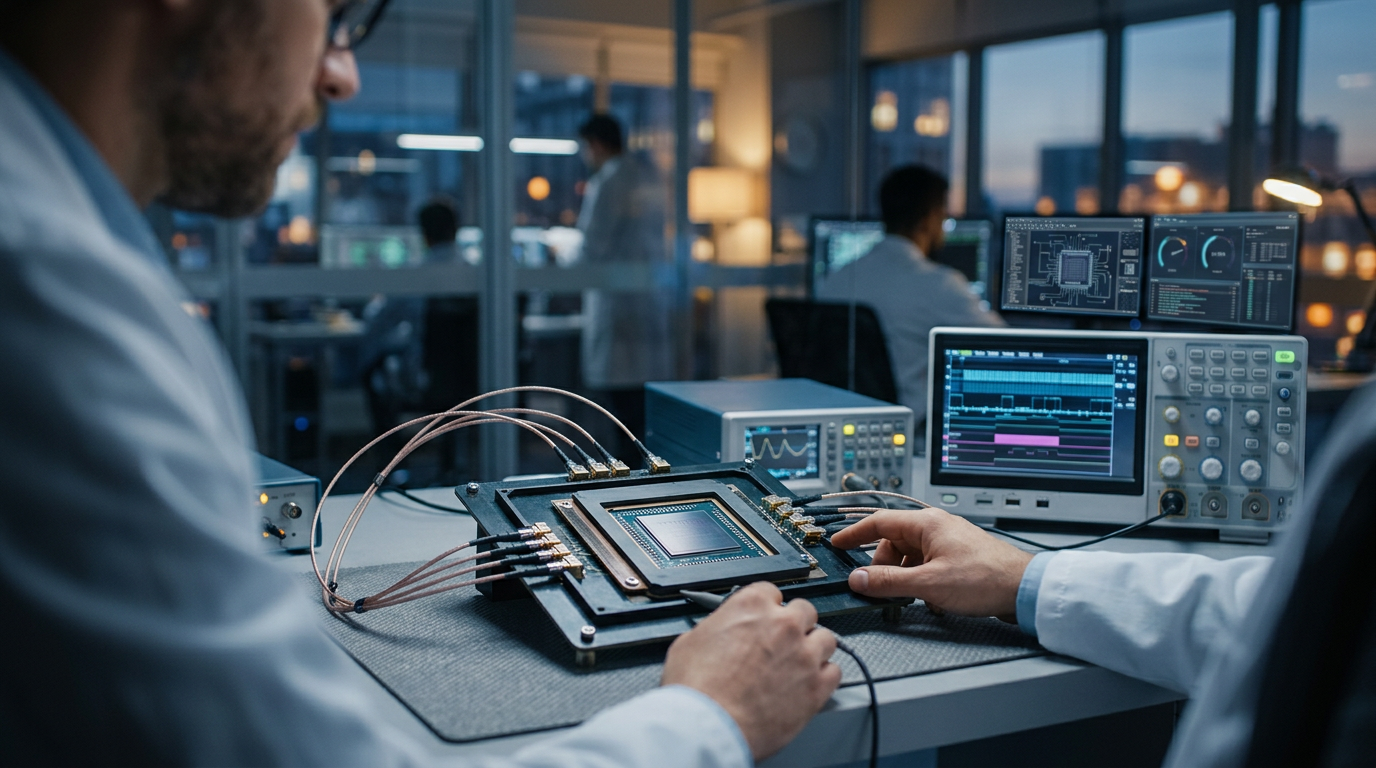
Marvell Technology (NASDAQ: MRVL) designs data infrastructure semiconductors — the chips that move, connect, and route data across AI systems. That sounds dry until you understand the bottleneck everyone is racing to solve right now. The AI industry isn’t just constrained by compute. It’s constrained by connectivity. Moving data between thousands of GPUs at terabit-per-second speeds, with minimal latency and power draw, is one of the hardest engineering problems in AI infrastructure today.
Marvell sits right at that choke point.
The company’s custom XPU (accelerator processor) business designs bespoke AI chips tailored for individual hyperscalers — companies like Amazon, Google, and Microsoft. Unlike Nvidia’s standardized GPUs, these chips are purpose-built for specific workloads, optimizing for cost, power, and throughput. Marvell has 18 XPU and XPU-attach socket design wins, many already in volume production, and a design pipeline worth an estimated $75 billion in lifetime revenue potential.
The Numbers Behind the Move
On May 27, Marvell reported record Q1 FY2027 revenue of $2.418 billion — up 28% year-over-year — with non-GAAP gross margins near 59% and record operating cash flow of $639 million. Management then guided Q2 to $2.7 billion, implying 35% growth. The full-year FY2027 revenue target was raised to approximately $11.5 billion, representing roughly 40% growth from fiscal 2026.
Analysts from CFRA, UBS, Wells Fargo, and B. Riley all raised price targets after the quarter. Wall Street is not just watching — it’s repositioning.
Marvell also unveiled the Teralynx T100, described as the industry’s first 102.4 Tbps AI-optimized switch chip. The product targets hyperscale AI clusters and promises up to 25% lower power consumption. Customer sampling is already underway. This is the kind of product launch that extends relationships with hyperscalers for years, not quarters.
The Optical Angle Nobody Fully Prices In
Slight tangent, but it matters: Marvell recently acquired both Celestial AI and XConn, deepening its optical and interconnect stack. Huang specifically called out the transition from copper to optical networking as critical for next-generation AI data centers. Marvell’s silicon photonics and optical DSP capabilities are increasingly central to that shift — and analysts at CFRA see Marvell’s leadership in high-speed optical interconnects as a multi-year moat, particularly as data centers push toward 1.6T and 3.2T speeds.
This isn’t just a momentum play. There’s a structural thesis underneath all the hype.
Where the Risk Lives
None of this is without nuance. The valuation is elevated — MRVL trades at over 100x trailing earnings after the surge. Insider selling has been notable, with approximately $32 million in shares sold over the past three months with no purchases reported. Customer concentration risk is real; any slowdown or strategic shift at a major hyperscaler feeds directly into Marvell’s results. And the stock has moved from the $160s to above $300 in weeks — that kind of parabolic price action almost always includes some reset at some point.
Analysts project custom silicon revenue could exceed $10 billion for Marvell by fiscal 2029. Whether the current stock price is getting ahead of that timeline is the central debate.
The Bigger Picture
The AI infrastructure buildout is not slowing. Global AI-related capex is projected to exceed $500 billion, and the hyperscalers are not just buying GPUs — they’re rebuilding entire data center fabrics. Custom silicon, optical networking, and high-speed switching are the unglamorous but essential layers of that rebuild. Marvell may be positioned at more of those layers simultaneously than any other single semiconductor company outside of Nvidia itself.
Worth watching closely. The story is just getting started — and the trillion-dollar question is how much of it is already priced in.