The Section 301 overcapacity findings have been years in the making and hours in the delivering. The Trump administration is poised to release the findings of a Section 301 investigation into alleged excess industrial capacity in 16 major U.S. trading partners, with new import duties on a wide range of goods expected, and results could come as soon as today, November 25.
But the institutional reaction worth watching is not about China. Portfolio managers who have spent years stress-testing China exposure already have frameworks for that risk. The debate inside investment committees right now is about the allies.
Why the Ally Problem Is Structurally Different
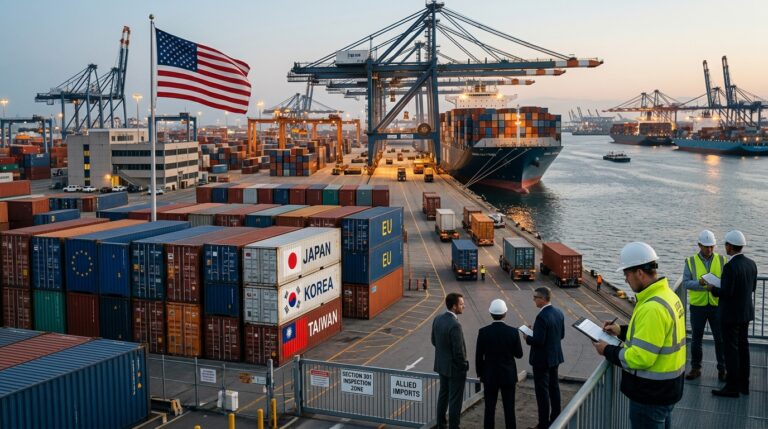
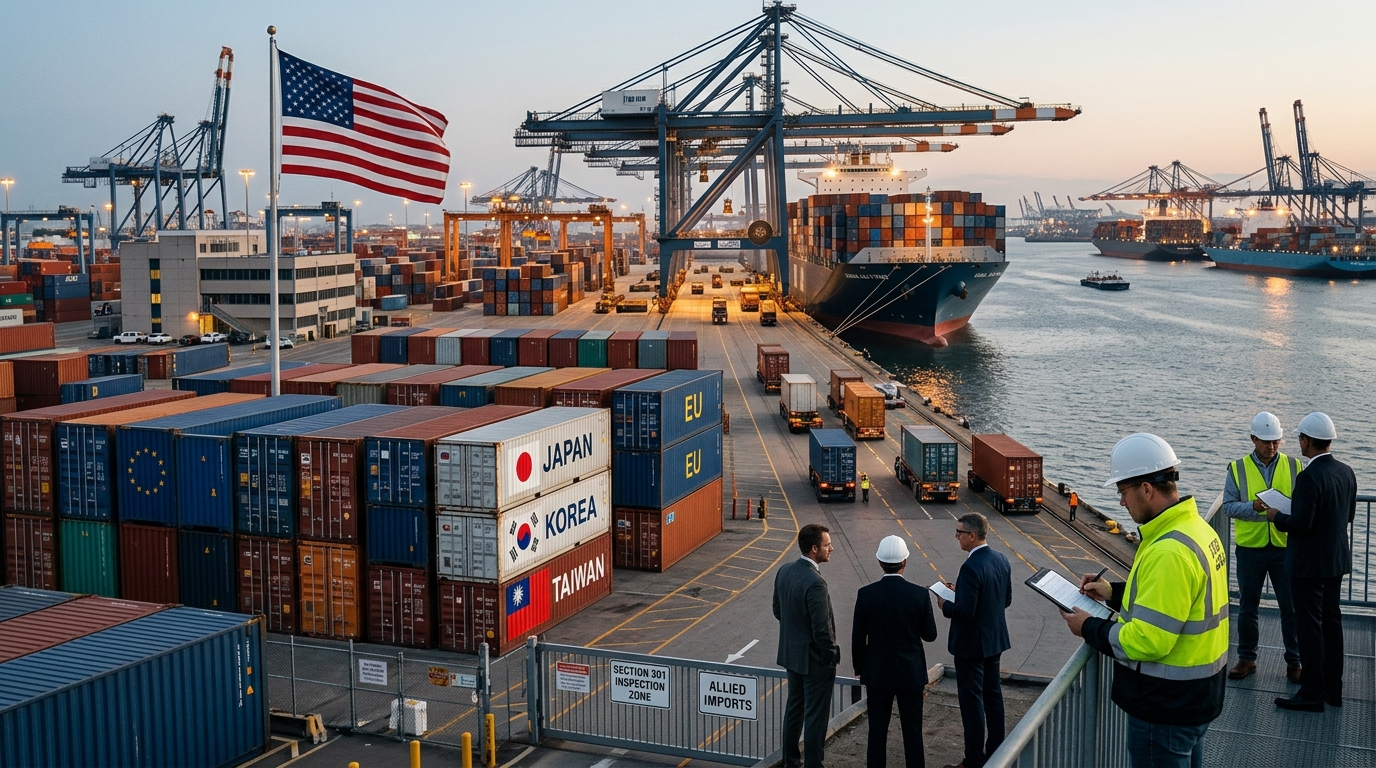
The investigation targets China, the European Union, Singapore, Switzerland, Norway, Indonesia, Malaysia, Cambodia, Thailand, Korea, Vietnam, Taiwan, Bangladesh, Mexico, Japan, and India, all 16 at once. USTR initiated these investigations on March 11, 2026. USTR has described an illustrative list of 21 manufacturing sectors, including aluminum, automobiles, batteries, cement, chemicals, electronics, energy goods, glass, machine tools, machinery, paper, plastics, processed food and beverages, robotics, satellites, semiconductors, ships, solar modules, steel, and transportation equipment.
That list is essentially the entire intermediate goods economy of the developed world. When China is the only target, supply chains reroute: source from Korea, Japan, Taiwan, Vietnam. When Korea, Japan, and Taiwan are simultaneously in the dock, the rerouting logic breaks down. That is what supply-chain desks are grappling with today.
In theory, a single country’s goods could be subject to tariffs under two separate Section 301 actions, in addition to existing Section 232 and prior Section 301 tariffs on Chinese goods. For companies that diversified out of China into allied-nation supply chains over the past three years, the overcapacity action lands as a direct hit on their hedges.
The Rate Question and the Treaty Floor
The final numbers are not yet public, and public reporting has not confirmed a uniform 15% cap for overcapacity tariffs. What is clear is that the United States has recently used deal-specific ceilings in other tariff programs, including a 15% ceiling in the EU-U.S. trade deal and a 15% baseline tariff framework in the U.S.-Japan framework agreement, and South Korean officials have sought confirmation that additional Section 301 tariffs would not exceed 15% under the November 2025 U.S.-ROK arrangement.
China, given the scale of its subsidies, could face the highest rate. That escalation risk matters to anyone modeling a multi-year cost base.
South Korea’s trade minister said in August that Seoul was working to keep Section 301 tariffs, including any on overcapacity, within the agreed 15%, adding that trade authorities on both sides had reached “a certain level of consensus.” Japan and the EU are in a similar position. The uncertainty is not the existence of ceilings in prior deals, it is whether any new overcapacity action is structured to respect them sector by sector, or to bypass them through product carve-outs.
What Investors Are Missing
The debate about tariff rates is obscuring a quieter strategic question: Section 301 gives USTR, at the president’s direction, a flexible tool to adjust duties economy by economy. Unlike some other tariff authorities, Section 301 has a long track record and has generally withstood court challenges. That means the overcapacity findings are not a one-time event. They are a durable lever that can be tightened sector by sector as negotiations progress, or as overcapacity data shifts.
For portfolio managers, the second-order consequence is in semiconductors and electronics. Taiwan’s chip industry and Korea’s memory sector sit inside the investigation’s scope. Even a modest stacking of duties on top of the existing forced-labor tariffs, which USTR finalized in July at 10% or 12.5% depending on the economy and product, changes the cost calculus for every fabless U.S. chipmaker sourcing wafers from TSMC or Samsung.
Stocks to Watch
TSMC (TSM) and Samsung Electronics face direct exposure as the dominant producers in Taiwan and Korea inside the two most tariff-sensitive sectors: semiconductors and electronics. Any tariff layer that meaningfully increases the effective duty on covered chips would reopen cost conversations with their largest U.S. customers.
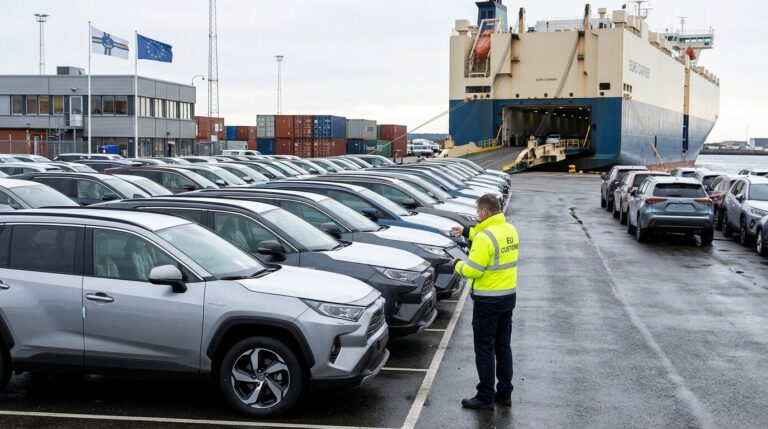
Toyota Motor (TM) and Hyundai Motor are caught in the automobiles sector from two different deal positions. Toyota’s framework includes a broad 15% baseline tariff structure for most Japanese imports, and South Korea’s November 2025 arrangement has been described by officials as implying a 15% ceiling for additional tariffs. Either way, both face margin compression if the effective rate on specific auto components ends up higher than the headline number.
First Solar (FSLR) is the domestic beneficiary hiding in plain sight. USTR’s overcapacity materials have pointed to subsidized overproduction in sectors that include steel, aluminum, autos, and solar modules. Solar modules are explicitly named. First Solar manufactures in Ohio. Every new duty on imported panels widens its competitive gap versus Asian module makers already under multiple layers of U.S. trade action.