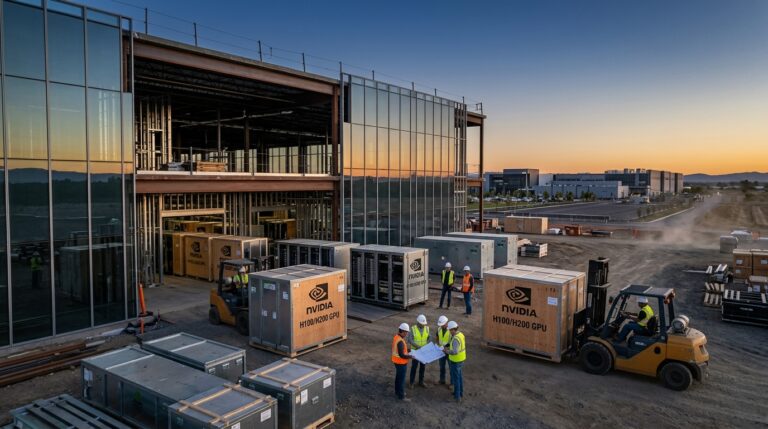
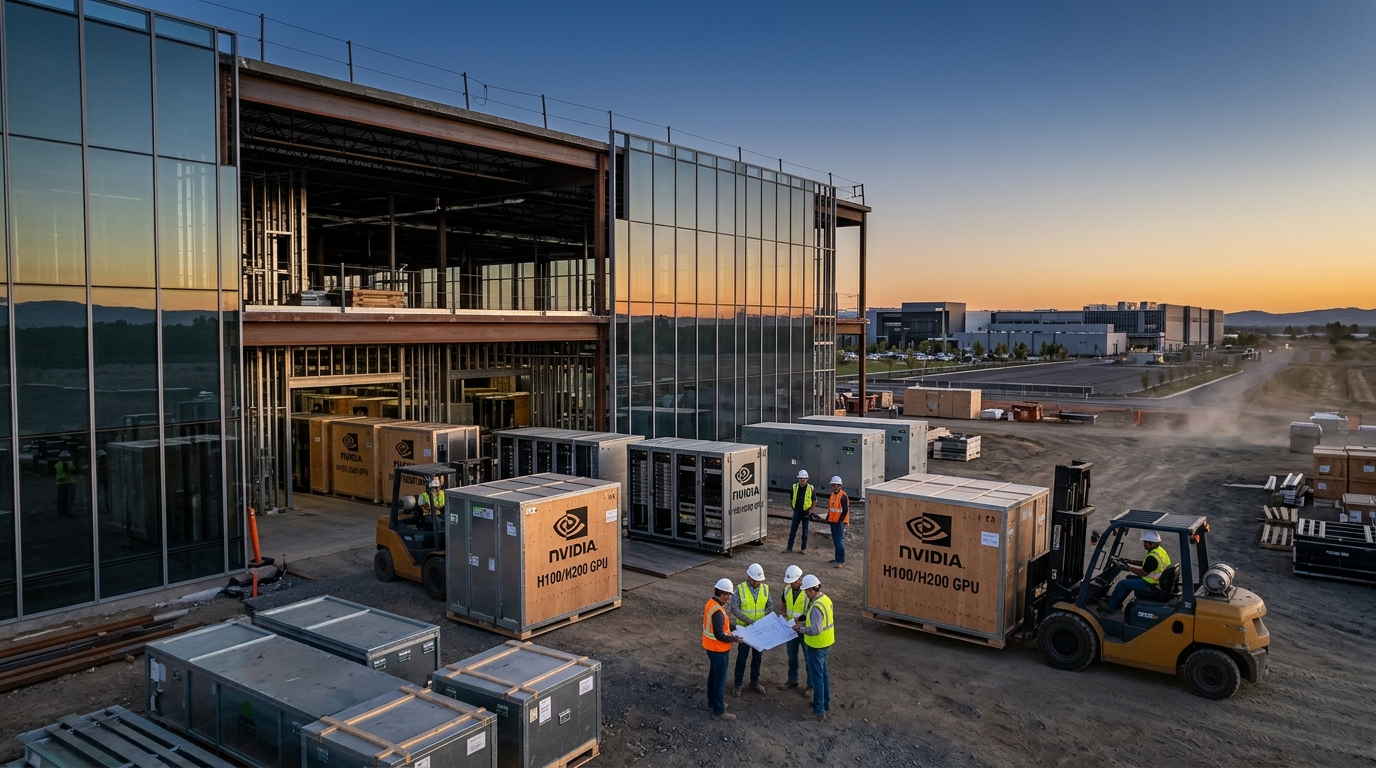
Bond investors delivered a verdict on neocloud financing last week. The Wall Street Journal reported that CoreWeave, Nebius, and Nscale have effectively been shut out of the bond market as lenders and investors demand tougher terms. CoreWeave’s bonds, issued earlier this year with a 9.75% coupon, are now trading in the secondary market at yields in the mid-teens, a level bankers say is prohibitively expensive for new issuance. Within 24 hours of that report, a different picture emerged: Nvidia stepping in where the bond market stepped away.
Nvidia is in talks to guarantee billions in debt financing for AI cloud provider Nscale’s planned Anthropic data center in West Virginia. The guarantee would cover the value of the 460MW building itself, and under this structure, known as a residual value guarantee, Nvidia would step in if Nscale failed to make its construction payments, take over the site for a time, and help find a buyer and a new tenant. The size of the credit support has not been disclosed, nothing has been signed, and the terms could still change.
The Bull Case: A Supplier Protecting a Strategic Customer
Anthropic struck a deal in late August to spend about $45 billion over six years to rent computing power from Nscale’s West Virginia campus. That contract covers the first 460MW building and is expected to use Nvidia’s next-generation Vera Rubin chips. From that vantage point, Nvidia is not rescuing a distressed borrower. It is protecting a chip order worth billions across multiple hardware generations.
The idea is that Nvidia is using its balance sheet to lock up long-lived sites where its chips can run across multiple hardware generations. One investor told The Information that Anthropic’s role likely explains Nvidia’s interest in keeping the project on track. Anthropic is one of the largest buyers of AI computing anywhere. Letting its primary West Virginia facility stall for want of a cosigner would be a costly own goal.
The precedent also supports the bull reading. Nvidia disclosed in its Form 10-Q for the quarter ended July 26, 2026 that it has entered into land, power, and shell guarantees for select AI cloud partners’ data center lease obligations, with $3.5 billion of maximum gross exposure under those agreements. Separately, in August 2026 Nvidia entered into guarantees capped at $105 billion to provide credit support on a land, power, and shell buildout with affiliates of SB Energy Corp., with each guarantee generally becoming effective as the applicable lease commences and the amounts increasing as each of the nine phases of construction is completed. Nvidia also disclosed that OpenAI agreed to reimburse and indemnify Nvidia for amounts Nvidia actually pays under the SB Energy guarantees. The Ohio deal is a template: Nvidia as the creditworthy intermediary that unlocks financing an early-stage counterparty could not obtain alone.
The Bear Case: Paying for Its Own Demand
The problem with that framing is where it leads. Nvidia’s own filings show it has made very large ecosystem commitments that tie its balance sheet to the buildout it supplies. Its 10-Q for the quarter ended July 26, 2026 discloses $56 billion of additional commitments and $108.5 billion of maximum gross exposure under guarantees, and it also discloses $99 billion of equity investments and $25 billion of equity investment commitments as of that date. That is not a supplier offering an occasional financing facility. That is a chipmaker increasingly backstopping the demand stack its revenue depends on.
The circular logic is hard to avoid. Nvidia is effectively helping fund a customer’s ability to buy Nvidia chips, and now through a direct guarantee tied to a marquee buildout. The Nscale situation extends the same pattern one step further: bond investors assessed the credit risk independently and said no. Nvidia then arrives to override that judgment. If the credit were genuinely sound, the guarantee would not be necessary.
Nscale’s IPO prospectus has also warned that it has not obtained binding commitments for the financings required to fund performance under the Anthropic services agreements, and that certain customer contracts include termination rights tied to delays. That means Nvidia is not simply guaranteeing construction debt. It is racing a contractual clock to prevent an anchor tenant from exercising an exit right. That urgency changes the negotiating dynamic considerably, and it raises the question of whether the terms Nvidia accepts reflect the actual risk.
Where the Evidence Points
CoreWeave’s market value has recently been around $30 billion. The equity market has already delivered a partial verdict on the GPU-leasing model. Bond investors have now done the same. When two distinct markets reach similar conclusions about credit quality simultaneously, a third party stepping in with guarantees is not correcting a market failure. It is absorbing the risk those markets declined to take.
The bull case holds if Anthropic’s compute demand over a six-year, roughly $45 billion contract actually materializes and Vera Rubin chips remain competitively unassailable at delivery. Under those conditions, Nvidia’s guarantee costs it nothing and locks in a generation of chip revenue. The bear case holds if demand softens, Anthropic’s credit deteriorates, or a rival chip architecture narrows the moat. Under those conditions, Nvidia has taken on contingent construction liability for a building it does not own, to fill orders that have not yet shipped.
The honest read is that this guarantee tells investors more about the state of neocloud credit than it does about Nvidia’s confidence in the project. A supplier that genuinely expects a customer to pay does not need to stand behind the customer’s debt. Watch Nscale’s IPO prospectus for the disclosed size and structure of the guarantee. That is where the real risk pricing begins.