August 24, 2026
Featured: Memory Stocks’ 7% Drop Is a Policy Scare, Not a Pricing Shift
I’ve spent my career studying gold cycles – and what just happened on February 28th…
It is the most important shift I’ve ever seen.
While the headlines show missiles and war maps…
Iran made a move that’s far more consequential to the money in your bank account…
They installed a toll booth in the Strait of Hormuz – the chokepoint that carries one out of every five barrels of oil on Earth.
Every tanker now pays to pass that Strait – but not in dollars.
In Chinese yuan.
Since then, more than 11.7 million barrels of crude have already moved through this system… completely outside the U.S. dollar clearing network.
That’s not theory.
It’s execution.
For 50 years, oil forced global demand for dollars.
Oil-producing nations recycled those dollars into U.S. Treasuries… and back into markets like the S&P, NASDAQ, and Dow.
That’s how America funded itself.
Now, that engine is breaking down.
Because if oil moves without dollars… Countries don’t need dollars.
And if they don’t hold dollars… They won’t buy Treasuries.
You’re already seeing it:
Foreign central bank holdings just hit their lowest level since 2012… with $82 billion dumped in three weeks. Even worse…
Central banks now hold more gold than Treasuries for the first time in 30 years.
So, what’s coming next?
The U.S. must refinance $9 trillion in debt in the next 12 months.
If buyers don’t show up…
The Fed steps in.
Which means more money printing… a lot more.
Historically, this ends one way:
And here’s where most investors will go wrong…
Most investors will look to buy physical gold. Wrong move.
Because the real leverage is in miners – miners still priced for $1,800 gold… not $4,800.
Go here to see my top four picks before this repricing accelerates.
To your wealth,
Garrett Goggin, CFA, CMT
P.S. Oil just moved outside the dollar system – and $9T in debt is coming due with fewer buyers. That forces money printing… and gold higher. Go here to see the four miners positioned to make early investors a generational fortune as gold accelerates to the upside.
Memory Stocks’ 7% Drop Is a Policy Scare, Not a Pricing Shift
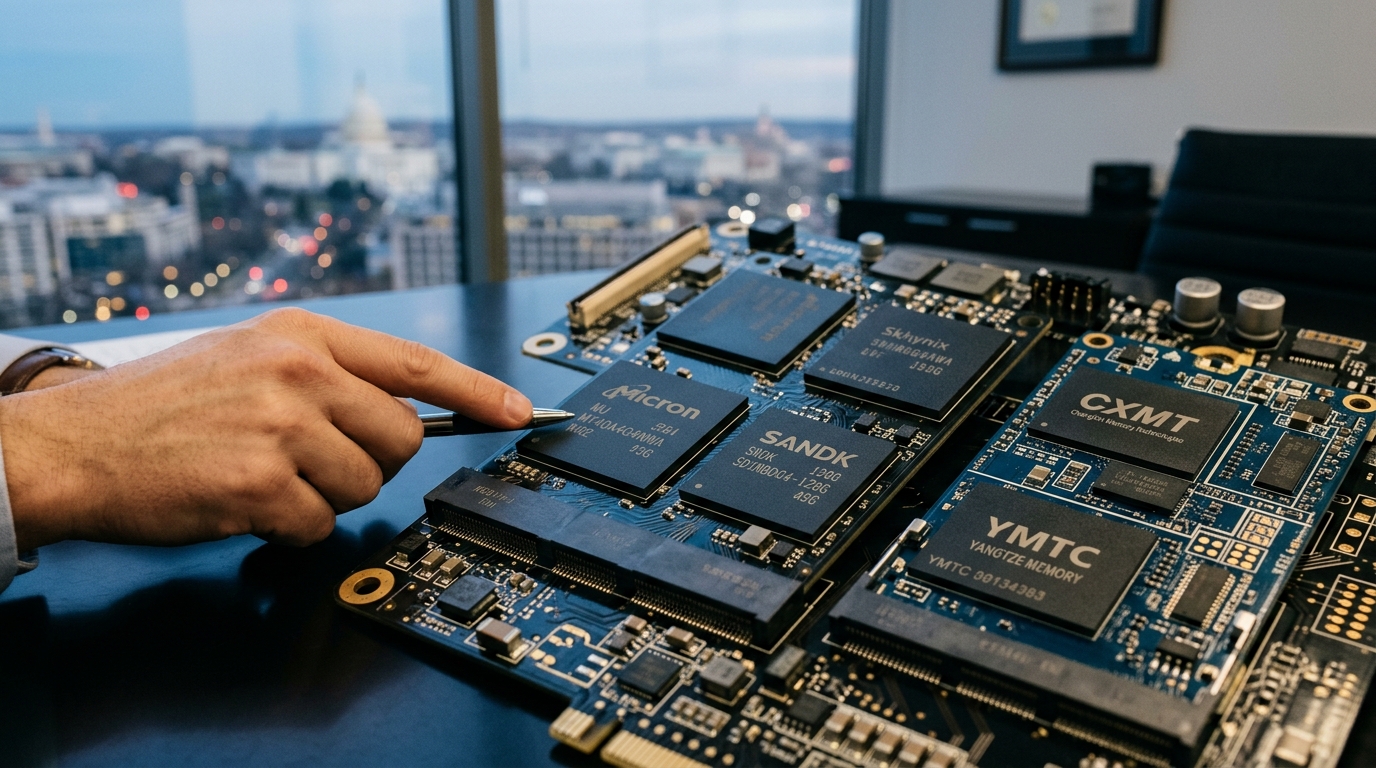
The memory complex opened Monday in freefall. SanDisk (SNDK) dropped about 9% to around $1,443, Micron (MU) fell 7% to about $898, Western Digital lost about 7%, and SK hynix shed about 5%, all on weekend reports that Washington may permit Apple to source DRAM from China’s ChangXin Memory Technologies (CXMT) and NAND from Yangtze Memory Technologies (YMTC). The Philadelphia Semiconductor Index was down about 3.5% in early trading. The question worth asking is whether the selloff priced a real structural threat or a headline that the qualification calendar will ultimately dismiss.
The Bull Case: The Physics Don’t Work Yet
Lynx Equity analyst KC Rajkumar called the move an overreaction the same morning, and the underlying data backs him. Rajkumar wrote that CXMT supply is unlikely to dent the shortage Apple is facing in DRAM, nor could CXMT supply improve Apple’s negotiation position at traditional suppliers such as MU. On YMTC, he found Apple has not qualified its NAND for any product, and that YMTC has allocated its latest-generation NAND to domestic customers including Android smartphones, electric vehicles, and Lenovo notebooks.
The regulatory ceiling matters too. Both CXMT and YMTC have been identified by the Pentagon under Section 1260H as Chinese military companies, which can complicate corporate and procurement decision-making even when it does not automatically ban purchases. And YMTC faces an additional structural constraint: the company has been on the U.S. Entity List since December 2022, which restricts U.S. exports to it and makes it harder to access certain Western technology inputs.
Then there is the pricing reality. CXMT has reportedly resisted Apple’s push for discounted pricing and sought pricing in line with major incumbents, undercutting the simplest version of the Apple leverage thesis. Apple’s entire motivation for exploring Chinese suppliers was cost relief. No discount, no deal.
The Bear Case: Capacity Is Coming Regardless
The long-run threat is harder to dismiss. CXMT accounted for roughly 8% of global DRAM revenue in Q1 2026, up from about 4% a year earlier. The NAND market grew about 90% quarter over quarter in Q1 2026, with Samsung maintaining its top position at 29% market share, while YMTC increased its share to 13% from 8% in Q1 2025, boosted by memory shortages and rising prices.
The memory market underpinning this standoff is genuinely stressed. DRAM pricing has risen sharply in 2026 as AI data-center demand crowds out supply for consumer electronics. That is the environment in which a policy permission slip matters most. If Apple gets clearance and Chinese chips reach volume qualification, even partial displacement in Mac SKUs changes the negotiating dynamic for all buyers, not just Apple.
YMTC and CXMT are using the current demand window to expand capacity, lock in pricing, and position themselves well ahead of a supply wave many analysts expect to hit in 2027. That supply wave is coming whether or not Apple signs a purchase order.
Where the Evidence Leads
The policy environment is more constrained than the weekend headlines suggested. In an interview with the Wall Street Journal published on August 17, 2026, Commerce Secretary Howard Lutnick said it is not “great American companies using Chinese memory.” A permissive policy reversal within a week would be a sharp departure from a position stated publicly just days earlier.
Rajkumar’s overreaction call is well-supported for a 12-month horizon. CXMT qualified on one low-volume Mac SKU is not a pricing event. What it is, combined with YMTC’s capacity ramp and a 2027 supply wave, is a multi-year development that deserves monitoring rather than a full position exit. Investors who sold MU around $898 today on a two-year threat priced in a near-term risk that the qualification calendar does not yet support.
Watch the FAR rulemaking from the Federal Acquisition Regulation Council, which implements Section 5949 of the FY2023 NDAA and takes effect December 23, 2027. That deadline, not today’s headlines, is when the structural argument becomes current.