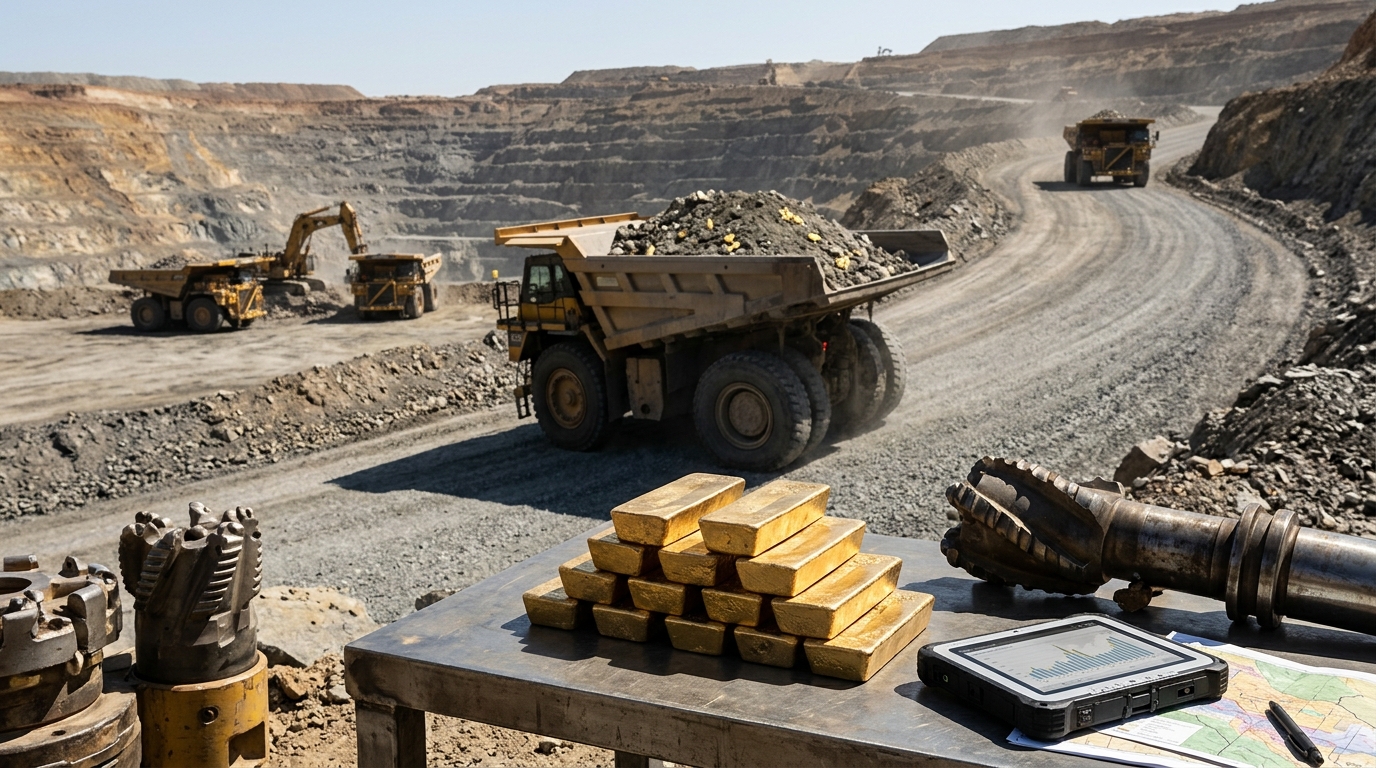
Gold hit $5,589 an ounce in late January. That’s not a typo. The highest price ever recorded for the metal, and most investors still think of gold as a dusty hedge for the paranoid.
What happened next is the part nobody is talking about enough.
The miners — the actual companies pulling gold out of the ground — reported earnings that looked less like a cyclical commodity business and more like a software company during a product supercycle. Newmont (NEM), the world’s largest gold producer, posted Q1 2026 free cash flow of $3.1 billion. A single quarter. That’s an all-time record for the company. Revenue came in at $7.31 billion, up 46% year-on-year, with adjusted EPS of $2.90 — crushing the analyst consensus of $2.24 by 33%.
Barrick wasn’t far behind. Operating cash flow soared to $2.55 billion in Q1, up 111% year-on-year, on gold production of 719,000 ounces that came in well above its own guided range. Net earnings per share jumped 256% from the same period last year.
Both companies did something that would’ve been unthinkable a decade ago: they used the cash surge to aggressively return capital. Newmont authorized an additional $6 billion in share repurchases. Barrick approved a new $3 billion buyback. These are companies that used to carry heavy debt loads and chase acquisitions at the top of the cycle. Not this time.
Why the Disconnect Exists
Here’s where it gets interesting. Despite those numbers, the GDX — the VanEck Gold Miners ETF — has a 52-week range of $50.32 to $117.18. As of mid-June, it’s sitting around $84. That’s a long way from the highs. The ETF has pulled back roughly 28% from its March peak even as the underlying fundamentals for the biggest miners are still running hot.
Part of that is seasonal — early summer is historically weak for gold and miners. Part of it is the metal itself cooling off from its January record, with spot gold now trading in a range roughly between $4,170 and $4,730 after that January spike. J.P. Morgan has a year-end target of $6,000/oz. Societe Generale matches that call. Deutsche Bank is on record with the same number. The thesis isn’t fringe anymore.
And yet the equities lag. Generalist fund managers remain broadly underweight gold miners. Institutional flows into GDX and GDXJ have been modest compared to physical gold ETFs — which themselves saw $89 billion in annual inflows in 2025, the largest on record.
Slight tangent, but it matters: the leverage math here is real. At an all-in sustaining cost around $1,029 per ounce for Newmont, every dollar gold moves above that baseline flows almost entirely to earnings. The non-linear relationship between gold price and miner profitability is precisely what has historically made this trade explosive when it finally moves.
What Drives the Next Leg
Central bank demand is the structural pillar. A record 45% of central banks surveyed by the World Gold Council in 2026 plan to increase their gold allocations this year. China extended its gold-buying streak. These aren’t momentum traders — they’re institutions recalibrating decade-long reserve strategies.
Fed policy is the near-term catalyst. Goldman Sachs estimates every 50 basis points of Fed easing adds approximately $120 per ounce of price support. Markets are currently pricing in further cuts in 2026. If that path holds, the math gets compelling fast.
The risks are real too. Gold is in a technical no-man’s land right now, trading above its 200-day moving average but capped below its 50-day. Options flows have leaned bearish on short-term positioning. A stronger dollar or a geopolitical de-escalation could take the wind out of the trade.
But the income statement story for the biggest miners has rarely looked this clean. The question isn’t whether these companies are generating cash. They clearly are. The question is whether the market prices in $5,000+ gold as a floor or keeps treating it like a ceiling.
For informational purposes only.