Five trading days. That’s what separates CoreWeave from one of the most mechanical, price-insensitive buying events in the equity market.
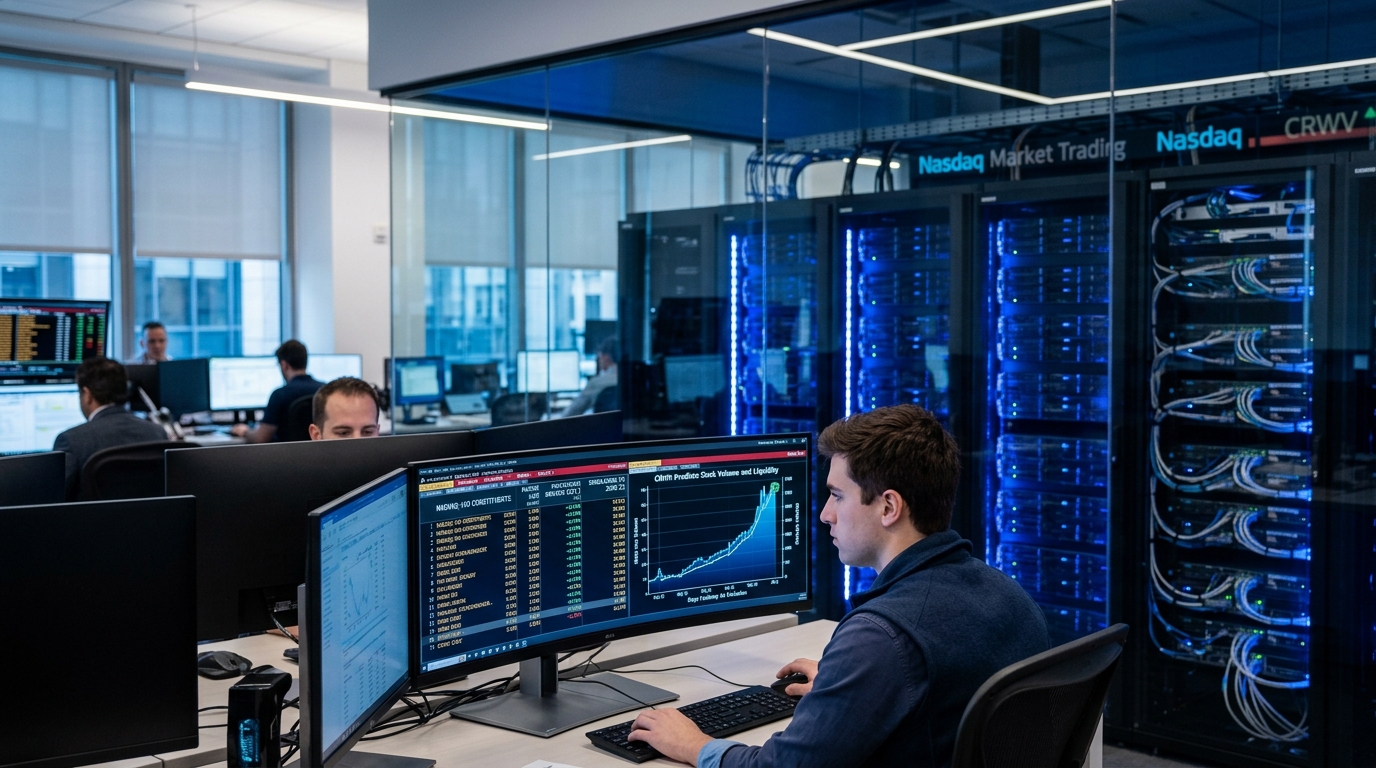
CRWV joins the Nasdaq-100 effective June 22, 2026. And that date isn’t just symbolic.
When a stock enters the Nasdaq-100, passive funds and index-linked products designed to track the index must purchase shares to bring their holding from zero to its assigned weight, regardless of whether the manager believes the stock is fairly priced. The Nasdaq-100 is tracked by exchange-traded funds with more than $800 billion in assets, creating meaningful index-related flows around inclusion dates.
CRWV isn’t the only addition. The June 2026 quarterly rebalance adds five companies: CoreWeave, Astera Labs, Nebius Group, Rocket Lab, and Teradyne, spanning every layer of the AI supply chain below the model itself. But CoreWeave is drawing the most attention.
What the Numbers Actually Look Like
Here’s the thing about CRWV that makes it genuinely difficult to frame with conventional valuation metrics.
Q1 2026 revenue came in at $2.08 billion, up 111.6% year-over-year. Revenue backlog reached $99.4 billion as of March 31, the strongest bookings quarter in the company’s history. The company has surpassed 1 gigawatt of active power and has said it believes it is on track to more than 8 GW by 2030.
Gross margin sits at 69.4%. EBITDA margin reached 56% on an adjusted basis in Q1. Those are infrastructure-grade numbers for a company that completed its public listing in March 2025.
The stock’s 52-week range tells the volatility story well: $63.80 to $187.00. It has swung from the low $90s to above $130 and back again in recent weeks. As of June 16, CRWV was trading near $117, up roughly 9% on the day, as index inclusion headlines piled on top of other company news.
But Here’s Where It Gets Complicated
CoreWeave is not a clean balance sheet story. Not even close.
Total debt-to-equity sits near 7.4. The current ratio is approximately 0.3. Free cash flow for the latest quarter ran about negative $4.7 billion as the company poured roughly $7.7 billion into capital spending, primarily data center buildout.
Recent financing headlines have included multiple debt offerings, including a $4 billion convertible senior notes deal due 2032 and a senior notes offering due 2031. The Chief Strategy Officer sold approximately $7.45 million in Class A shares on June 10 while the stock was near $100.
That’s junk-level debt pricing for AI infrastructure. Plans to tap high-yield markets have been a notable overhang at times as traders weigh leverage and funding costs. Insider activity has also skewed heavily toward selling recently, with several trackers showing no open-market insider purchases in the last 90 days.
For context: CoreWeave guided Q2 2026 revenue to $2.45 billion to $2.6 billion, below Wall Street’s roughly $2.7 billion expectation. Full-year capex guidance of roughly $30 billion to $35 billion is the number that keeps bears circling.
Slight tangent, but worth flagging: Meta’s multi-year commitment to CoreWeave is part of what underpins the backlog figure. The concentration risk in that backlog is real. If one or two anchor customers pull back capacity orders, the math shifts fast. That’s not a prediction. It’s a scenario that deserves space in any risk framework.
Sector Context
The broader AI infrastructure buildout is not slowing. The S&P 500 remains up roughly 24% over the past year, and earnings growth across the market is forecast at approximately 19% annually. AI cloud and compute names have been among the leadership group throughout this cycle.
CoreWeave sits between the models and the silicon in its own framing. As the AI workload mix shifts from training to inference, the company’s argument is that distinction becomes a competitive moat. The launch of new agentic AI capabilities connecting training and inference in a continuous feedback loop gave shares a smaller 1.4% lift separately from the index and other company news. It’s product momentum, not a revenue needle-mover yet.
The price-to-sales ratio currently stands around 8.4x on trailing revenue. Given negative earnings, traditional P/E isn’t applicable. Analysts have set a one-year average price target of approximately $140, with a high estimate of $303 and a low of $36. That spread alone tells you this is a genuinely contested name.
Technical Framework
The stock has been operating in a wide band. The $110 area has functioned as near-term support since the early June bounce off the $91 low. The $130 level represents a zone where CRWV has struggled to hold on multiple prior attempts. Volume has been elevated on recent up-days, which is constructive.
The index inclusion creates what traders call a mechanical demand wall into June 22. Passive ETF and benchmarked mandates tracking the Nasdaq-100 have to buy shares into that date. That structural buying tends to support price on pullbacks in the sessions leading up to rebalance.
After June 22, that mechanical bid disappears. The stock trades on its own fundamentals again, which means leverage, rates, and free cash flow become the dominant conversation. Any renewal of hawkish rate signals or high-yield issuance concern can hit CRWV quickly once the forced buying has cleared.
VWAP from the June 10 low has been holding as an anchor on dips. Watch the $110 level as a decision point. A break below on volume post-June 22 would open the path back toward the $95-$100 zone where several technical buyers showed up earlier in June.
Scenario Modeling
Bull Case: CRWV stays above $110 into the rebalance, momentum traders press it through $130, and company news around long-term contracted revenue signals a broader wave of durable demand. The $99B backlog provides visibility that justifies aggressive capital spending if credit markets stay open on reasonable terms. Price action above $140 would signal bulls regaining control of the larger trend.
Base Case: The index inclusion creates a technical tailwind through June 22, stock trades in the $115-$130 range, then faces near-term selling pressure as passive buyers complete their mandated purchases. The stock consolidates while the market digests the balance sheet and awaits Q2 earnings for evidence that revenue can beat the soft guidance.
Bear Case: High-yield credit spreads widen, bond demand for new CRWV issuance comes in weak, and post-inclusion selling accelerates. A break below $100 would re-test the April lows and return the debate to whether the growth trajectory can service a $35 billion annual capex program without diluting equity holders significantly. The $79 low from the Q4 earnings selloff remains on the chart.
Active Trader Framework
The mechanics here are unusual. There’s a hard expiry on the forced buying catalyst June 22. That makes the pre-inclusion trade structurally different from a typical fundamental thesis.
- Watch credit market headlines closely. Bond deal announcements have been the single most reliable negative catalyst for CRWV in recent weeks.
- The $110 area is the first line of support worth respecting. Below that, $100 matters.
- Resistance at $130 has been tested multiple times. A clean break above it with volume would change the posture for swing traders.
- Volatility is high and by design in this name. Position sizing needs to account for intraday ranges of $5-$10 as normal, not exceptional.
- Q2 results will be the next major binary event after the index mechanics clear.
The bottom line on CRWV right now is that the forced-buying window is the trade with a defined clock on it. What happens after that clock runs out is a different question entirely. One that the balance sheet will have to answer.
For informational and educational purposes only. Not investment advice. Trading involves risk, including loss of principal.